
Community Engagement & Audience Growth
3.6 Monitoring Community Growth & Engagement
Here’s the big shift: a “healthy community” isn’t just follower growth. It’s follower growth with a stronger connection over time.
In this section, you’ll learn how to measure whether your engagement efforts are working long-term. You’ll be able to answer questions like:
- Are we growing the right audience or just growing numbers?
- Is our community getting more active and loyal?
- Which content is building relationships, not just reach?
What to measure (and why)
Follower growth on its own doesn’t mean much. What matters is why people followed you.
For beginners, a simple way to add context is to connect follower changes to what happened that week:
- Did you post a new format (carousel, video series, template)?
- Did you collaborate with someone?
- Did one post go semi-viral?
- Did you change your content topic or tone?
What to do with this insight: When you notice follower spikes, look at the content that caused them and ask: Did those posts also bring saves, shares, comments, or DMs?
- If yes, that’s “healthy” growth (people followed because they cared).
- If not, it might be shallow growth (people followed out of curiosity but didn’t connect).
A single post can perform well by chance. A trend shows what your community really wants.
Instead of asking “Did my last post do well?” ask:
- Is my engagement rate rising, stable, or falling over the last 4 weeks?
- Are saves and shares becoming more frequent?
- Are comments becoming more meaningful (questions, opinions, stories)?
Tip: If your follower count grows but engagement rate consistently drops, it often means you’re attracting people who don’t truly match your content or your content isn’t meeting expectations.
Think of your community like a simple funnel:
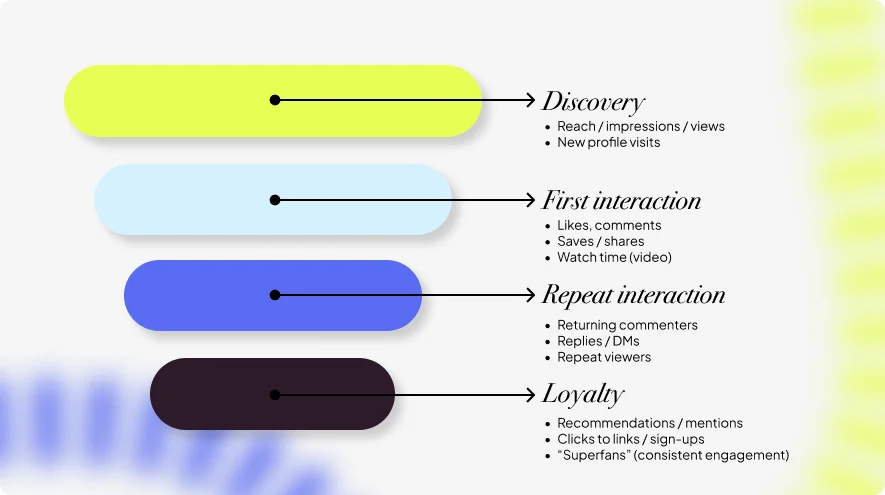
Goal: move people down the funnel by increasing meaningful interactions over time.
Here’s how it looks in real life:
- Discovery: someone finds you (reach, views, impressions).
- First interaction: they like/comment/save/share (or watch longer).
- Repeat interaction: they engage again next week, reply to stories, send a DM, or comment often.
- Loyalty: they recommend you, buy, defend your brand, or become a regular.
Once you understand this “community funnel,” you might wonder how it connects to leads or sales. That’s a separate topic (and not required for this module), but if you want to go one step further, this guide breaks down the basics of a sales funnel.
What to track:
You’re not only looking for reach. You’re looking for signs people are moving deeper:
- Saves/shares (value + intent)
- Repeat commenters
- DMs and replies
- Clicks to your profile or links
- Consistent engagement on recurring formats (“I’m back for part 2!”)
Here are clear signals:
Healthy signals
- Saves and shares are increasing (people find your content useful).
- Comments are becoming more specific (“This helped me with…”, “Can you explain…?”).
- You see repeat names in comments/DMs.
- Your best formats keep performing consistently (not random spikes only).
Declining signals
- You’re posting consistently, but interaction keeps falling.
- Comments become shallow or disappear (“nice!” only, or nothing).
- Saves/shares drop (people stop keeping your content).
- Your community stops replying or participating in prompts.
What to do if you spot a decline:
Don’t panic. Treat it as a signal to test:
- Go back to your best-performing format
- Simplify your topic (more practical, less broad)
- Ask better questions (specific prompts)
- Improve hooks
Your goal is to identify repeatable winners (content you can recreate in different topics).
Start by finding patterns:
- Which topics generate the most comments?
- Which formats lead to saves/shares?
- Which posts trigger DMs or questions?
Then create a “community content loop”:
- Post a valuable piece of content (template/checklist/how-to)
- Collect questions in comments/DMs
- Turn those questions into follow-up posts
- Repeat the format that performed best
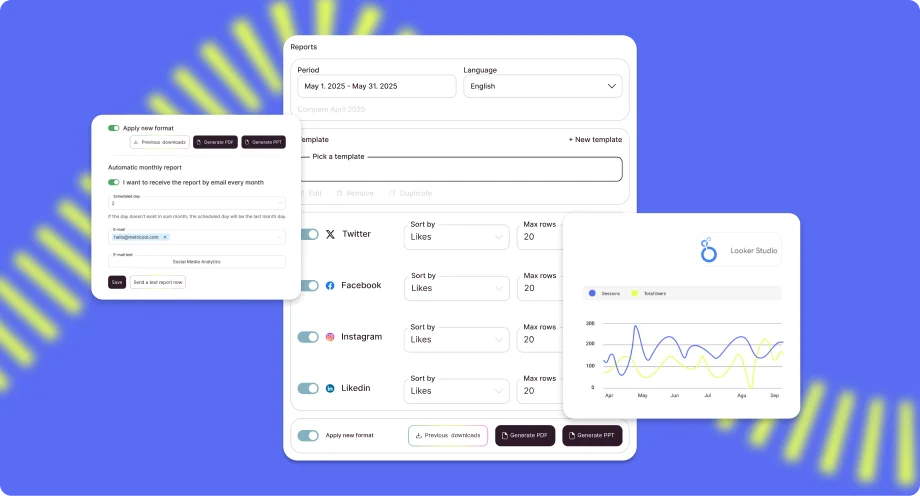
Reports are your strategy’s “memory”. They help you compare performance over time without relying on screenshots or gut feelings.
- A simple monthly reporting routine:
- Look at follower evolution (what weeks grew most?)
- Check engagement trends (up/down/stable?)
- Identify top posts by meaningful interaction (saves/shares/comments)
- Decide what to repeat and what to stop next month
The point of reporting isn’t to collect data. It’s to make decisions.

Your Learning Journey
Explore what’s next and stay on track. You’re in control of your progress!
Let’s keep learning!
Quick exercise
Pick 3 metrics you’ll track weekly for the next month:
- One engagement metric: saves/shares/comments
- One growth metric: followers gained (and what content triggered it)
- One action metric: clicks / DMs / replies
At the end of the month, write:
- One thing to repeat (a winning format/topic)
- One thing to improve (a weak format, topic, or CTA)
Ready to move!