

Top 10 YouTube Mistakes to Avoid
 Gretchen Oestreicher
05 August 2026
Gretchen Oestreicher
05 August 2026 
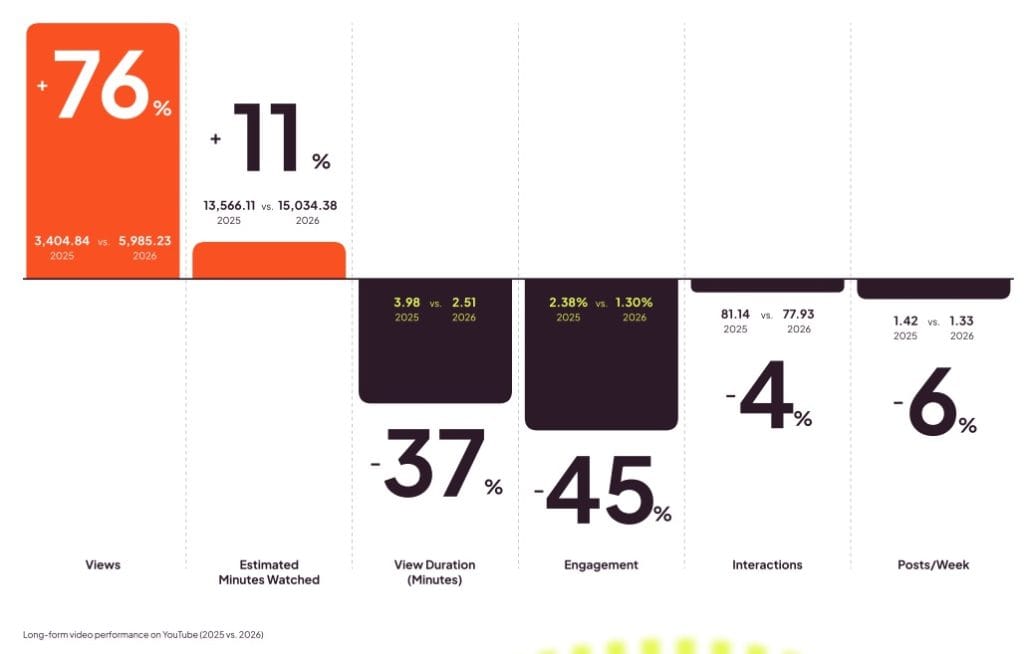
YouTube rewards different habits in 2026 than it did a year ago. We looked at 799,718 videos from 71,177 accounts, and the same pattern showed up almost everywhere: more people are pressing play, but they’re leaving sooner. Long-form views climbed 76% and Shorts views climbed 127%, while average watch time dropped on both. Most of what’s holding channels back now comes from strategy that hasn’t caught up with how the platform behaves, and less from how videos are shot or edited.
Underneath those headline numbers, total watch time on long-form grew about 11%, so channels aren’t losing minutes overall. It’s each individual view that’s getting shorter, and that gap between more views and shorter views sits under most of the mistakes below.
1. Chasing Views and Forgetting About Watch Time
Long-form views climbed 76% in 2026 and Shorts views jumped 127%, but watch time moved the other way. Average view duration on long-form fell 37%, down to about two and a half minutes. On Shorts it dropped 67%, to roughly 16 seconds per view, which is 32 seconds shorter than a year ago. Engagement followed, with long-form engagement now down 45%.
People are finding your videos and then leaving early. A rising view count can hide a retention problem, and retention is what the YouTube algorithm reads as a signal worth promoting. So watch the first 30 seconds of your videos as closely as you watch your thumbnails. Open with the payoff, cut the slow build, and give viewers a reason to stay before you give them a reason to click away.
The by-size data shows this is fixable. Small accounts, the 2,000 to 10,000 subscriber tier, were the only group where long-form view duration went up, rising about 13%, with interactions up 14% too. Retention doesn’t depend on your subscriber count, and that tier proves it. They earned longer views by matching content to what a specific audience wanted.
2. Posting More than Your Format Rewards
Daily uploads aren’t the goal they’re often made out to be. For long-form video, each post performs best at 2 to 4 videos per week. Push past that and the math turns against you. Posting 7 or more times a week brings total monthly views below what 2-to-4 delivers, for a lot more work. Even the range just above, 4 to 7 per week, only adds about 6% more monthly views while asking for far more content, so the extra effort rarely pays for itself.
Shorts work the opposite way, with no clear upper limit on how much you can publish. Monthly Shorts views keep climbing the more you post, from around 70,000 a month at 2-to-4 per week to over 160,000 at 7-plus. The constraint here is production rather than the algorithm, so more Shorts means more views as long as you can keep them worth watching.
The mistake is applying one cadence to both formats. Treat long-form as a quality game and Shorts as a volume game, and set your schedule per channel.
3. Skipping Shorts or Drowning in Them
Shorts are where discovery happens now. The Shorts feed accounted for 61% of all views in the study, more than subscribers, search, and suggested videos combined. Channels that publish no Shorts average 4,364 views per long-form video, below the global average of 5,985. Add around five Shorts a month and that figure climbs to 8,789, about 46% above average.
Channels posting 35 or more Shorts a month, though, see their long-form views fall back to the level of channels posting none. A handful of Shorts a month lifts the whole channel, and flooding the feed doesn’t.
Now that the two recommendation systems run separately, Shorts don’t mechanically raise your long-form ranking. The link in the data has more to do with the creator than the algorithm, since people who post consistent Shorts tend to be the same people posting consistent, audience-aware long-form. So publish Shorts because they’re where discovery lives, not because you expect them to push your longer videos up the rankings.
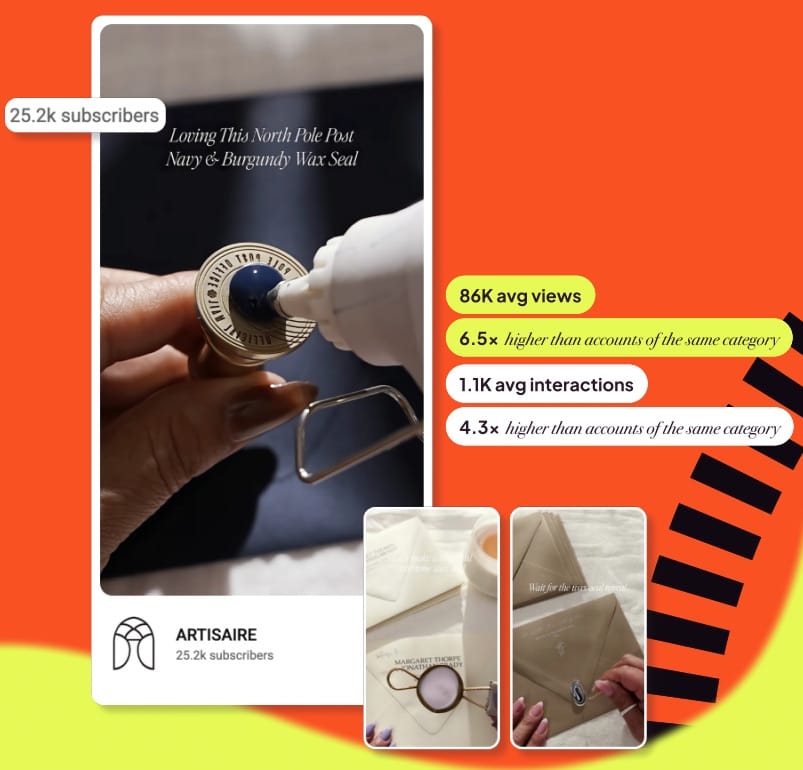
Artisaire shows how far this can go for a smaller channel. The wedding-invitation and wax-seal brand posts Shorts only, sits at around 25,000 subscribers, and averages 86,000 views per video, roughly 6.5 times the average for accounts its size. The content is simple, satisfying to watch, and consistent, which is exactly what the feed rewards.
4. Going Quiet in the First 72 Hours
A YouTube video does most of its early work fast. The first three days are its strongest stretch, when the algorithm shows it to your subscribers and viewers with similar interests. Day one alone accounts for about 35% of a video’s total interactions, day two adds another 17%, and roughly 83% come in within the first 10 days.
Publishing and walking away wastes that window. Reply to early comments, share the video where your audience already spends time, and build momentum while the algorithm is paying attention. YouTube videos also keep working long after that first push. If your title and description match what people search for, a video can keep pulling views for months or even years after the opening spike, which is something most other platforms can’t offer.
5. Assuming You’re Too Small to Grow
Small channels have an opening right now. Across the whole study, about 10% of YouTube accounts grew enough to move up a subscriber tier, second only to TikTok among the platforms we track. Accounts with 2,000 to 10,000 subscribers are the most likely of any tier to move up, with about 16% doing so, and even accounts under 2,000 subscribers moved up nearly 10% of the time.
The advantage is sharper on Shorts, where accounts under 10,000 subscribers grew their views the most, with small accounts up over 200% and interactions up 42%. The Shorts algorithm ignores how long you’ve been around or how many subscribers you started with, and looks instead at how people respond to each video. A Short that connects with a small audience can reach a much larger one, and smaller channels are well placed to make that happen in 2026.
6. Expecting Hashtags to Drive Views
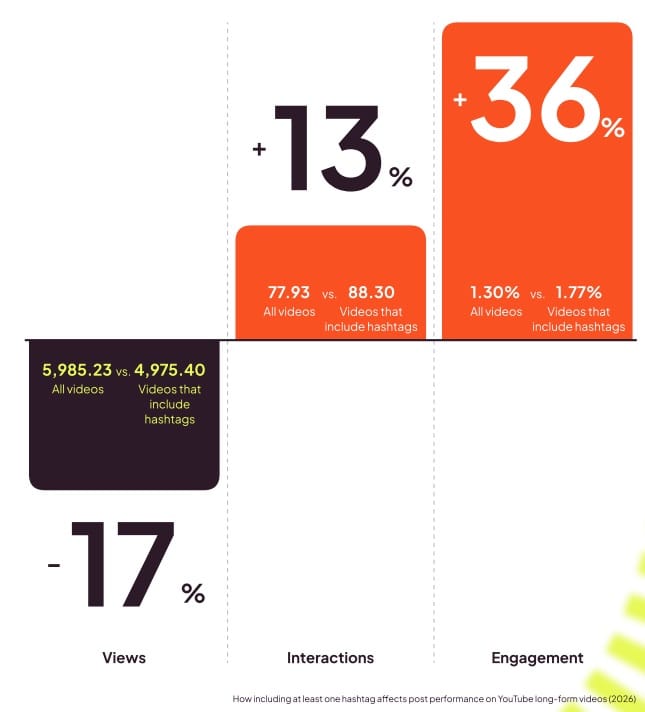
Hashtags aren’t a growth lever on YouTube. Long-form videos that used them saw about 17% fewer views, though interactions rose 13% and engagement per view was 36% higher. Shorts followed a similar pattern, with roughly 10% fewer views but stronger engagement per view.
The reason is that hashtags pull a smaller, more relevant audience rather than a bigger one. Someone who clicks a hashtag already cares about the topic, so they engage more even though there are fewer of them. Hashtags help the algorithm categorize your content, not rank it, and titles, thumbnails, and descriptions carry far more weight. Keep hashtags to one or two for long-form and up to five for Shorts, all tied directly to your topic.
7. Building for the Wrong Traffic Source
Plenty of creators treat YouTube like an endless feed and stop there. The feed matters, since 61% of views come through it, but it isn’t the whole picture. Subscribers drive around 11% of views and YouTube search another 9%, with related videos and playlists adding about 6% and 5% more. Both search and subscriber traffic are deliberate, since those viewers came looking. Only about 3% of views come from people heading straight to your channel page.
That mix should shape where you put your effort. Titles and descriptions that match real searches keep earning views long after you publish, and subscribers tend to be more valuable than followers elsewhere because they seek your content out. Timing plays a smaller part, and most brands publish long-form between 10 a.m. and 4 p.m. and Shorts between 2 and 6 p.m., which makes those windows crowded. Use them as a reference, or post around them to stand out.
8. Expecting Ad Revenue to Track Your View Count
More views haven’t meant more money in 2026. Even with long-form views up 76%, estimated ad revenue fell 55%, ad impressions dropped 51%, and monetized playbacks fell 59%. The cause traces straight back to watch time. Shorter views mean fewer chances to serve mid-roll ads, so the same video earns less than it would have a year ago. Estimated YouTube Premium revenue slipped too, down about 44%.
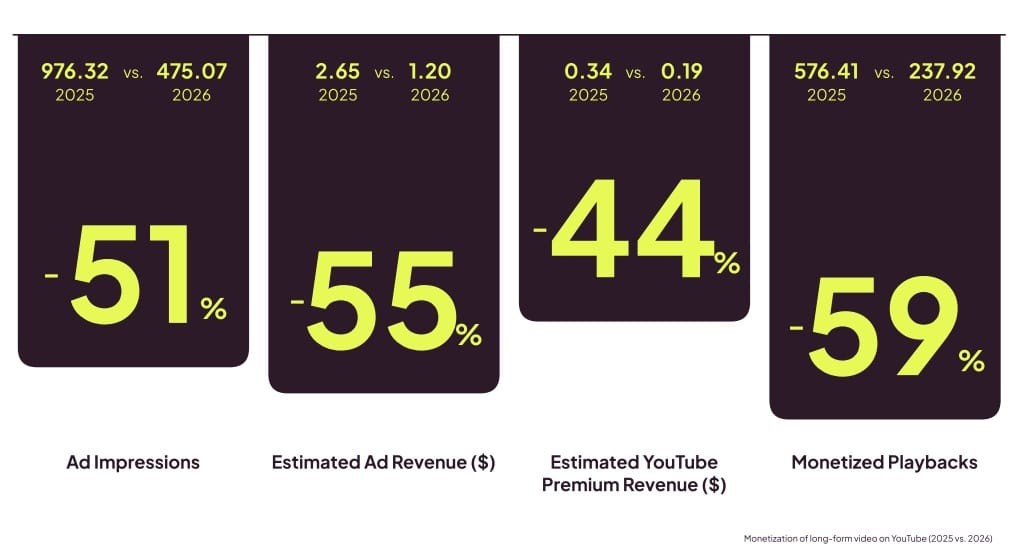
If monetization is part of your plan, watch time is the number to protect. Longer, more engaging videos leave more room for ads, and the channels that hold attention are the ones whose revenue holds up. It also helps to spread your income across memberships, Super Thanks, Shopping, affiliate links, and brand deals, none of which depend on fitting another mid-roll into a video people are already leaving early.
9. Copying What Everyone Else Is Doing
Authenticity is what YouTube rewards now, and its systems have gotten better at spotting content with little human behind it. The platform’s inauthentic-content policy targets uploads made with little original input, like AI voiceovers read over stock clips, videos mass-produced from one template, or near-identical uploads with the numbers swapped out. Using AI as a tool is fine, and the concern is over-relying on it, handing the whole job to a model and publishing whatever it produces. Reviewers look at a channel as a whole, weighing its themes, its most-watched videos, and how much real creation sits behind it. A channel can clear the subscriber and watch-hour thresholds and still be turned down, or lose monetization it already had.
Faceless content fits comfortably inside those rules, and plenty of channels build large, loyal audiences without ever showing a face. Showing your face matters far less than making the work your own. A specific niche, a take nobody else has, or a format you’ve built yourself will do more for a channel than polished production ever could. Let AI help with research or a rough first draft while you shape the final video, and remember that anything photorealistic and synthetic needs the altered-content label. The channels that hold up over time are the ones doing something their competitors aren’t, and that’s the one thing a template can’t copy.
What These Mistakes Have in Common
Almost every mistake here comes back to attention. Getting a view is easy now, and keeping it is where channels grow or stall in 2026. The habits that used to look like effort, posting every day, piling on hashtags, and watching raw view counts climb, have quietly stopped paying off, because the platform leans toward videos people choose to finish.
If you change one habit this year, make it the way you treat attention. Open with the payoff instead of a slow build, match your posting rhythm to each format, and keep an eye on where your views come from. Most of these fixes cost time and thought rather than better gear, and they tend to build on each other over the months that follow.
Plan Your YouTube Content in One Place
Schedule long-form and Shorts, watch retention and traffic sources in the same dashboard, and stop guessing which habits are costing you views.
