

How to Use YouTube for Inbound Marketing (2026 Data)
 Anniston Ward
17 August 2026
Anniston Ward
17 August 2026 
Inbound marketing earns attention instead of buying it. You publish content people actually want, they find it when they’re looking for it, and over time they move closer to becoming customers. YouTube fits that model better than almost any other platform, because discovery there runs on search and recommendation, and because a video you publish today can keep bringing in viewers months from now.
To see how that plays out this year, we pulled the numbers from Metricool’s 2026 YouTube Study, which analyzed 799,718 videos from 71,177 accounts. The data points to a handful of clear moves for building an inbound strategy on YouTube in 2026.
Why YouTube Works for Inbound Marketing
On YouTube, getting in front of people is the easy part. The platform reached more than 244 million adults in the US alone, around 91% of the adult population, so the audience you can attract without paying for every impression is enormous.
What makes it an inbound platform is how people find your content. Discovery runs on the Shorts feed, on search, and on recommendations, and all three put your videos in front of people already interested in the topic. In 2026, more than 61% of organic views came through the Shorts feed, with subscribers driving another 11% and search close to 9%.
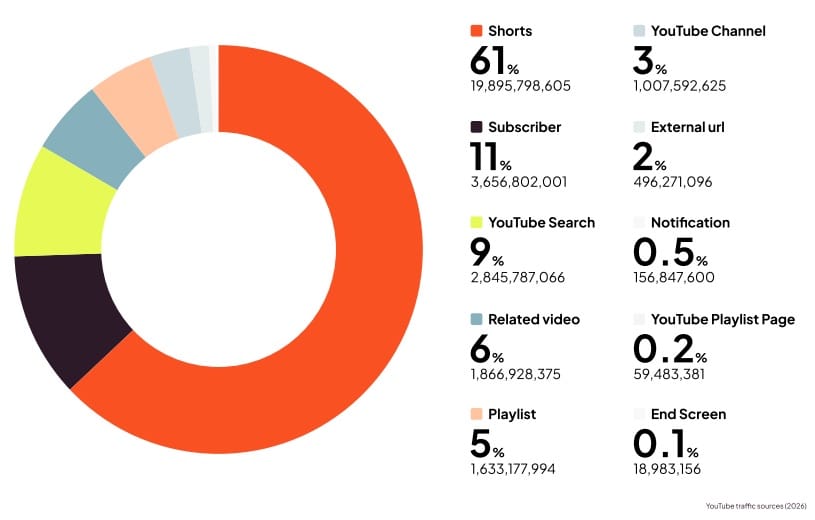
That search slice matters more than its size suggests, because those viewers went looking for something and your video answered it. Only about 3% of views came from someone visiting your channel directly, so search and the algorithm do most of the work of connecting you with new people.
YouTube content also sticks around in a way other social platforms can’t match. A video hits its strongest moment in the first three days, when it earns its biggest share of views and interactions. Day one alone accounts for roughly 14% of a video’s views and about 35% of its interactions, with over 80% of all interactions happening in the first ten days.
After that spike, the pace slows into a steadier rhythm that can run for months or even years. That holds as long as the content stays relevant and your keywords match what people search for. Most platforms let a post go stale within days, while a YouTube video keeps quietly working, which is what you want from an inbound asset.
A YouTube subscriber also tends to be worth more than a follower on most other platforms, because they’re far more likely to seek out your content on purpose than scroll past it in a feed.
Match Your Content to the Buyer’s Journey
The two main formats pull people in at different stages, so it helps to give each one a job.
- Shorts, Your Discovery Engine: Light, fast, and built for quick viewing, Shorts saw views jump 127% in 2026. They’re the format most likely to reach someone who’s never heard of you, so use them to introduce a topic, answer a common question in 30 seconds, or show a quick before-and-after.
- Long-Form, Where the Relationship Forms: Tutorials, explainers, product walkthroughs, and interviews live here, and long-form views climbed nearly 76% in 2026. Someone who watches ten minutes of your content is a very different lead from someone who caught a six-second clip.
- Subscribers and Community, the Payoff: When people subscribe, comment, and come back, you’ve turned attention into an audience you can nurture toward a sale, and one that recommends you to others. That’s what inbound is built to do, and YouTube gives you the tools for it.
Build Your Videos Around What People Search For
Since search and recommendation drive most of your views, the elements that tell YouTube what your video is about carry the weight. Titles, thumbnails, and descriptions get your content matched to the right people, so that’s where your effort should go.
Write titles that say plainly what the video delivers and include the terms your audience actually types. Give each video a real description with those same keywords, and use a thumbnail that reads clearly at a glance. Get these right and your video keeps surfacing in search for a long time, which is where that months-long lifespan pays off.
Hashtags are a smaller lever than most people expect, and they work in a surprising way. On long-form videos, adding hashtags came with about 17% fewer views but 13% more interactions and a higher engagement rate. The people who arrive through a hashtag already care about the topic.
Shorts follow a similar pattern, roughly 10% fewer views and about 9% higher engagement. Hashtags help YouTube categorize your content and can connect you to a niche community, so stick to one or two on long-form and up to five on Shorts.
YouTube Video Ideas for Inbound Marketing
The strongest inbound videos answer something your audience is already searching for or would stop scrolling to watch. Start from their real questions and the moments where they get stuck, then build the video around a clear answer. It helps to sort ideas by the job you want each one to do.
Shorts are where new people find you, so these work best when they deliver one idea fast.
- Answer a Single Common Question: Take the question you hear most often and answer it in under a minute. If people are searching for it, your Short becomes the quick answer they were after.
- Show a Quick Before-and-After: A messy result turned into a clean one is easy to follow and hard to scroll past. It shows what you do without a word of explanation.
- Bust a Common Myth: Pick something your audience believes that isn’t quite right, and set it straight. Correcting a misconception gives people a reason to trust the rest of your content.
- Share One Tip You’d Give a Friend: Skip the wind-up and give a single practical tip. These are simple to produce and easy to keep making week after week.
Long-form is where a casual viewer turns into someone who sticks around, so these earn the deeper watch.
- The Full Tutorial: Walk through a complete how-to from start to finish. Search sends steady traffic to tutorials for months, because people look them up exactly when they need them.
- A Real Walkthrough or Case Study: Show how something actually played out, with the steps and the outcome. Real examples build more trust than advice on its own.
- The Honest Comparison: Put two options side by side and explain which one fits which situation. People search comparisons when they’re close to a decision, so these tend to bring in viewers who are ready to act.
- A Behind-the-Scenes or Interview: Let people see how you work, or hear from someone worth listening to. This is the content that turns passing interest into a reason to subscribe.
One recording can feed a whole week of content. Turn a long-form video into several Shorts, then use those Shorts to point people back to the full version, so each clip becomes another chance for someone new to find you.
Find a Posting Rhythm You Can Keep
Consistency matters more than volume, and the data draws a clear line.
- Long-Form, Two to Four a Week: That range is the most efficient. Below it, you’re leaving reach on the table. Above it, the extra videos don’t earn their keep, since moving into a higher posting bracket takes noticeably more production for only single-digit gains in monthly views. Posting more than seven long-form videos a week actually pulls total views down compared to a steadier pace.
- Shorts, No Real Ceiling: Each individual Short performs best at two to four a week, but publishing more keeps adding to your monthly views. Every upload is another entry in an infinite-scroll feed and another chance to be seen. The real limit is production effort, so the honest question is how much you can make without letting quality slip.
- Timing, a Small Edge: Most brands publish long-form videos between 10 a.m. and 4 p.m., and most Shorts go up between 2 and 6 p.m. You can ride that busy window or post outside it to face less competition.
Let Shorts Feed the Rest of Your Channel
YouTube Shorts win views on their own, and they lift your long-form performance too.
Channels that publish no Shorts average 4,364 views per long-form video, below the study-wide average of 5,985. Channels posting around five Shorts a month climb to 8,789 views per long-form video, roughly 46% above average. There’s a limit, though. Once a channel pushes past 35 Shorts a month, long-form performance falls back to where the no-Shorts channels sit, so more isn’t automatically better.
You don’t need a separate workflow for this. When you post a short video to Instagram or TikTok, you can publish it to YouTube at the same time. Or let the other platforms test your ideas first and bring your winners over once you know what works, so your best content keeps generating YouTube views for months. For a closer look at how the format’s distribution works, our breakdown of the YouTube Shorts algorithm goes deeper.
Play the Long Game
Views are up across the board, but watch time is down. Average view duration on long-form dropped about 37% in 2026, and viewers now spend around 16 seconds on the average Short, roughly a third of what they gave it a year ago. People are showing up, they’re just not staying as long.
Reach is getting easier and retention is getting harder, so the channels that win now are the ones that make people stop and watch.
Smaller accounts are surprisingly well placed to do this. Accounts with 2,000 to 10,000 subscribers are the most likely to grow into the next tier, and channels under 100,000 subscribers have doubled their Shorts views this year. On Shorts, the algorithm doesn’t care how long you’ve been around. What matters is how people respond to what you post, so a video that connects with a small audience can reach a much bigger one.
This is where inbound and YouTube line up. Inbound has always been about publishing content that earns trust, keeps performing, and pulls people toward you over time, which is exactly how the platform behaves.
Track What’s Working
An inbound strategy improves when you can see what’s working. A few things worth watching:
- Retention and Average View Duration: These tell you if your content holds attention or loses people early.
- Traffic Sources: See how people are finding you, so you can do more of what’s bringing them in.
- Older Videos Still Pulling Views: Note which ones keep performing and make more like them.
Metricool is an official Google partner, so you can connect your channel, schedule and publish your long-form videos and Shorts, and see all of it next to the rest of your social content in one place. If part of your inbound goal is turning that audience into revenue, our guide to making money on YouTube covers how monetization works in 2026.
Connect your YouTube channel to Metricool and start building content that keeps working long after you hit publish.
