

Meta (Facebook) Business Manager: What It Is, How It Works, and When You Need It
 Gretchen Oestreicher
03 December 2025
Gretchen Oestreicher
03 December 2025 
Running Facebook and Instagram for your brand or clients can get messy fast. Pages, ad accounts, Pixels, catalogs, and apps scattered across personal profiles make it easy to lose track and even easier to lose control. That is where Meta Business Manager comes in.
Think of it as your command center. It organizes all your business assets, secures access for your team, and makes working with agencies or partners smooth and stress-free. Once it is set up, you will have one place to manage everything from Pages and ad accounts to Pixels and audience lists without mixing personal and business activity.
In this guide, we will explain how Business Manager works, when you need it, and how to set it up so your Meta workflow runs smoothly.
What Is Meta Business Manager?
Meta Business Manager brings all your Facebook and Instagram business assets into one organized workspace. Instead of relying on personal profiles to store Pages, ad accounts, or catalogs, everything sits in a central hub that’s built for teams, agencies, and brands.
Once you set it up, you’ll find all your core assets in one place, including:
- Facebook Pages
- Instagram profiles
- Ad accounts
- Pixels and Conversions API setups
- Catalogs
- Apps
- Billing
- Team members and external partners
This setup lets you stay in control of who can access what. You choose the level of permissions, decide who gets added, and keep assets protected even when team members change.
Business Manager works alongside two other Meta platforms you’re probably already using:
- Meta Business Suite for publishing content, checking messages, and reviewing basic analytics
- Meta Ads Manager for creating and tracking ad campaigns
Think of Business Manager as the foundation beneath those tools. It handles ownership, permissions, and organization, while Suite and Ads Manager are the places where daily work happens.
For agencies, Business Manager makes it simple to manage multiple client accounts without tying anything to personal profiles.
For brands, it gives teams a safe environment to run ads, publish content, and review data without handing over ownership.
Overall, Meta Business Manager acts as your main control center for managing Meta assets, people, and permissions across Facebook and Instagram.
Who Needs Meta Business Manager?
If your Facebook or Instagram setup has grown beyond one person posting from a single Page, Meta Business Manager becomes an important part of your workflow. It brings structure to your account, helps you stay organized, and keeps your assets secure as your social presence expands.
Many businesses start with Business Suite, and that’s completely fine for simple day-to-day publishing. But once you introduce ad accounts, collaborators, or multiple Pages, you need a workspace that can hold everything together.
Here are the situations where using it creates real clarity and control:
- You manage several clients as an agency or freelancer.
- You lead a social media or marketing team and need a place to organize all the assets.
- You run multiple Facebook Pages, Instagram profiles, ad accounts, or apps.
- You work with pixels, catalogs, or audiences for your campaigns.
- You collaborate with agencies, vendors, or contractors who need access to run ads or manage Pages.
- You require detailed permissions for who can publish, edit, or run campaigns.
If any of this sounds familiar, Business Manager helps you stay organized and reduces security risks that come from sharing personal logins or storing assets across multiple personal profiles.
Meta has several processes that only work through Business Manager, including:
- Sharing Custom Audiences with people or teams outside your organization
- Verifying your domain
- Using a credit line for ad spending
- Running publisher lists or delivery reports before launching campaigns
- Completing Meta’s business verification process
If you do any type of advanced advertising or handle campaigns at scale, these steps become part of your routine. Business Manager gives you the structure to complete them smoothly.
Features and Benefits of Meta Business Manager
Meta Business Manager is your central hub to organize, secure, and manage your Facebook and Instagram business assets. Here’s what it allows you to do:
1. Keep All Assets in One Place
One of the biggest advantages of Business Manager is the ability to store everything in one workspace. Instead of jumping between personal profiles or digging through settings, you’ll find:
- Facebook Pages
- Instagram accounts
- Ad accounts
- Pixels and Conversions API setups
- Catalogs and apps
- Verified domains
Having these assets in a single dashboard makes it far easier to audit, track performance, and maintain oversight as your account activity expands. For teams that juggle multiple clients or markets, this layout helps keep campaigns organized from the start.
2. Manage People and Permissions
If you work with collaborators, contractors, or agencies, you need control over who can access what. Business Manager solves this by letting you invite people with their business email and assign roles based on what they actually need.
For example:
- Give community managers access to Pages only
- Grant advertisers access to ad accounts
- Allow an agency to manage campaigns without giving ownership
- Restrict financial permissions to business owners or managers
This structure protects your account while also making it simple to remove someone if they leave your team. You never have to share personal passwords, and you stay in control of every asset at all times.
3. Control Ads, Pixels, and Billing
If you run ads, you’ll use Business Manager to manage the backend of your campaigns. This includes:
- Linking ad accounts
- Adding and updating payment methods
- Connecting Events Manager
- Setting up Pixels or Conversions API
These tools help you track website activity, retarget site visitors, and measure performance with accuracy. With the increase in privacy updates across Meta platforms, many advertisers now rely on both Pixels and CAPI to keep their data consistent, which Business Manager supports directly.
4. Protect Ownership and Security
Business Manager separates business assets from personal accounts. This creates a safety layer that helps you avoid common issues like:
- Losing access when a staff member leaves
- Accidental posts on the wrong Page
- Personal profiles owning business assets
- Security breaches from shared passwords
By keeping everything under a business-controlled system, you never risk losing ownership of your assets. Meta also recommends two-factor authentication for all collaborators, which you can manage from the Security Center inside Business Manager.
5. Collaborate Safely with Partners and Agencies
You can give vendors, agencies, or partners access to specific assets without transferring ownership.
Instead of transferring Pages or ad accounts, you can grant partner access to:
- Pages
- Ad accounts
- Pixels
- Catalogs
- Apps
This setup keeps ownership with your business, while allowing vendors to work on campaigns, schedule content, or track analytics. If the partnership ends, you can remove their access with a single click.
6. Streamline Audience Management
Audience management becomes far easier inside Business Manager, especially if you run campaigns for different segments or clients. You can create and store custom audiences, lookalike audiences, and website-based audiences from Pixel.
This helps you run consistent targeting across multiple campaigns while keeping everything in one place. Meta’s own reporting shows that brands using structured audience lists typically see stronger campaign performance, particularly when campaigns run across both Facebook and Instagram.
How to Set Up Meta Business Manager
Meta Business Manager is the place to start if you want to bring more structure and security to your Facebook and Instagram setup It gives you a clean way to organize your Pages, ad accounts, people, and partners without relying on personal profiles or scattered permissions.
Below, you’ll find a step-by-step walkthrough that shows exactly how to set everything up, with notes for brands, creators, and agencies along the way.
1. Create Your Meta Business Manager Account
Before you can manage assets, you need a business account.
- Go to business.facebook.com and sign in with your Facebook or Instagram login.
- Select Create Account.
- Add your business name, your name, and your business email.
- Open the confirmation email and click Confirm Now.
- Enter your business details like legal name, address, phone number, website, and tax details if Meta requests them.
After this, your Business Manager dashboard opens and you can start adding assets.
Tip: Use a business email rather than a personal one. It keeps ownership clear if your team changes later.
2. Add or Request Access to Your Facebook Page
Your Facebook Page sits at the center of your presence. Inside Business Manager, you can add one you own, create a new Page, or request access from a client.
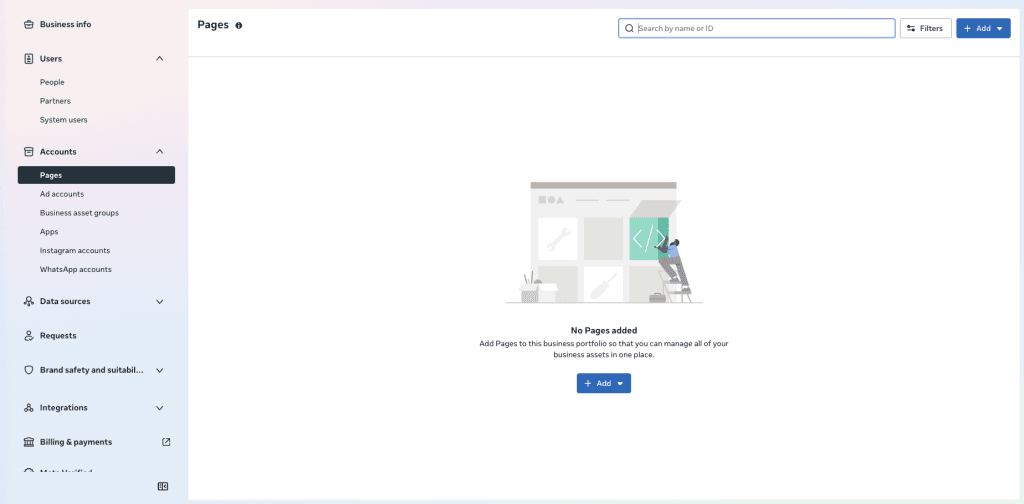
To add a Page you own
- Go to Business assets
- Choose Pages and click Add Pages
- Select Claim an existing Facebook Page and search for your Page
If you already have admin rights, the Page connects instantly.
For agencies or freelancers
Always choose Request Access, not Add Page.
If you add a client’s Page directly, you permanently attach ownership to your Business Manager, which can cause serious access problems down the road.
3. Connect Your Facebook Ad Account
Every ad account must live inside a Business Manager, and once it’s claimed by a business, it cannot be moved. This is important for long-term setup.
To link an existing ad account
- Go to Ad Accounts
- Click Add Ad Account
- Enter the ad account ID
To create a new ad account
- Go to Business assets and click Add assets
- Choose Advertising then Ad account
- Select Create a new ad account
- Add the name, time zone, and currency
For agencies
Use Request Access so the client keeps ownership of their ad account. This keeps responsibilities clear and avoids issues with billing or permissions
4. Add People and Set Roles
If multiple people help run your social media or ads, you can invite them directly into the Business Manager with the right level of access.
- Go to People in Business Settings
- Click Add People
- Enter their business emails
- Choose the access level:
- Full control for owners or managers who oversee everything
- Partial access for most social media and marketing roles
- Advanced options for people who handle billing or financial actions
- Assign them to the assets they will work on, such as Pages, Instagram accounts, Pixels, or ad accounts
You can revoke or adjust access at any time, which makes this much easier than sharing passwords or giving personal admin access.
5. Add Your Partners or Agency
If you work with an external team, you can give their company access instead of managing each individual user.
- Go to Business Settings
- Select Partners
- Click Add under “Partner to share assets with”
- Enter the partner’s Business Manager ID
This system keeps your list of collaborators tidy and avoids manual permission management.
6. Connect Your Instagram Account
To manage Instagram posting and ads through Meta tools, you need to connect your Instagram account.
- Go to Business Settings
- Select Instagram Accounts
- Click Add and log in to Instagram
Once linked, your Instagram profile appears alongside your Facebook Page and ad account in the dashboard.
7. Set Up Your Meta Pixel
Your Pixel records website activity and helps you build stronger audiences, measure conversions, and power retargeting campaigns. It’s one of the most important parts of your ads setup.
To create your Pixel:
- Go to Business Settings
- Open Data Sources, then Pixels
- Click Add
- Name your Pixel
- Enter your website URL and click Continue
- Follow the steps to install the Pixel on your website
You can create up to 100 Pixels in one Business Manager, which is useful for agencies or brands with multiple properties.
8. Strengthen Your Account Security
If several people or partners access your business assets, security matters even more. Setting everything up correctly now saves headaches later.
- Open Business Settings
- Go to Security Center
- Turn on two-factor authentication and choose Everyone
This is one of the simplest ways to protect your Pages, ad accounts, billing info, and audiences.
9. Double-Check Your Setup
Before you start publishing content or launching ads, take a moment to review the main elements:
- Your Facebook Page is connected
- Your Instagram account is linked
- Your ad account is active
- Team access looks correct
- Partners have been added if you work with vendors
- Two-factor authentication is active
- Your business verification status is visible in the Security Center
If you’ve been working in Business Suite until now, you can still switch to Business Manager whenever you want. Both tools work together.
10. Start Building Your First Campaign
Once your Pages, ad accounts, Pixel, and team access are in place, you’re ready to open Ads Manager. From there, you can:
- Pick your campaign objective
- Build your audience
- Set your budget
- Choose placements
- Upload your creative
Ads Manager will walk you through the steps, but using Meta’s recommended setup can help you avoid rejected ads or missing data.
Business Manager vs Business Suite vs Ads Manager
Meta offers three main tools for managing Facebook and Instagram, and each has a distinct role in your workflow. Once you understand how they connect, the entire system becomes far easier to work with.
Below is a simple breakdown of what each tool does, when to use it, and how they support each other during your day-to-day work.
Meta Business Manager: The Backend Hub
Meta Business Manager, also called Business Portfolio in newer versions, is the control center behind your account. This is where you organize and protect every asset tied to your brand.
Think of it as the place where ownership sits. You use it to:
- Create or claim assets like Facebook Pages, Instagram accounts, ad accounts, pixels, catalogs, and apps
- Add or remove team members and choose exactly what they can access
- Give partners or agencies permissions to manage ads or Pages
- Connect advanced tools such as Events Manager or Commerce Manager
Business Manager does not handle posting, replying, or reviewing comments. Its purpose is to store assets safely and keep your account structure clean, especially when more people join your team or when you work with outside partners.
Meta Business Suite: The Daily Dashboard
Business Suite is the workspace you spend the most time in. It pulls your Facebook and Instagram activity into one dashboard to help you manage ongoing content and communication.
Inside Business Suite, you can:
- Draft, schedule, and publish posts, Reels, and Stories
- Review and reply to messages and comments from both platforms
- Check page-level insights to understand reach and engagement
- Boost posts or create simple campaigns directly from the dashboard
If you ever try to manage roles or connect ad accounts from Business Suite, you’ll notice it sends you straight back to Business Manager. That’s because Suite focuses on execution, not setup.
Meta Ads Manager: The Campaign Engine
Ads Manager is where paid campaigns come to life. This is the tool advertisers rely on when they want full control over their budgets, targeting, and creative.
You use Ads Manager to:
- Build structured campaigns with objectives like awareness, traffic, leads, and sales
- Choose placements and audiences, set bidding, and manage delivery
- Track performance in detail
- Run A/B tests and compare results
While you can access Ads Manager from Business Suite or Business Manager, the tool stands on its own. It exists purely for running campaigns with precision.
How They Work Together
Each workspace plays a different role, but they were built to support one another.
- Business Manager holds everything in place. It manages ownership, structure, and permissions.
- Business Suite is where you publish content, reply to followers, and review surface-level analytics.
- Ads Manager handles every step of your paid campaigns, from setup to reporting.
Together, they give you a complete setup for managing your social presence across Facebook and Instagram.
Ready to Organize Your Meta Accounts?
Once your Meta tools are organized, managing content, ads, and reporting becomes far smoother. If you want a single place to plan posts, schedule campaigns, track analytics, and share automated reports with clients or your team, Metricool brings everything together in one workspace.
Start exploring how Metricool can support your Meta workflow and help you stay on top of your content and campaigns.
