

Social Media Burnout: How to Avoid Spreading Yourself Too Thin
 Kalum
13 March 2026
Kalum
13 March 2026 
The notifications never truly stop. For those working behind the screens of the world’s most recognizable brands and smallest passion projects, the digital world is not a place of leisure. It is a workplace that operates twenty-four hours a day, seven days a week. Over the last few years, a specific type of exhaustion has moved from a whispered complaint in private forums to a full-blown industry crisis. We are talking about social media burnout.
At Metricool, we wanted to look past the high engagement rates and viral trends to see how the people responsible for them are actually doing. We conducted a comprehensive Well-being Study, surveying content creators, entrepreneurs, marketing professionals, community managers, and social media managers. The data we gathered provides a sobering look at the mental state of the industry. It reveals that the pressure to be constantly creative, constantly available, and constantly performing is taking a significant toll. So join us as we find out how well social media professionals are managing and look at ways to relieve some of the pressure before it gets too much.
What is Social Media Burnout?
So, what is social media burnout? The definition is not simply feeling tired after a long day of work. It is a state of emotional, physical, and mental exhaustion caused by excessive and prolonged stress within the digital marketing environment. It occurs when you feel overwhelmed, emotionally drained, and unable to meet constant demands.
As the stress continues, you begin to lose the interest and motivation that led you to take on the role in the first place. Social media manager burnout often feels like being trapped. You are responsible for the voice of a brand in a space that never sleeps, which we all love, but it can also make you feel like you can never truly clock out.
The Statistics of the Solo Struggle
One of the most striking findings from our study relates to the size of the teams handling these massive responsibilities.
How many people are in your team?
| Team Size | Percentage (%) |
| Just me | 59.01% |
| 2 to 5 people | 32.58% |
| 6 to 14 people | 6.80% |
| 15+ people | 1.62% |
Nearly 60% of people we surveyed work entirely alone. In an industry that requires graphic design, video editing, copywriting, and data analysis, most professionals are a “team of one.” This isolation is a primary driver of social media burnout. When there is no one to delegate to and no one to cover your shift, the weight of the brand rests entirely on your shoulders.
This solo work is often spread across multiple fronts. Our study found that only 32.90% of people manage a single brand. The rest are juggling multiple identities:
- 2 to 3 brands: 36.35%
- 4 to 8 brands: 20.93%
- 9 or more brands: 9.82%
Managing nine or more brands as a solo creator is not just difficult; it is impossible without sacrificing personal well-being.
Identifying Social Media Burnout Symptoms
Burnout does not happen overnight. It is a slow erosion of energy and enthusiasm. Our survey asked participants about the specific physical and mental issues they have experienced because of their job. The responses provide a clear list of social media burnout symptoms to watch out for.
The Human Cost of the Feed
- Loss of motivation or creativity: 73.25%
- Mental fatigue: 69.04%
- Difficulty disconnecting: 62.14%
- Stress related to performance or results: 50.38%
- Burnout or near-burnout: 45.63%
- Sleep issues: 43.69%
The fact that 73% of professionals have experienced a loss of motivation or creativity is particularly alarming. Creativity is the fuel of social media marketing. When that fuel runs out, the work becomes a repetitive, painful chore. Mental fatigue and sleep issues further compound the problem, creating a cycle where some of us are too tired to be creative, but too stressed to rest.
Performance Pressure
Why is this happening? The study suggests that the expectations placed on social media professionals are often unrealistic. When we asked if they felt they were expected to do too many different things at once, 75.40% said: “Yes, clearly too many.”
This reflects a fundamental misunderstanding of the role. A social media manager is often expected to be a 24/7 customer service agent, a skilled video editor, and a strategic consultant simultaneously. This leads to a baseline of stress that is significantly higher than in many other professions.
How stressful do you find your work?
| Stress Level | Percentage (%) |
| Very stressful | 15.21% |
| Quite stressful | 53.94% |
| Slightly stressful | 26.00% |
| Not stressful | 4.85% |
Combined, over 69% of people find their work to be quite or very stressful. Only 4.85% of people feel their job is not stressful at all. This high-stress environment is made worse by a lack of understanding from those in charge. Our study found that only 9.92% of people feel their work is very well understood by managers, clients, or stakeholders. Meanwhile, 42.18% feel their work is “not really” or “not at all” understood.
When your hard work is invisible or undervalued, the stress becomes much harder to justify, leading quickly to social media manager burnout.
The Difficulty of Disconnecting
The “always-on” nature of social media makes it incredibly difficult to establish boundaries. We asked our participants if they felt able to completely disconnect outside of their working hours. The results highlight a major issue with work-life balance:
- Yes, very often: 21.04%
- Yes, sometimes: 35.38%
- Rarely: 31.82%
- Never: 11.76%
When over 43% of the workforce says they rarely or never disconnect, the brain never has the chance to enter a state of recovery. This constant state of “digital alertness” is a direct path to mental fatigue. This is reflected in how people rate their work-life balance: 34.74% rate it as poor, and 4.53% rate it as very poor.
Social Media Burnout Signs and Prevention Strategies
Spotting the burnout signs of social media burnout is about noticing small changes before they become permanent. If you find yourself dreading the act of opening an app that you used to love, or if you feel a sense of resentment toward your audience, these are early warning signs.
Prevention Strategies
- Strict “Digital Off” Hours: You must establish times when your phone is in another room. The world will not end if a comment goes unreplied to for six hours on a Tuesday night.
- Notification Management: Turn off non-essential notifications. Check your accounts on your schedule, not when the app decides to ping you.
- Client Education: Since nearly 42% of stakeholders don’t understand the work, it is up to the creator to set boundaries. Explain the “why” behind your posting schedule and your response times.
- Community Support: Since 59% of people work alone, finding a community of peers is vital. Talking to others who understand the specific stress of a “dropped reach” or a “viral hate comment” can reduce the feeling of isolation.
- Multi-Platform Management: While we see choosing a social media management platform as the first step for anyone in these roles, there are still some people attempting to manage multiple networks via their native platforms. This is one of the easiest ways to cause social media burnout; constantly jumping from platform to platform is exhausting. This is where Metricool can be your saviour…
Creating a Time-Saving Workflow with Metricool
One of the most effective ways to combat social media burnout is to move from a reactive workflow to a proactive one. When you are constantly reacting to notifications, you are in a state of stress. When you have a plan, you are in control. Metricool helps you build this control by centralizing your entire digital presence into one grounded dashboard.
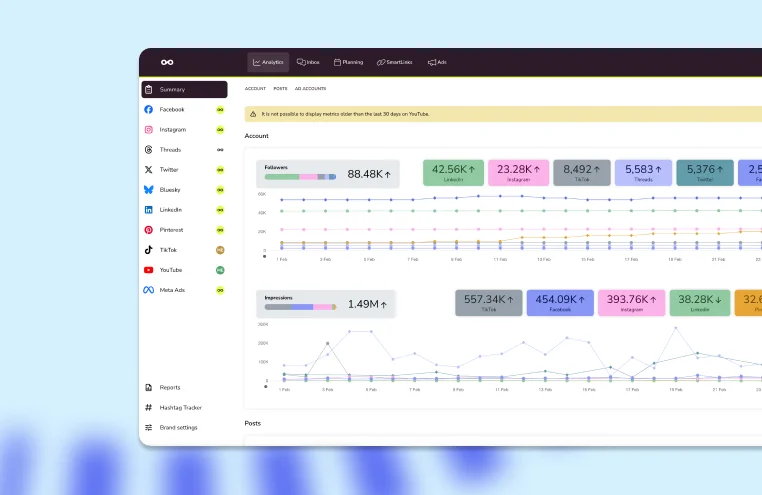
Instead of logging into five different platforms and getting distracted by the “For You” feed, you can schedule a week’s worth of content in one sitting. This addresses the 75.40% of you who feel you have too much to do at once. By batching your tasks and using our automated reporting, you can eliminate the hours spent on manual data entry that leads to mental fatigue.
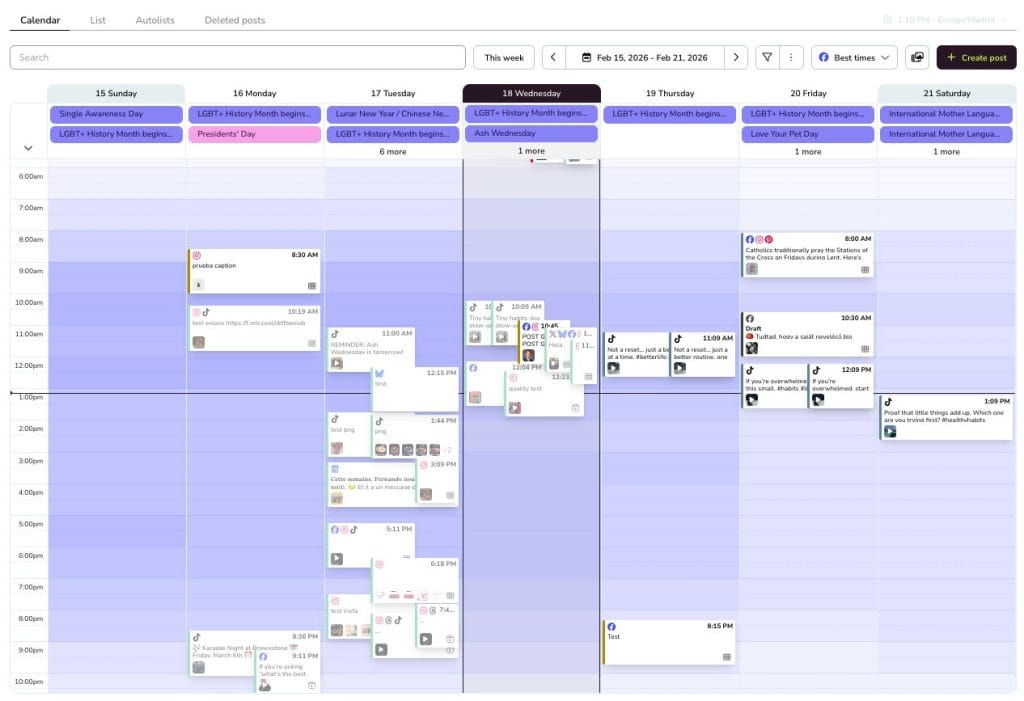
Our unified inbox allows you to handle community management on your own terms. Metricool isn’t just a tool for posting; it is a tool for professional boundary setting, allowing you to prove your results to stakeholders with clear data so you can finally step away from the screen and rest.
Keeping the Flame Alive
The cumulative weight of these issues has led many to consider a complete career change. In our study, we asked: “Have you ever considered leaving social media work because of stress or burnout?”
- Yes: 46.28%
- No: 53.72%
Nearly half of the people in this industry have considered walking away. This should be a wake-up call for agencies and brands. We are at risk of losing an entire generation of creative talent because the current model of work is not sustainable.
Despite these challenges, there is still a core of positivity. When asked how they feel about working in social media right now, considering their workload and stress, 52.64% said they feel “mostly positive.” This suggests that people love the work itself, but they hate the conditions under which they are forced to do it.
Rebuilding a Sustainable Digital Career
To survive in this field, we must move away from the “hustle” culture that suggests more is always better. More posts, more brands, and more hours do not necessarily lead to more success. They often just lead to more burnout.
The Shift Toward “Slow Social”
In 2026, we are seeing a movement toward “Slow Social.” This involves posting with more intent and less frequency. It means prioritizing the 10.90% who feel “very positive” about their work by protecting their creative energy. It means understanding that a social media manager’s value is in their strategy and ideas, not their ability to reply to a DM at 3:00 AM.
Re-evaluating Work/Life Balance
If 39% of the industry has a poor or very poor work-life balance, the system is broken. Re-evaluating this balance requires a shift in how we measure success. Instead of just looking at follower growth, we should look at “Efficiency Metrics.” How much are we getting for every hour of human effort? If we can achieve the same results in 20 hours that we used to get in 40, that is a massive win for burnout prevention.
The Path Forward
Social media burnout is a real, documented issue that is currently affecting nearly half of the professionals in the digital space. The findings of our Well-being Study serve as both a mirror and a map. They reflect a reality where solo workers are managing too many brands with too little understanding from their peers.
However, they also show a path forward. By identifying the social media burnout symptoms early, implementing a time-saving workflow, and using tools to create hard boundaries between work and life, we can preserve the creativity that makes this industry so vibrant. The digital world will always be there. The notifications will always be waiting. Your mental health, however, is a finite resource. It is time to treat it with the same level of care and strategy that we give to our most important clients.
