

TikTok Content Strategy Guide 2026
 Anniston Ward
09 June 2026
Anniston Ward
09 June 2026 
TikTok is still the top platform for video marketing, but how the platform works has shifted. According to Metricool’s 2026 TikTok Study, which analyzed over 2.3 million posts, content volume jumped 72% for videos and 140% for image posts in a single year. More content means more competition for attention, which means a clear strategy does more of the heavy lifting.
This article walks through how to build a TikTok content strategy that fits how the platform actually works today, with data from the 2026 TikTok Study shaping each decision.
What Works on TikTok
TikTok is a video platform, full stop. Videos get 5.6 times more views and 7.8 times more interactions than image or carousel posts. For every static post published, there are roughly five videos in the feed, so a carousel has to earn its place fast or get scrolled past. The algorithm leans into watch time as a core signal, which keeps video at the center of the feed even as other formats grow.
Image and carousel posts grew 140% year over year, but per-post views dropped 23% and interactions fell 62%. Users are skipping them more than they used to.
Carousels still work for certain content types, though. A handful of beauty, fitness, and education accounts are pulling 100x to 200x the average engagement of their size category with carousels. The pattern: treat slide one as a headline, give every slide standalone value, and design for saves with content people want to come back to, like checklists, tutorials, and before-and-afters. If your niche fits, a small carousel rotation alongside video can earn outsized engagement.
SEO-Friendly Content
TikTok works more like a search engine every year. Hashtag-driven views grew 114% in the past year, and search now drives nearly 4% of impressions on the average video. Larger accounts pull even more from search, climbing past 6% for accounts with over 1 million followers. Users increasingly open TikTok to look something up the way they’d open Google, which means your captions, hashtags, and on-screen text all carry weight.
A few rules for hashtags: stick to one or two per post, and never go above five. Skip generic tags like #fyp and #viral, since they tell the algorithm nothing about your content. Specific, descriptive tags do the work, especially ones that match the way real people search.
Adding even a single relevant hashtag lifts views by about 5% and interactions by 9%. Pair that with a caption that naturally includes the topic and you’ve covered the basics of TikTok SEO.
Social Selling
TikTok Shop has become a serious sales channel. Shopping and product tagging features keep the buying experience inside the app, so users don’t bounce out to a browser to complete a purchase. That short distance from discovery to checkout is part of why TikTok converts well for product-led content, especially in beauty, fashion, home, and wellness.
Creator commerce is the other half of the picture. Affiliate links and creator commissions give brands a way to scale UGC-style selling without producing every video in-house. The same engagement environment that rewards relatable content also rewards genuine product mentions, which is why creator-led campaigns often outperform polished brand ads on the platform.
Metricool’s TikTok Ads study covers what’s working in paid campaigns if ads are part of your plan.
“Unhinged” Marketing
TikTok users come for content that feels real. Brands like Duolingo, Nutter Butter, and Scrub Daddy have leaned into bold, weird, self-aware content, and it works because it fits the tone of the platform. Overly polished content signals a brand keeping the audience at arm’s length. Personality signals one that’s willing to show up.
The catch is that “unhinged content” still needs consistency. A single chaotic video sitting in a feed of corporate posts looks like a misfire. Brands that pull this off commit to the voice across weeks and months, so each post compounds rather than confuses. If your brand can’t sustain that tone, a softer version (relaxed, conversational, occasionally funny) lands better than a hard pivot to weird.
Finding Your Audience on TikTok
Before you commit to a content plan, you need to know your audience is actually here. Buyer personas built around demographics, behaviors, pain points, and active times will tell you most of what you need.
From there, your analytics fill in the rest. TikTok’s native insights give you up to a year of data on your content, viewers, followers, and LIVEs. Metricool’s TikTok analytics layer on top of that with your top-performing posts, where your impressions come from, average video views, and how well you’re holding attention. You can connect a free account to check it.
Why a TikTok Content Strategy Pays Off
A few reasons it pays to plan instead of post on a whim:
- Organized planning. A content calendar replaces last-minute scrambling with a clear roadmap.
- Benchmarked goals. With a plan in place, you have something concrete to measure against.
- Consistent posting. Accounts on a steady cadence tend to grow faster. 44% of accounts under 100K followers moved up at least once in the past year.
TikTok also outpaces every other social platform for growth. 16.47% of TikTok accounts moved up a tier between 2025 and 2026, compared to 8.87% on Instagram, 6.89% on LinkedIn, 4.36% on YouTube, and 3.86% on Facebook. If audience growth is the goal, this is where the math works in your favor, and the tier-jump data from the 2026 TikTok Study makes it one of the few platforms where smaller accounts still have a real path to scale.
How to Build Your TikTok Content Strategy Step by Step
Eight steps to get you from blank page to published.
1. Define Your Goals
Setting goals up front gives you something concrete to measure against. Pick one or two priority metrics rather than trying to win across all of them. Common ones for TikTok:
- Brand awareness. Track reach, impressions, and views. A realistic goal might be: “Grow TikTok reach by 10% next quarter by publishing five videos a week instead of three.”
- Sales. If you’re driving to TikTok Shop or a product page, track conversions, average order value, and cart completion rate.
- Engagement. Measure interactions, comments, shares, watch time, and engagement rate.
- Customer connection. Comments and DMs are the clearest signal of an active community. Track response rate and sentiment over time.
2. Set Your Content Pillars
Content pillars are the three to five recurring themes your content rotates through. They give your account a consistent identity and help your audience know what to expect.
A vintage clothing store, for example, might rotate through new finds, styling tips, and pop culture moments that connect with the audience. Pillars aren’t set in stone, treat them as a working hypothesis and adjust based on what your top posts tell you over the first 60 days.
Your tone matters as much as your topics. If your brand were a person, what would they sound like? That voice should carry through every post.
3. Look at Your Competitors
Check what’s working in your space. Track top-performing videos, the keywords your competitors rank for, posting frequency, average video length, and which formats they lean on. Pay attention to comment sections too, since those tell you what their audience actually cares about. The goal is to spot gaps and angles they’ve missed, not to copy what they’re already doing.
4. Define Your TikTok Audience
If your buyer persona work is solid, this is the easy part. For each persona, define the demographics (age, location, language) and the behaviors (when they’re online, what they engage with, how they use your product day to day).
Metricool’s Best Times feature shows when your audience is most active, so you can publish into the windows where they’re already scrolling. As a general rule, TikTok views peak between 6 p.m. and 9 p.m., with 8 p.m. as the standout hour. Day of the week matters much less than time of day, which gives you flexibility on what days you batch and publish.
5. Organize Your Content Calendar
A calendar means you’re never scrambling for what to post tomorrow. Schedule a few weeks out, leave room for trends and reactive content, and you’ll save hours every week. A good rule of thumb: plan 70% of your content in advance and leave 30% open for real-time moments.
Metricool’s drag-and-drop planner auto-publishes to TikTok and your other connected platforms. Google Drive and Canva integrations let you pull in assets without leaving the tool.
6. Create Content That Connects
Quality content depends on whether the post lands with the right people, more than on production value. A few things the 2026 data makes clear:
- Move fast. 96% of a post’s total reach happens in the first 10 days. The first second of the video decides most of it, so front-load your hook with movement, a strong line, or a clear visual payoff.
- Ask questions. Posts with a question in the caption get 26% more comments. People engage more when the post feels like a conversation.
- Be careful with calls to action. Asking for a comment lifts comments by about 14%. Asking for a like tanks likes by 60%. Users respond to content that respects their time.
- Tag thoughtfully. Mentions help smaller accounts a lot (tiny accounts see comments jump 46% and reach climb 21% when they tag someone). For accounts over 100K, the benefit fades. For accounts over 1M, mentions hurt reach.
7. Stay Engaged With Your Audience
Comments and DMs are where the community actually lives. Replying matters, but if you’re managing multiple accounts, it adds up fast. Metricool’s inbox brings messages from every connected platform into one place, and the Saved Text feature lets you reuse common responses without typing them out every time. Aim to reply within the first few hours of a post going live, since that’s when comment threads are still building and your responses get the most visibility.
8. Analyze Your Results
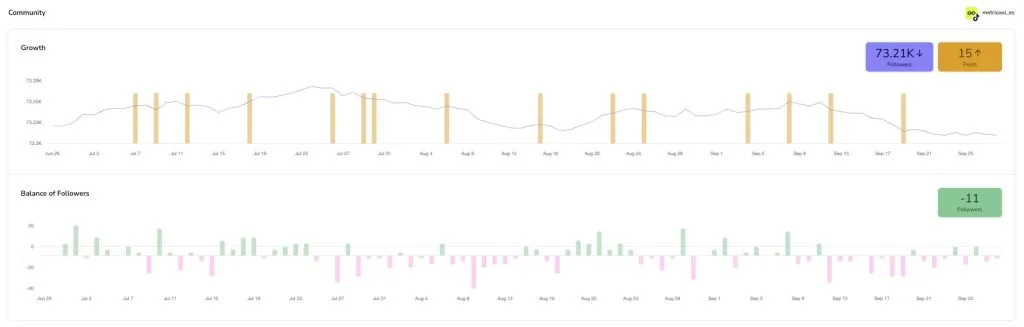
Posting without checking what worked is content with no feedback loop. Metricool’s TikTok analytics include a Brand Summary that compares your channels at a glance and a detailed view that sorts posts by views, likes, comments, shares, reach, video length, and engagement.
With Metricool’s Free plan you get one month of historic analytics data, Premium plans go up to a year. A monthly review is usually the right cadence: look at what’s working, what’s not, and which pillar is pulling its weight.
TikTok Content Ideas
Planning a TikTok calendar tends to get stuck on the same step: the blank Wednesday slot. The 12 ideas below are specific enough to use this week. Pick a few that fit your niche and run them on rotation.
- Day in the life. Walk your audience through a few hours of your work, anchored around a clear moment (morning before a shoot, first hour at the studio, closing the shop). This is the format the small-business outliers in the study run on: WildHats publishes 7.1 posts a week of workshop and process content and pulls 31x its category’s average interactions.
- Tutorial or how-to. Pick one specific task from your niche and break it into clear steps. The 2026 Study found education accounts (like language teacher Pikingli, at 1M followers) winning with this format by pairing the lesson with everyday moments and pop culture references that keep viewers from scrolling.
- Storytime. Open with a setup that promises a payoff (“the time my client asked for…”, “what happened when I posted…”). The format invites the “wait, what happened” reply in the comments without needing a CTA, and works on a single take, a carousel, or a multi-part series.
- Before and after. Show the state before something changed and the state after, with as little in between as possible. Carousels can be a strong home for this format: clear first slide, before on slide 2, after on slide 3, optional process slides after that.
- Get ready with me (GRWM). Talk through whatever you’re getting ready for while you do the routine. The key is layering the routine with something more interesting than the routine itself: a conversation, a story, a take on something happening in your space.
- Top 5 list. Pick something rankable in your niche and rank it on camera or as a carousel. Listicle content travels well on TikTok because viewers can argue with the ranking, and ranked positions are easy to disagree with by design.
- Q&A from the comments. Pick a real question from a previous post’s comment section and answer it in a follow-up. Tagging the commenter back is a built-in cross-traffic signal for smaller accounts and gives the original commenter a reason to share.
- Trending sound adaptation. Take a sound that’s having a moment and adapt it to your niche. Direct sound-driven impressions are down to 0.01% of the average post, but sound still feeds the algorithm signals about what your content is, which helps your post land on more For You Pages.
- Myth busting / “Stop doing this”. Call out a common misconception in your space and replace it with the real answer. The format splits rooms by design, which keeps the comment section moving and gives the algorithm engagement signals to work with.
- Behind the scenes / how it’s made. Show the part of your work most people don’t see: the prep, the mistakes, the second take, the workshop floor. Food outliers in the study win on visuals plus sound, so let texture and sound carry the post (the chop, the pour, the sear).
- Hot take / unpopular opinion. Stake out a clear position on something your audience cares about and back it up in under 60 seconds. The format pulls comments on its own because people show up to agree, disagree, or share their own version.
- Unboxing or first look. Open something, react in real time, and let the visual reveal do the work. The same texture and sound principle that works for food content applies to anything tactile: makeup, packaging, prints, tech, fabric.
Put Your TikTok Content Strategy to Work With Metricool
TikTok’s more crowded in 2026, and the accounts winning at every size are the ones treating the platform like a system. Pick the formats and content ideas from this article that fit your niche, set a cadence you can keep, and use your analytics to decide what to do more of. Metricool makes that workflow simpler: schedule your TikToks alongside every other platform you manage, pull your insights from one dashboard, handle comments and DMs from a single inbox, and use Best Times to publish when your audience is most active.
Build Your TikTok Strategy on Real Data
Best times, top posts, growth tracking, and a planner that publishes for you in one place.
