

LinkedIn Trends: 6 Strategy Insights from Our 2026 Study
 Kalum
16 April 2026
Kalum
16 April 2026 
If LinkedIn is part of your strategy, you’ve probably asked yourself this more than once: What’s working on the platform right now?
To answer that with data—not gut feeling—we analyzed 673,658 posts from 63,108 accounts in our 2026 LinkedIn Study. The result? A clear snapshot of how the professional network behaves and which trends are worth paying attention to this year.
In this article, we break down the most important LinkedIn trends for 2026, and more importantly, what they actually mean for your LinkedIn strategy.
LinkedIn Trends 2026
Based on the data, these are the key trends shaping where LinkedIn is heading:
In short, here’s what the 2026 LinkedIn Study tells us:
- Clicks are more important than ever, with LinkedIn tracking them as part of your engagement metrics.
- Personal profiles generate more interaction and engagement than company pages
- Posts featuring questions or CTAs to comment receive more comments than those without.
- Timing matters more than it seems: a big part of performance happens within the first 48 hours
- Links don’t work the same way on personal profiles as they do on company pages
- There’s a huge gap between the most popular formats and the ones that achieve the best engagement on LinkedIn
1. Clicks Are the New “Ghost” Engagement Metric
One of the most significant trends we discovered on LinkedIn is the rise of the “invisible” interaction. While likes and comments are the most visible metrics, clicks are doing the heavy lifting for your account authority.
Our data shows that between 2025 and 2026, the average number of clicks per post rose from 97.54 to 102.32, a 4.90% increase. This contributed to a healthy jump in overall engagement rates, which moved from 12.21% to 13.90%. Interestingly, this happened even as the average number of posts per week dropped by nearly 10%.
The takeaway? LinkedIn is tracking every time someone swipes through your carousel or clicks a “see more” link. These actions factor into your engagement rate. Quality and “clickability” now matter more than how many times you post per week.
Optimizing Your LinkedIn for Clicks
Follow these tips to earn more clicks and improve your engagement on LinkedIn.
- Utilize content formats that encourage interactions: Carousels, Polls and posts with external links are more likely to stop the scroll and make your followers do something.
- Save key info for the end of carousels and videos: Give your followers an incentive to swipe to the end of a slideshow or watch a full video (and tell them you’ve done that).
- Use polls for controversial industry topics: Every profession has those topics that divide opinions; use them to drive participation in your polls.
2. Personal Profiles Outperform Company Pages
One of the clearest conclusions from the study: personal profiles perform better than company pages across many of the most important metrics (impressions, interactions, and comments).
While both types of accounts get a similar number of impressions per post, personal profiles drive more interactions and reach a significantly higher engagement rate: 2.60% vs. 1.60% for company pages. They also post more frequently throughout the week (3.05 vs. 2.34).
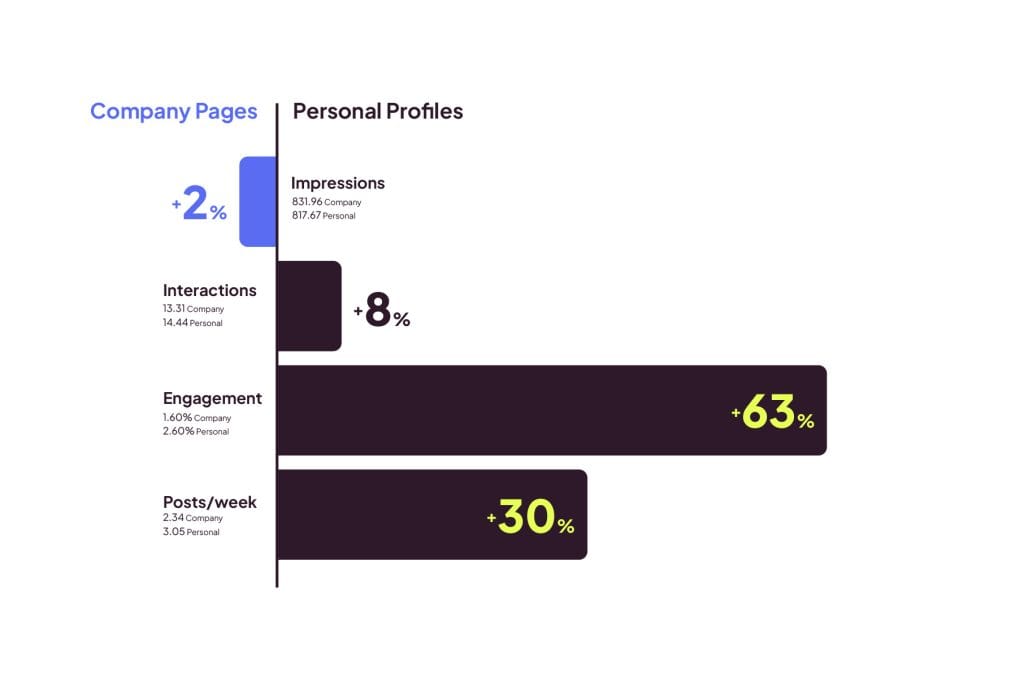
There’s another useful insight: personal profiles tend to generate conversation, while company pages drive distribution. In other words, people get more comments per post, while brands get more shares.
So what does that mean?
It’s not about choosing one type of account over the other—it’s about understanding what each one is for:
- Personal profile: start conversations, share insights, give opinions, show the human side
- Company page: reinforce messages, expand reach, build brand
And if you’re just getting started, here’s something worth noting: personal profiles tend to grow faster, especially for small and mid-sized accounts.
3. If You Want a Conversation, Ask a Question
Engagement is no longer about just “posting and praying.” The data shows that the most successful creators and brands are those who explicitly invite their audience to participate.
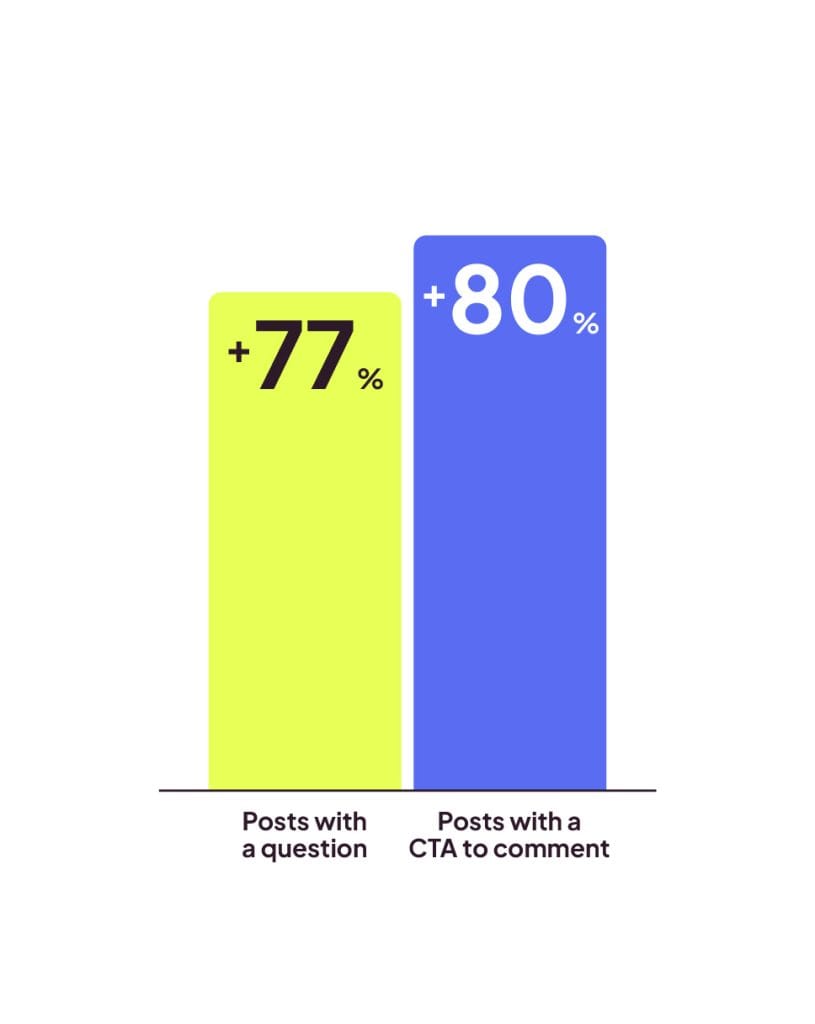
Posts that include a direct question see 77.39% more comments compared to the average post. If you take it a step further with a specific call to action (CTA) to comment, that number jumps even higher to an 80.07% increase.
| Post Type | Average Comments | Difference |
| Posts with a question | 2.61 | +77.39% |
| Posts with a CTA to comment | 2.96 | +80.07% |
People might want to share their expertise, opinion, or even a follow-up question. By providing a clear prompt, you remove the friction of them having to think of something to say. Incentivize comments by offering something in return, e.g., “Comment ‘template’ for the download link”.
Which formats receive the most comments?
| Text | Image | Multi-image | Carousel | Poll | Video | |
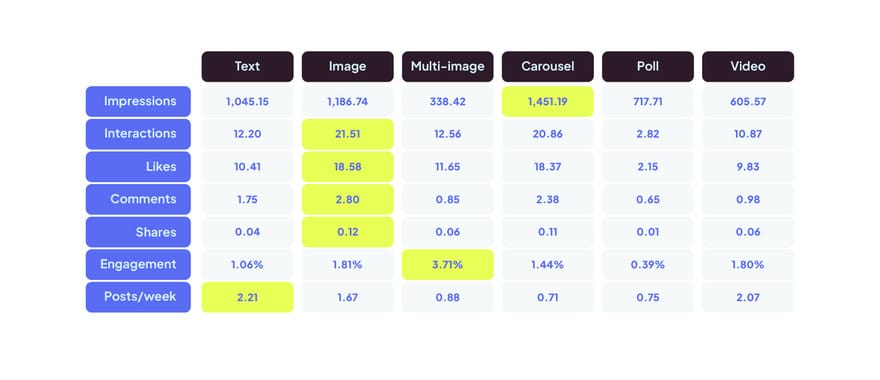
| Comments | 1.75 | 2.80 | 0.85 | 2.38 | 0.65 | 0.98 |
Interestingly, our study found that posts containing an image received the most comments, with 2.8 per post. This isn’t surprising when we consider that text-only posts are getting rarer, so even the simplest messages are usually accompanied by a picture. Carousel posts were a close second, with 2.38 per post, further cementing their status as an engagement engine.
4. Timing Matters More Than You Think
On LinkedIn, a large part of a post’s performance is decided quickly. According to the study, 50% of total impressions happen within the first 48 hours. A significant portion of interactions also comes in during this initial phase, especially on day one.
In practice, this means posting at the wrong time can cost you visibility right when your content has the most potential.
So on LinkedIn, it’s not enough to publish good content; you also need to give it the best possible chance to take off. If a post is important, when you publish it shouldn’t be decided at the last minute. Timing impacts performance just as much as format, copy, or topic.
The study also points out that 9:00 to 12:00 is a high-activity window on LinkedIn, a useful reference point before validating it with your own data.
Tip: With Metricool, you can check the best times to post on LinkedIn and use that data to decide when to publish.
5. Posting Links Doesn’t Always Hurt Performance
You’ve probably heard that adding a link on LinkedIn reduces reach. The data says: not always.
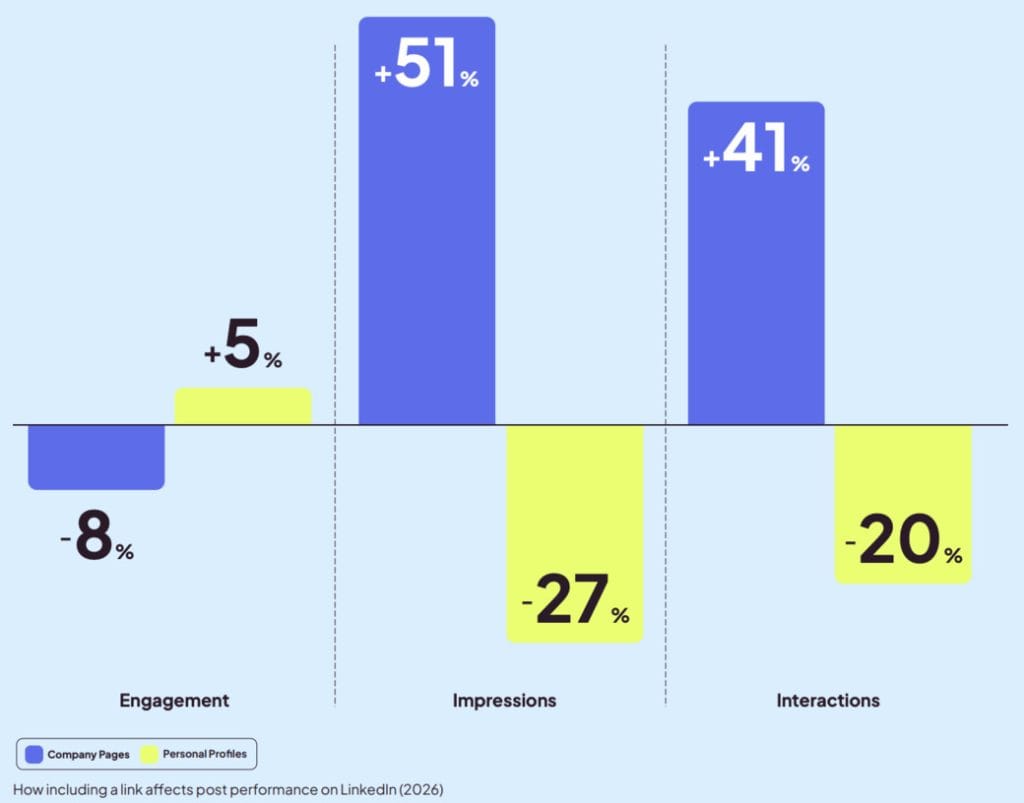
On company pages, posts with links actually perform above average in both impressions (+51%) and interactions (+41%). On personal profiles, the opposite happens, both impressions and interactions drop (−27% and −20%).
So what’s going on?
The issue isn’t the link itself; it’s how it fits into the content and where it’s posted.
- On a company page, linking to a report, guide, or webinar makes sense. It matches what the audience expects from a brand.
- On a personal profile, posts tend to perform better when they stand on their own; sharing an idea, opinion, or experience that already delivers value before the click.
Instead of asking “Should I include a link?”, a better question is:
Does this content work on its own, and does the click actually make sense here?
6. The Gap Between Popular Formats and Peak Performance
Perhaps the most surprising finding in our LinkedIn trends research is the massive disconnect between what people are posting and what the algorithm is actually rewarding.
Images and videos currently make up nearly 75% of all content on the platform. However, they are often outperformed by formats that users post much less frequently. For example, Multi-image posts boast an engagement rate of 3.71%, which is more than double the engagement of standard video (1.80%) or single images (1.81%).
Meanwhile, Carousels continue to dominate reach, earning an average of 1,451.19 impressions per post, far surpassing the 605.57 impressions seen by video content. If you are stuck in a cycle of only posting single images or short clips, you are leaving significant reach and engagement on the table.
Final Takeaway
LinkedIn keeps evolving, but the data makes one thing clear: it’s about understanding what works.
- What works for each type of account?
- Which formats deserve more space in your strategy?
- And which decisions actually move the needle?
If you’re working on your LinkedIn strategy, this might be a good moment to take a step back, review what you’re posting, and check whether it aligns with what’s working right now.
Want the full picture? Download the LinkedIn Study and draw your own conclusions.
Download the 2026 LinkedIn Study
Fill out the form and get your free copy
Metricool Software, S.L. is responsible for processing your data in order to manage the delivery of this resource and to send you updates and promotions if you check the corresponding box. You have the right to access, rectify, delete, limit, oppose the processing of your data, and request data portability. You can exercise your rights by contacting [email protected]. For more information, please refer to our Privacy Policy.
