

How to Create an AI Use Policy for Social Media
 Gretchen Oestreicher
24 September 2026
Gretchen Oestreicher
24 September 2026 
95% of social media professionals now use AI tools at work, but only 12% work under a written policy that says what’s allowed. AI showed up in the workflow faster than anyone wrote down rules for it, and that’s where the trouble starts: leaked client data, off-brand posts, an AI campaign a client objects to after the fact, or ad creative that trips over regional labeling laws.
Metricool’s 2026 State of AI in Social Media Study shows most teams are making these calls on instinct. The good news is that fixing it doesn’t take a legal department. A small team can write a working AI use policy for social media, plus a short disclosure rule, in a single afternoon, and that alone puts them ahead of most of the market while the rules and tools are still settling.
Most Social Teams Are Working Without Written AI Rules
AI use is close to universal now: 95% of social media professionals use it for their work, and 37% run more than four AI tools regularly, up from just 14% a year ago. Writing posts and copy, generating ideas, and adapting copy across tones and channels are the three most common uses, while automating repetitive tasks is climbing fastest, nearly doubling from 20% to 43% since 2025.
Written rules haven’t kept up. Among professionals working inside a company:
- No Rules at All: 62% say there’s nothing written down about how they use AI.
- A Clear, Written Policy: Only 12% work under one.
- Tool or Use-Case Limits: 8% have restrictions that rule out specific tools or use cases.
- Guidelines Wanted: 10% think their team needs clearer rules but doesn’t have them yet.
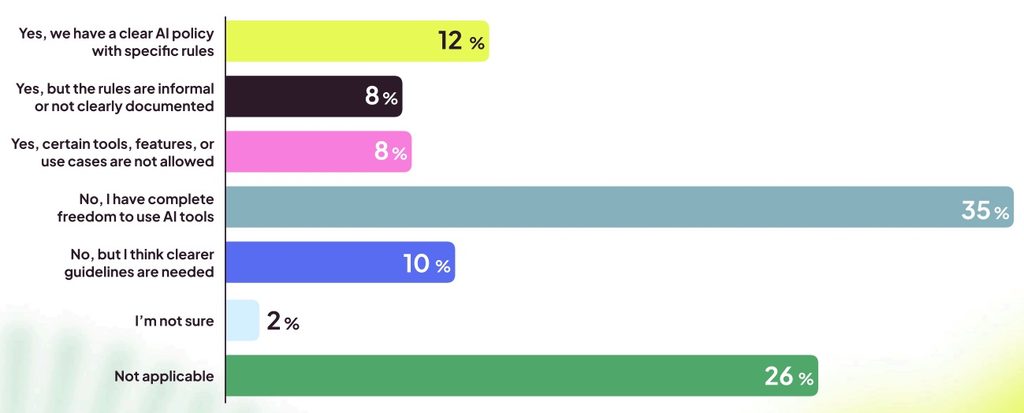
That leaves most social teams making calls about AI with nothing written down to point to. The questions that matter get answered informally, in the moment: what client data is safe to put into a public chatbot, which brand documents can go into a training run, and who signs off on an AI-drafted campaign before it publishes.
Why Ad-Hoc AI Use Turns into a Business Risk
Legal or ethical concerns hold 11% of professionals back from using AI more, and among those already using it, the worries that come up most are privacy and data usage (10%) and legal or copyright questions (5%). These aren’t abstract fears, and a normal week on a team without rules tends to produce at least one of them:
- A junior manager pastes a client’s Q3 campaign brief into a free AI tool to summarize it, and the tool’s terms let that content feed future training.
- A designer uses a generative image model for a paid campaign running in the EU with no label attached, which became a compliance question under Article 50 of the EU AI Act as of August 2, 2026.
- A copywriter drafts testimonial-style captions that read as first-person quotes, the kind of undisclosed synthetic testimonial the US FTC treats as deceptive advertising.
- Two team members run the same client through two different AI tools with two different tones, and the brand voice drifts until the client notices.
Every one of these happens under normal working conditions, when nobody has written down what the team should and shouldn’t do.
How to Create an AI Use Policy, Step by Step
None of this requires a formal governance process. A small social team can get a working first draft down in an afternoon by taking these steps in order, then refining it as real situations come up.
1. Get the Right Two or Three People in the Room
You want the people who feel these decisions day to day in the room, not a big committee. For most social teams that’s the social lead, whoever manages the client relationships, and one person from legal or operations if you have someone to pull in. A three-person content team can skip the formal working group entirely. What matters is getting the people who know what’s in the client contracts talking to the people who use the tools every day, because that’s how the rules end up matching the real work. A policy written by someone too far from the day-to-day tends to ban things people rely on and miss the risks that come up most.
2. Write Down What the Policy Is For
Before you get into specifics, write one sentence that says what the whole policy is for. Something like: “we use AI to work faster without losing accuracy, brand voice, or audience trust.” It sounds almost too simple, but that one line settles most of the arguments that come up later, because it frames the document as permission with clear limits rather than a list of bans. A policy built around “don’t use AI” gets ignored when 95% of the team is already using it every day, so the version that works starts from how people already work and adds guardrails on top.
3. Approve Your Tools and Draw Your Data Red Lines
This is the step that prevents real damage, so it’s worth slowing down for. Start by listing the specific tools the team is allowed to use and what each one is cleared for, keeping any brand or client work on paid or enterprise plans that don’t train on what you feed them. Then, just as clearly, spell out what can never go into an AI tool: client names, unreleased campaigns, embargoed announcements, customer personal data, analytics exports, and anything covered by an NDA. A safe assumption is that if a tool doesn’t offer a setting to turn off training on your inputs, you should treat everything you paste into it as public. Finally, add a catch-all for the tools nobody’s gotten around to reviewing yet, so anything that isn’t on the approved list gets a quick check before it touches brand or client work.
4. Sort Tasks into Green, Yellow, and Red
Teams usually agree on the obvious cases and argue about everything in between, so it helps to name the categories out loud. Green is for the low-risk work you don’t need to think twice about: coming up with ideas, first drafts, repurposing posts you’ve already published, and translation. Yellow is for anything that leans on data, statistics, or trends, where the rule is simply that a human checks the facts before it goes out. Red is for the things that shouldn’t happen without a real conversation: fully automated publishing with no human in the loop, and AI-generated likenesses of real people. Sorting this out once, in writing, means nobody has to argue the same call over again every time they’re on deadline.
5. Set Human Review Gates by Risk Level
The simple version is that a named person signs off on anything before it publishes, and how closely they look depends on what’s at stake. A routine evergreen post is fine with a single reviewer. A post that includes a number, a statistic, or a factual claim deserves a second set of eyes and a quick fact-check, because a confident but wrong statistic is one of the most common ways AI-assisted content goes out broken. Anything more sensitive, like a crisis response or a post touching health, finance, or a named person, should go to a lead before it goes anywhere else.
6. Write One Disclosure Rule and Keep the Mechanics Separate
You only need one durable rule in the policy itself: disclose when AI meaningfully creates or changes what the audience sees or hears, and follow each platform’s rules for realistic synthetic media. The specifics of how each network wants you to label things, and what the regulations currently require, change far more often than your policy should, so keep those details in a separate living document you can update on their schedule instead of yours. As a default, match whatever the strictest platform or region you regularly work in asks for, and that single habit will cover almost everything you publish. The full picture of which platforms and regulators require a label, and exactly when, is really its own guide.
7. Name an Owner and a Review Date
A policy with nobody’s name attached to it goes stale within a couple of months. Pick one person to own it and keep it current, and set a regular time to revisit it, roughly once a quarter while the tools and the rules are still moving this fast. It also helps to version the document, so anyone can see what changed and when, and nobody ends up working off an outdated copy without realizing it.
8. Wire It into Where You Publish
A rule that only lives in a document nobody opens won’t hold up under deadline pressure, so the last step is to put it where the work happens. Keep the approved-tools list right next to the content calendar, and build the human-review step into your scheduling or approval flow, so “someone signed off before this went live” becomes a real step in the queue instead of something everyone assumes happened. It also helps to give the team one clear place to take the edge cases, like a Slack channel or a named reviewer, so nobody’s stuck guessing on a Friday afternoon with no one to ask.
Why a One-Page AI Use Policy Works Better Than No Policy
Right now, 95% of social teams use AI and only 12% have written rules for it. That imbalance won’t last. Either teams write their own rules, or a client, a platform, or a regulator ends up writing the rules for them. Platforms have already formalized their labeling systems, the EU AI Act is now enforceable, and clients have started asking sharper questions about how their content gets made.
A one-page AI use policy and a two-sentence disclosure rule put a team ahead of most of the market, and they take an afternoon to write.
Give Your Team One Content Calendar
Plan and schedule every post across channels in Metricool, so the whole team works from the same view.
