

How To Go Viral on TikTok
 Gretchen Oestreicher
08 June 2026
Gretchen Oestreicher
08 June 2026 
Going viral on TikTok in 2026 looks different now than it did even just a few years ago. It’s what a lot of creators are chasing, and it’s harder to pull off than it used to be.
According to Metricool’s 2026 TikTok Study, which looked at more than 2.3 million posts across 92,000 accounts, video views dropped 31%, reach fell almost 29%, and interactions per post are down 31% compared to last year. There’s a clear reason behind those numbers: there’s a lot more content. Creators and brands published 72% more videos and 140% more image posts than they did in 2025. The feed is full, and every post has to work harder to get seen.
Here’s what still works if you’re figuring out how to go viral on TikTok in this kind of feed, with what the data actually shows.
1. Participate in Trends and Challenges
Joining popular trends is still one of the fastest ways to get visibility. Check the Discover page regularly to spot which sounds, formats, and challenges are picking up speed.
Be picky. Not every trend fits your niche, and forcing one that doesn’t will hurt more than help. Pick trends that line up with what you do and add your own twist, so your version stands out from the dozens of identical takes already in the feed.
2. Lead With Video (Almost Always)
If you’re choosing between posting a video or a carousel, the data points to video, with very few exceptions. Videos get 5.6x more views and 7.8x more interactions than image and carousel posts. For every image on TikTok, there are five videos in the feed, so a static post has to grab attention right away or get scrolled past.
The gap between formats got wider in 2026. Engagement rate on image and carousel posts dropped from 5.24% to 2.62%, almost half what it was. Video engagement held steady at 3.67%. Users are scrolling past static content faster than they used to.
That said, a few creators are making carousels work, and there’s a clear pattern behind their success:
- Slide 1 is your hook. Treat the first frame like a headline. If people don’t swipe past it, the rest of the carousel doesn’t matter.
- Give value on every slide. Each frame should stand on its own, like a step in a tutorial, a before-and-after, or a tip worth screenshotting.
- Design for saves, not just views. Carousels are the format people come back to. Checklists, references, and tutorials get saved at much higher rates than entertainment-style content.
If your content fits one of those patterns, carousels can still perform well. Otherwise, default to video.
3. Use Hashtags Wisely (Less Is More)
Hashtags had a quiet comeback in 2026. Hashtag-driven traffic is up 114% year over year, which makes it the only impression source besides the For You Page that grew. Posts with at least one hashtag get 5% more views and almost 10% more interactions.
But the old advice to pack your caption with tags doesn’t hold up anymore. The data is clear: fewer hashtags actually do better.
- Stick to 1 or 2 hashtags. Don’t go over 5.
- Skip generic tags like #fyp and #viral. They don’t help the algorithm understand your content, and they don’t affect how your post performs.
- Pick specific, descriptive hashtags that match what your video is actually about. They give the algorithm context, which is the whole point.
Smaller accounts (under 100K followers) lean on hashtags more heavily for traffic. As accounts grow, search becomes a bigger source of traffic, but for everyone else, hashtags still help.
One related finding worth flagging: sound isn’t a meaningful traffic source anymore. Only 0.01% of impressions come from the sound page, down 59% from last year. Trending audio still helps the algorithm categorize your content, so it’s not useless, but the old advice to “jump on a trending sound for the algorithm boost” doesn’t really apply. Use trending sound to help the algorithm understand your video, not as a way to reach new viewers.
4. Start With a Hook and Keep It Short
The first second of your video does most of the work. If you don’t grab attention right away, the rest of the video won’t get watched. Open with a surprising statement, a question, a relatable moment, or a strong visual.
Short videos still win. The average video duration on TikTok is 46 seconds, and that number hasn’t changed in a year. Aim for under 60 seconds and don’t waste any of them.
5. Engage With Your Audience (and Ask for the Right Things)
Comments took the biggest hit of any interaction type in 2026, dropping almost 45% year over year. Likes dropped 31% and shares dropped 30%, but comments are the metric in real trouble. That makes the few tactics that still drive comments worth paying attention to.
Two findings from the study are worth applying directly:
Ask questions. Posts that include a question in the caption get 26.19% more comments than posts that don’t. People are more willing to jump into the comments when they feel directly invited.
Ask for comments, not likes. Posts with a “comment below” type of CTA get 14% more comments than average. Posts that ask for a like get 60% fewer likes. Asking for a comment takes more from the viewer than tapping like, which is why posts that ask for one tend to perform better.
If you’re a smaller account (under 10K followers), there’s one more move that pays off: tagging other accounts. Mentions can lift comments by over 45% and reach by 20% for Tiny and Small accounts. That edge disappears as you grow, and for accounts over 1M followers, mentions actually hurt performance.
6. Get Comfortable With Editing
Editing skills make a real difference on a platform this visual. TikTok’s built-in tools cover most of what you need:
- Filters and effects to set the mood
- Text overlays and captions to highlight key points
- Transitions to keep the pace tight
- Speed and timer controls for precision
When the built-in tools start feeling limiting, apps like CapCut, InShot, or Adobe Express give you more room to experiment. Pay attention to how successful creators in your niche cut their videos. Most of what looks effortless is usually consistent editing habits applied over time.
7. Collaborate With Other Creators or Brands
Collaborations get your content in front of people who didn’t know your account existed. Find creators whose content overlaps with yours but doesn’t directly compete, and look for formats that work for both sides:
- Duet or stitch each other’s videos
- Film a behind-the-scenes or day-in-the-life together
- Launch a challenge your audiences can take part in
- Host a joint Q&A
- Build a series across both accounts on a shared topic
Pick the right partner and a collaboration does more than give you a short-term spike in views. You get exposure to a new audience that’s already inclined to like what you do.
8. Post Frequently, and Post at the Right Time
TikTok rewards consistency, and how often you post depends on the size of your account. Based on the 2026 data, here’s roughly what accounts at each tier are publishing per week:
- Tiny (under 2K followers): about 1.7 videos
- Small (2K to 10K): about 3 videos
- Medium (10K to 100K): about 4.5 videos
- Big (100K to 1M): about 9 videos
- Huge (1M+): nearly 30 videos
If you’re aiming to grow into the next tier, the accounts already there are posting more often than you are. Match their pace, or get close to it, without sacrificing quality.
When you post matters as much as how often. The study found that timing matters more than day of the week. Performance stays fairly even Monday through Sunday, but time of day makes a real difference:
- Peak window: 6 PM to 9 PM
- Best single hour: 8 PM
There’s also a short window after you publish where most of the activity happens. 96% of a post’s reach and almost 98% of its interactions show up in the first 10 days. After that, performance flattens out and barely moves. The takeaway: post when your audience is actually awake and watching, because the first few days are where almost everything happens.
9. Manage Your TikTok With Metricool
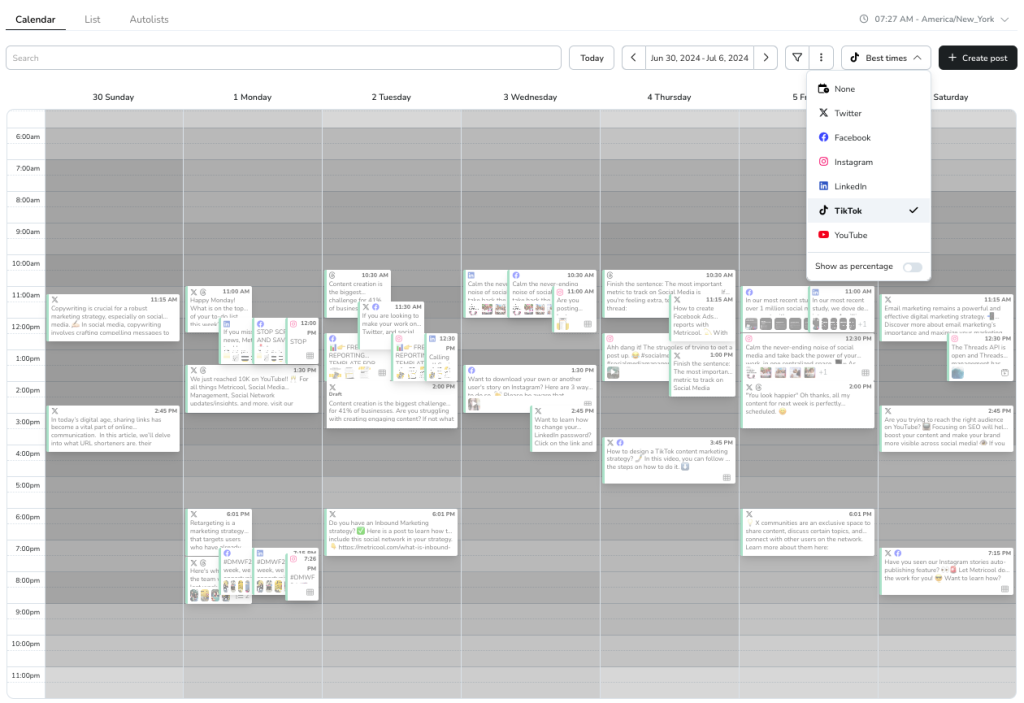
A lot of what we’ve covered comes down to the same handful of tasks: posting at the right time, adding the right hashtags and sounds, and checking which videos are actually working so you can do more of those. That’s a lot to keep track of, especially across more than one account.
Metricool brings that work into one place. You can schedule videos for your audience’s peak hours, look up hashtags that fit what you’re posting, browse a regularly updated library of trending sounds, and see which videos are pulling the most views, interactions, and shares. Follower growth, engagement, and audience demographics all sit in the same dashboard.
That’s the short version of how to go viral on TikTok in 2026: pay attention to what the data is telling you, post when your audience is awake, and adjust based on what’s actually working. The feed is more crowded than it’s ever been, but you can still see what works, and the accounts paying attention to it are the ones still growing.
Ready to Go Viral on TikTok?
See which TikTok videos resonate with your audience, and make data-driven decisions to help expand your reach.
