

Human in the Loop AI: Why 83% Don’t Publish AI Content As Is
 Kata
27 October 2026
AI can write a caption in seconds and draft a month of social posts before your morning coffee cools. Yet very few people take it as a “final cut” without a second look.
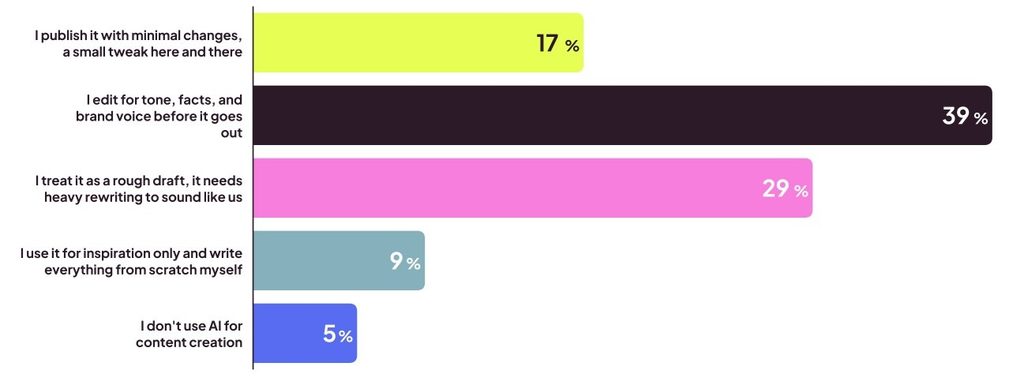
According to Metricool’s AI report, only 17% of people publish AI-generated content with minimal changes. The other 83% edit, rewrite, fact-check, or reshape it. Most teams already work with a human in the loop, whether they call it that or not.
This guide covers what human in the loop AI is, how it works, how it compares to other levels of AI autonomy, and how to set up a workflow that keeps AI’s speed without giving up human judgment.
What is Human in the Loop AI?
Human in the loop (HITL) AI is an approach where people take part in an AI system’s process:
- training it
- reviewing its outputs
- correcting its mistakes
- or approving its decisions.
The aim is to keep results accurate, safe, and in line with human judgment. Imagine it as a fast junior employee whose work still needs a manager’s sign-off. The AI generates, sorts, and predicts and a manager (you) checks the work at key moments, adds context, and makes the final call.
HITL is a hybrid way of designing systems so human judgment is part of the process from the start, rather than added after something goes wrong.
How Does Human in the Loop Work?
People can join the loop at three stages of an AI system’s life. Most businesses using generative AI today focus on the third.
1. Training: showing the model what “good” looks like
A model needs examples before it can make predictions. People label data, such as tagging images, classifying support tickets, or marking emails as spam, so the model learns from reliable ground truth.
2. Tuning: feedback that improves the model
Once a model exists, humans help refine it. Two common methods:
Reinforcement learning from human feedback (RLHF): people rank or rate model responses, and the model learns to prefer the answers humans find more helpful and accurate. This is a big part of how modern chat assistants are trained.
Active learning: the model flags the cases it’s least confident about and sends them to a person, so human time goes where it’s most useful.
3. Review and approval: checking outputs before they go live
This is where most teams deal with HITL day to day. The AI produces a draft, recommendation, or decision, and a person reviews it before it reaches a customer, a patient, or a social feed. They can approve it, edit it, or reject it.
Each correction is also data. When teams track what they change and why, they can improve their prompts, guidelines, and even the model. That’s what closes the loop.
Human in the Loop vs. Human on the Loop vs. Human Out of the Loop
These terms describe how much control people keep over an AI system, depending on when, or whether, a human steps in.
| Model | Who makes the final call | When humans step in | Typical use cases |
| Human in the loop | A person | Before the output is used | Publishing content, medical diagnosis support, loan approvals |
| Human on the loop | The AI, with human supervision | Only when something looks wrong | Fraud monitoring, content moderation queues, industrial automation |
| Human out of the loop | The AI | Not during operation | Spam filtering, product recommendations, autocomplete |
The higher the stakes, and the harder a mistake is to undo, the closer a person should stay to the decision.
The Benefits of Human in the Loop
AI doesn’t know when it’s wrong. Keeping people involved helps in five ways.
- Accuracy: AI can state errors with total confidence (often called hallucinations). A reviewer catches wrong facts, outdated information, and answers that miss the point.
- Less bias: Models learn from historical data, blind spots included. People can spot unfair or skewed results before they do damage.
- Accountability: When something goes wrong, someone has to own the decision, and HITL makes it clear who approved what. Regulation is heading the same way: the EU AI Act will require human oversight for high-risk AI systems.
- Brand safety: One off-tone post or an unfortunate customer reply can undo years of trust. A human check protects your voice and reputation.
- Continuous improvement: Every correction is feedback that, over time, makes prompts, processes, and models better.
Human in the Loop in Practice
Theory is one thing. What do people actually do with AI at work? Metricool’s AI study suggests humans are still very much involved.
Most AI content still gets edited
Only 17% of respondents publish AI-generated content with minimal changes, so more than eight in ten treat AI output as a first draft.
That doesn’t mean AI is failing. People have figured out what it’s good at: getting past the blank page, generating options, and handling repetitive formats. What it rarely gets right on its own is a brand’s voice, a specific audience’s context, or the timing of a message.
The tasks people see as human-only
The study also asked which areas people think should stay in human hands:
| Area | Share who see it as human-only |
| Creativity | 30% |
| Customer relations | 18% |
| Strategy | 17% |
Creativity (30%): AI is your robot DJ that remixes what already exists. Original ideas, cultural references that land, humor, and a distinct point of view are still best in the hands of actual humans. AI can give you twenty headline options, but telling the fresh one from the forgettable one takes taste.
Customer relations (18%): Customers can tell when they’re talking to a script. Handling a complaint, calming a frustrated client, or reading between the lines takes empathy and context that AI can imitate but not really own.
Strategy (17%): AI can analyze data and suggest options. Deciding where a business should go, which risks to take, and which trade-offs to accept comes with accountability, and that stays with people.
Examples of Human in the Loop AI
HITL shows up wherever mistakes are costly or context matters.
- Social media and content marketing: AI drafts captions, hashtags, and post ideas; a social media manager edits for brand voice and approves before scheduling.
- Customer support: a chatbot handles common questions and passes complex or emotional conversations to a human agent.
- Content moderation: AI flags potentially harmful posts; human moderators decide the borderline cases.
- Healthcare: AI highlights possible issues in medical scans; doctors confirm the diagnosis and decide on treatment.
- Finance: algorithms flag suspicious transactions; analysts investigate before an account is frozen.
- Self-driving and driver-assist systems: the car handles routine driving, but a human has to be ready to take over.
- Hiring: AI screens applications for basic requirements; recruiters review candidates and decide.
How to Build a Human in the Loop Workflow for Your Team
You don’t need a data science team for this. For most marketing and content teams, it comes down to five steps.
- Split the work: Decide which tasks AI drafts and which ones people own. The Metricool data is a reasonable starting point: give AI first drafts, variations, and repurposing, and keep creative direction, customer conversations, and strategy with people.
- Set review checkpoints: Decide where a person has to look before anything moves forward: before publishing, before sending to a client, before replying to a customer.
- Write down your quality criteria: A brand voice guide, a fact-checking checklist, and a list of off-limits topics make reviews faster and more consistent.
- Assign ownership: Every piece of AI-assisted content should have a named person who approves it. Approval flows in your scheduling or publishing tools make this easy to track.
- Feed corrections back in: Pay attention to what you keep fixing. If you always rewrite the opening line or cut the same phrases, update your prompts and guidelines so the next draft starts closer.
Conclusion: AI Drafts, You Decide
Using a human in the loop is about using AI well, not about distrusting it. AI brings speed and scale; people bring judgment, creativity, and accountability. Most teams have already settled into a pattern: AI does the first pass, and a person makes the final call.
If you’re adding AI to your content workflow, start there. Decide where AI helps and where people lead, and make sure every piece of content has someone standing behind it. In Metricool, the AI assistant can write the first draft, and the approval system makes sure a person signs off before anything goes live.
