

TikTok Trends 2026: What Actually Works?
 Gretchen Oestreicher
13 May 2026
Gretchen Oestreicher
13 May 2026 
If you post on TikTok for work, you’ve probably noticed it feels different lately. Reach is a little harder to come by, and the formulas that worked last year aren’t always landing the same way.
TikTok is still one of the social platforms with the biggest growth potential for brands and creators. It’s also become a much more competitive space, with more content, more accounts publishing, and a harder time grabbing attention.
So what actually works on TikTok in 2026?
To answer that with data instead of guesswork, Metricool analyzed more than 2.3 million posts and 92,000 accounts in our TikTok Study 2026. The numbers tell a clear story about where the platform is heading and which trends are worth your time this year.
Here’s what we found, what it means for you, and how to adjust your strategy without throwing everything out.
TikTok Trends 2026
Before we get into each finding, here’s the short version of what changed this year:
- TikTok is in a saturated landscape, and posting more no longer guarantees better results.
- The “For You” algorithm still controls almost all views.
- Hashtags matter again, for traffic and for interactions.
- Video is still the dominant format and clearly beats carousels.
- Questions and comments weigh more than likes for engagement.
- The day and time you post on TikTok matter.
- A piece of content on TikTok has a lifespan of around 10 days.
- Small accounts still have real room to grow on TikTok.
1. TikTok Is More Saturated Than Ever
The first thing the study makes clear is that TikTok is going through a moment of saturation. There’s more content than ever, and that should shape how you plan your posts this year.
Over the past year, the volume of posts grew by 72% in video and 140% in images and carousels. But almost every performance metric dropped, as you can see in the chart.
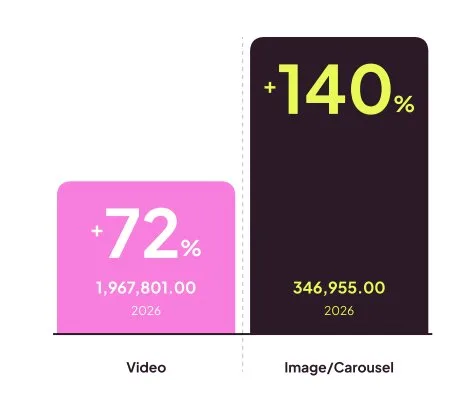
The math is simple. When there’s this much content out there, posting more on its own doesn’t get results anymore. People swipe fast and only stop when something catches their eye, so the work has shifted toward fewer posts with stronger ideas behind them.
That changes what a good post looks like. Before publishing, it’s worth pausing to rethink the topic, the script, and the angle. A stronger idea will almost always do more for your reach than just another video added to the queue.
How to Improve Your TikTok Videos
- The first seconds of the video matter more than ever.
- Hooks need to land in those first seconds.
- Keep it easy to understand. If it’s complex, they swipe.
- Hold attention with a solid script through the rest of the video.
2. The “For You” Page Is Still in Charge
TikTok is more algorithm-driven than any other social platform, and 2026 hasn’t changed that.
According to the TikTok Study 2026, 73% of views come directly from the “For You” tab. After that come visits to the creator’s profile, and views attracted by hashtags.
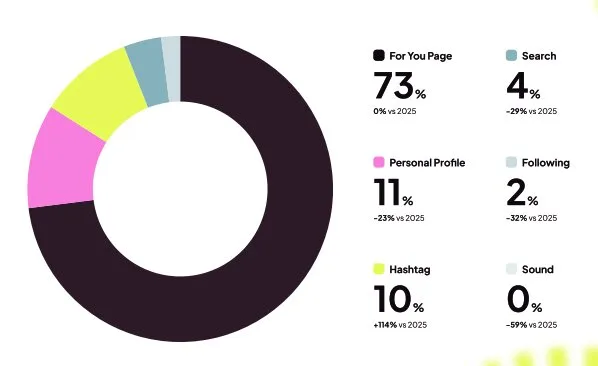
What this means in practice is that on TikTok, most of the people who see your videos don’t follow you. So your scripts and your content strategy need to work for someone who’s encountering your brand for the very first time, with no context about your tone, your niche, or your previous posts.
How to Adapt to the TikTok Algorithm
The starting point is simple: plan your content for people who haven’t heard of you yet. From there, the signals you give the algorithm matter more than anything else, because they’re what decides who gets to see you.
That’s why these work especially well right now:
- Repeatable formats, so the algorithm can place you.
- Clear niches, so you can position yourself in a sector.
- Content that’s easy to categorize, so the algorithm shows you to the right people.
- Themed series, so people keep coming back to you.
TikTok needs to understand what you do quickly to decide who to show you to. To do that, it tries to answer three questions about your account: Who am I talking to? What sector am I in? How do I explain what I do? The clearer your answers, the better your reach.
3. Do Hashtags Matter on TikTok? In Short: Yes
A lot of people consider hashtags dead on TikTok, but the 2026 data tells a different story. They’re back, and they’re working harder than they have in years.
Traffic coming from hashtags grew by 114% compared to the previous year, and posts with hashtags get 5% more views and nearly 10% more interactions.
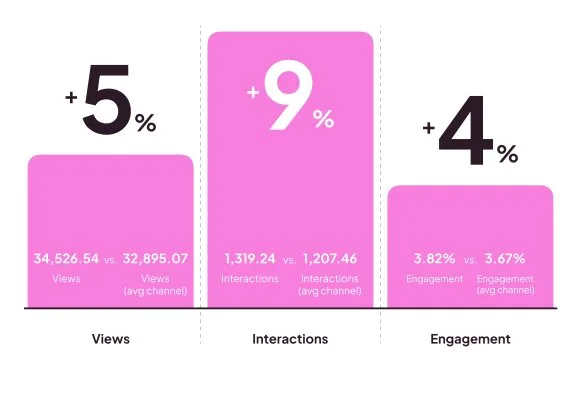
What works is using 1 to 5 specific, descriptive hashtags that help the algorithm place your video. A home cook posting a pasta recipe will get more out of #pastarecipes or #weeknightdinner than #fyp. The same principle applies to a fitness account, a small business, or a travel creator. The more specific the hashtag, the better the match.
Discover the most popular TikTok hashtags
4. Video Is Still King
Even though TikTok has pushed other formats like images and carousels, video still clearly leads the platform. And the data leaves little room for doubt.
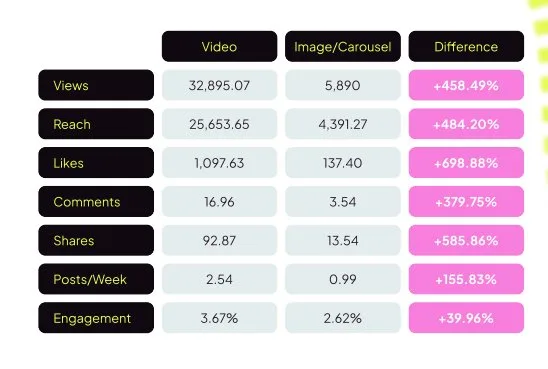
Video gets 5 times more views and 6 times more interactions than carousels. That’s a wide gap, and it’s worth keeping in mind when you decide where to put your time.
That doesn’t mean carousels don’t work. Some very niche profiles get huge results with that format, but they take a different approach:
- The first image is strong and eye-catching.
- The visual structure is clear and easy to understand at a glance.
- The content is built more for saves than for going viral.
So carousels can be a smart pick if your content is reference-style or designed to be revisited. For growing reach, video is still the format to lead with.
TikTok vs Instagram
The study also points to a useful split between the two platforms. TikTok dominates in video, while Instagram is very strong with carousels.
- TikTok dominates in video.
- Instagram still wins with carousels.
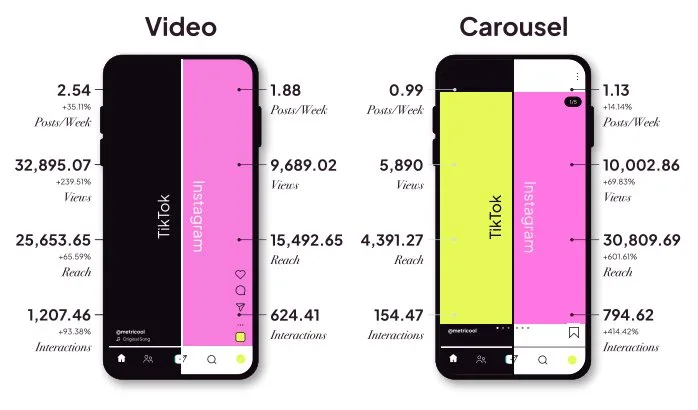
If you’re posting on both, this is worth considering when you decide what to publish where. The same idea can land very differently depending on the format, so adapting it to the platform tends to outperform pushing the exact same content across both.
5. Want Comments? Ask Questions
Conversation is one of the most important signals for TikTok’s algorithm. When your content gets people to leave comments and reply to each other, the algorithm reads it as “this post is interesting” and keeps showing it to more people.
That makes the comments section more than a courtesy. It’s part of the engine that decides whether your post gets distributed. And if you don’t ask for comments, you’re leaving a lot of those interactions on the table. In the study, posts with questions generated 26% more comments.
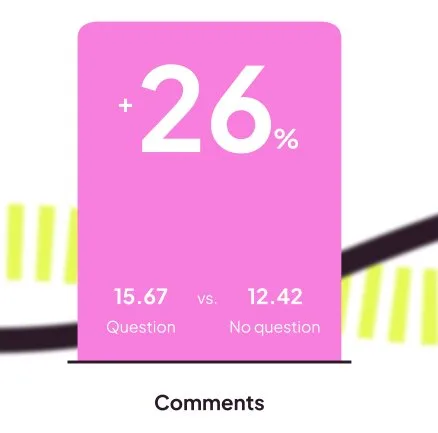
The study also shows something interesting about CTAs:
- Asking for comments increases engagement by 14%.
- Asking for likes reduces interactions by 60%.
The reason is that a comment keeps people on the platform longer than a like does. It also signals that your content sparked something, which the algorithm cares about more than passive approval.
How to Use This in Your Content
The first thing to drop is the old CTA habits. “Like this,” “follow me,” and “share” don’t carry the same weight they used to. And according to the study, asking for likes will actually hurt your reach. So replace them with prompts that invite a real response.
- Open questions that are easy to answer.
- Split opinions that pull in lots of comments.
- Personal experiences that connect on a deeper level.
Once the comments start coming in, treat them as part of your strategy. Replying, asking follow-ups, and creating new content around common questions all feed back into how the algorithm reads your account.
6. The Hour You Publish Matters More Than the Day
Does the time you publish on TikTok matter? Yes, and more than the day of the week does.
The study shows that the window between 6:00 PM and 9:00 PM concentrates the highest volume of activity, with 8:00 PM as the peak hour. Those are the best hours globally.
That said, global doesn’t always mean your audience. If your followers are concentrated in a specific country or time zone, your best posting hours might look very different from the global average. The only way to know for sure is to look at your own analytics, which you can do in the Metricool planner.
7. Content Has a Short Lifespan
One of the most useful findings from the study is about how long content actually lives on TikTok. The answer: not very long, but longer than you might think.
96% of views and 98% of interactions happen during the first 10 days. After that, reach drops sharply, as you can see in the image.
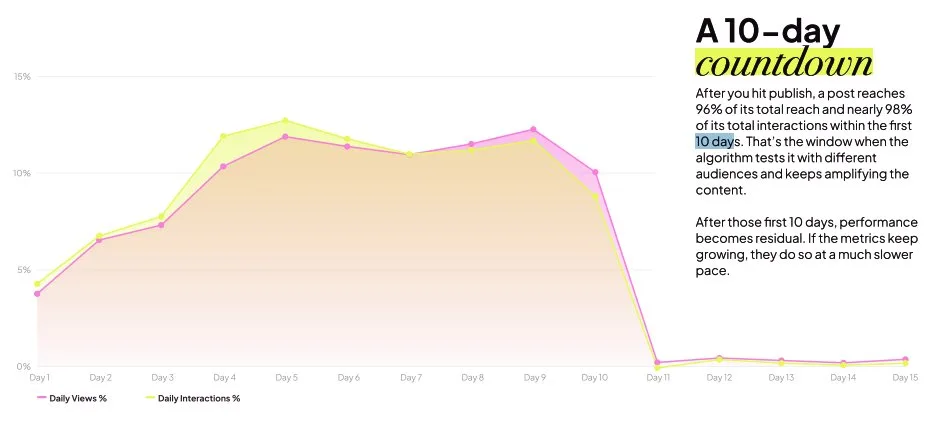
Two practical takeaways come out of this. First, TikTok keeps testing your content with new audiences well beyond the first 24 hours, so a post you wrote off as a flop on day two might still find its audience by day seven. Give it time before you decide it didn’t work.
Second, a TikTok post has a longer window to perform than a tweet or an Instagram story, but a shorter one than a YouTube video or a blog post. Plan your content calendar with that rhythm in mind, and don’t expect a single post to keep pulling in views for months.
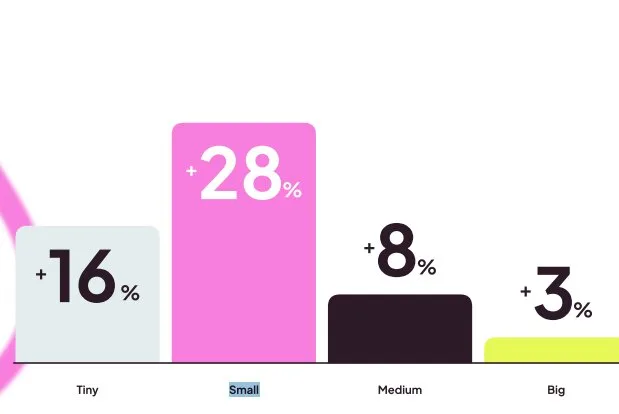
8. Small Accounts Still Have Room to Grow
Even though TikTok is more saturated than ever, small accounts still have real room to grow. That’s one of the more encouraging findings in the study, especially if you’re starting from a smaller follower base.
Reach on TikTok depends much more on the content than on the number of followers. That’s why these work so well:
- Specific niches.
- Repeatable formats.
- Content focused on real problems.
- Themed series.
In many cases, small profiles with content that works get better results than large accounts publishing generic posts. The algorithm rewards relevance more than size, which gives anyone with a clear angle a real shot.
Schedule and Analyze Your TikTok Results
Everything we’ve covered so far is only half the path to success on TikTok. The other half is measuring how your content actually performs, because without that, it’s hard to know what to change or where to invest more of your time.
Analyzing your TikTok content lets you adjust your strategy, improve your results, and reach new audiences that don’t know your brand yet. That’s where a tool like Metricool helps.
You can see which formats and which posts have the biggest impact on your audience, along with your best personalized hours to publish. At a glance, it’s easy to spot which content drives more engagement and which posts didn’t land the way you expected. From there, the next move usually becomes obvious.
Conclusion
TikTok is more saturated, the competition is tighter, and grabbing attention is harder than it was in previous years. It’s also still one of the best social networks for growing and gaining visibility, as long as you’re willing to rethink how you publish.
If you want your strategy to work in 2026, focus on content that’s specific to a niche, easy to understand, and built around what the TikTok algorithm is looking to distribute to new users.
Now it’s your turn to dig into the full study, adjust your strategy, and pull your own conclusions from the data.
See What’s Working on Your TikTok
Metricool shows you which posts, formats, and hours bring the best results, so every decision you make is backed by real data.
