

The Impact of AI in Social Media: What the 2026 Data Reveals
 Gretchen Oestreicher
20 August 2026
Gretchen Oestreicher
20 August 2026 
AI in social media work isn’t a novelty anymore. For our 2026 AI Report, we surveyed more than 700 social media professionals, mostly business owners, social media managers, and freelancers. 95% of them use AI in their work, 74% use it every day, and nearly 6 in 10 have been using it for over a year, so most are well past the trial stage.
Adoption itself hasn’t really changed since 2025, when 96% used AI and 72% used it daily. What’s different in 2026 is what happens once nearly everyone already has AI in hand: what it changes, the time it saves, the work it still can’t do, and where the money goes.
Adoption Is Near-Universal, and the Toolkit Keeps Growing
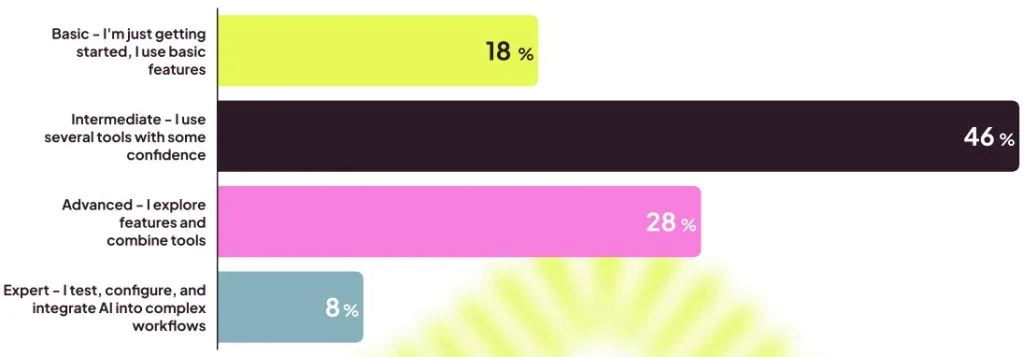
Overall, adoption sits at 95%, and it runs highest inside agencies, where 88% of employees use AI every day. Experience is clustering in the middle rather than at the extremes:
- Comfortable, Not Expert: 46% call themselves intermediate and 28% advanced, with only about 1 in 12 at expert level.
- Agencies Lead on Confidence: Just 6% of agency employees call themselves beginners, while in-house teams are the most likely to stay intermediate or below (71%), even with company resources behind them.
People aren’t loyal to one tool, either. More than a third now use over four AI tools in their workflow, up from 14% a year ago. The toolkit is expanding fast, and no single tool has locked up the market. ChatGPT leads, followed by Canva, Gemini, and Claude, with CapCut, Nano Banana, and Adobe close behind.
And most of this happens with little oversight:
- Few Written Rules: Only 16% work under a clear, written AI policy, and among those inside a company, 62% report no rules at all.
- Bottom-Up Adoption: 77% choose their own tools, and 37% picked up AI on their own initiative rather than being told to.
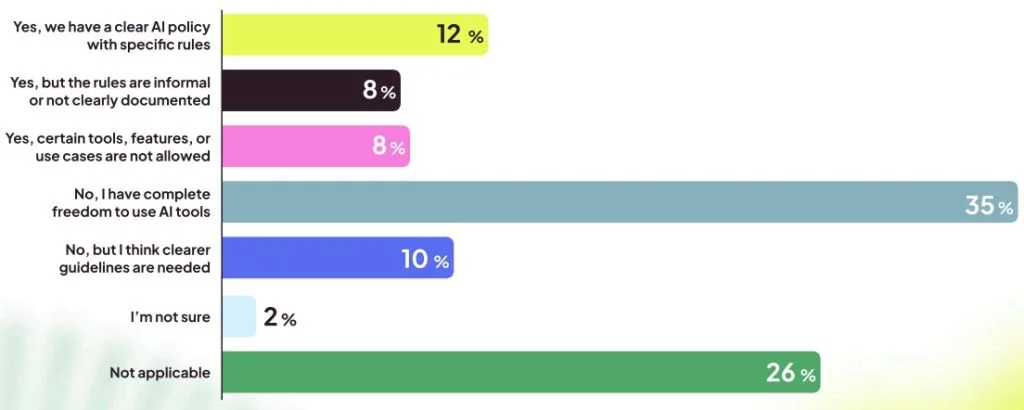
For most that means the choice of tools is theirs to make, not something handed down from higher-ups.
The Jobs People Hand to AI Are Changing
Writing posts and generating ideas are still the two most common uses of AI in social media marketing, at 86% and 84% respectively. But the real movement is in the tasks that used to feel too important to hand over. Since 2025:
- Strategy Design: Jumped from 39% to 62%.
- Trend and Topic Research: Climbed from 36% to 61%.
- Analyzing Metrics: Rose from 32% to 59%.
- Automating Repetitive Tasks: More than doubled, from 20% to 43%.
Beyond those, professionals also lean on AI to adapt copy to different tones and channels (66%) and to handle graphic design or image editing (61%), so it’s spreading across both words and visuals.
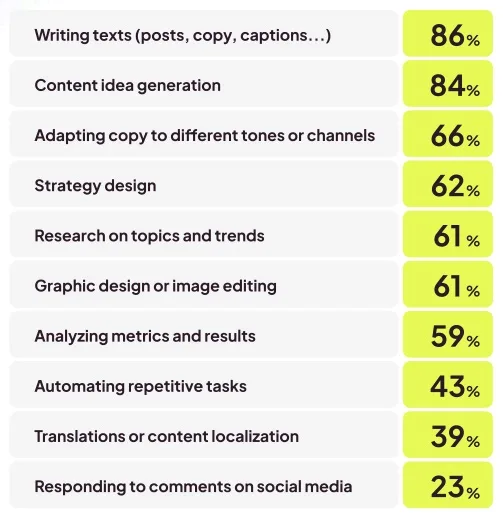
A year ago, AI mostly handled the drafting. Now it’s closer to a co-pilot, helping shape strategy, read the data, and decide what to do next. The tasks you might have guarded as too judgment-heavy for AI are the ones your peers are starting to share with it.
Across everything, AI now plays a role in 94% of the content professionals produce. That covers idea generation, drafts, and image edits alike. The figure has barely moved since 2025, so the reach of AI is about as wide as it’s going to get. What’s changing now is the depth of what people trust it with.
Where AI in Social Media Saves the Most Time
Ask professionals how they measure AI’s value and one answer comes out on top:
- Time Saved: 54%, the clear leader.
- Content Quality: 6%.
- Post Performance: 4%.
- Cost Reduction: 2%.
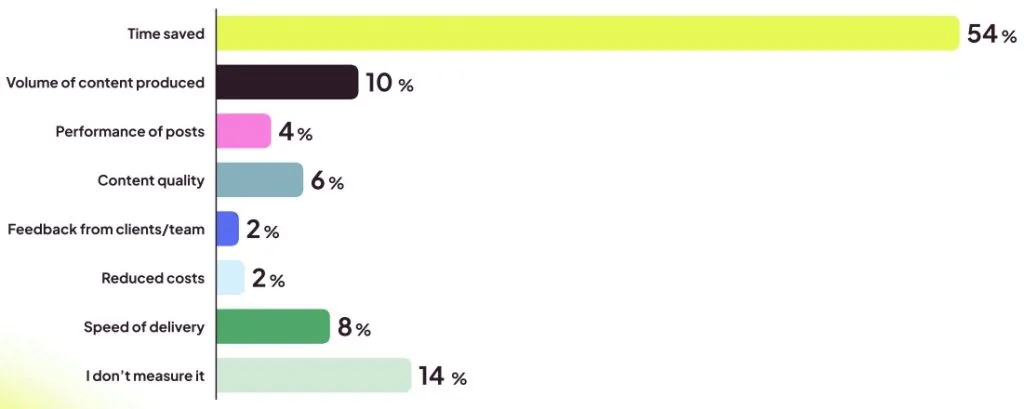
So for most people the payoff shows up as hours back in the day, well ahead of better content or cheaper output. And the hours are real:
- Almost Everyone Gains Something: Only about 1 in 10 say AI saves them no time at all.
- A Working Day Back: Around 44% save between four and ten hours a week, and nearly 12% save more than ten.
Those hours matter because the job leaves so few of them. In a separate Metricool well-being study of more than 1,000 social media professionals, nearly 9 in 10 said their workload overwhelms them at least some of the time. Asked what they rely on to cope, they put AI and automation tools first, at 72%. This is well ahead of every other resource, including dedicated social media tools. People are stretched thin, and time is the thing AI most often gives back to them.
Time isn’t the only gain, though. When professionals name what AI has changed for them, speed leads, but the next answers are about range:
- More Content in Less Time: 77%.
- Fewer Repetitive Tasks: 69%.
- Doing Things They Couldn’t Before: 53%.
- Room to Experiment With New Formats: 47%.
That last pair is the quiet story here. Alongside the speed, AI is widening what a small team or a solo professional can take on.
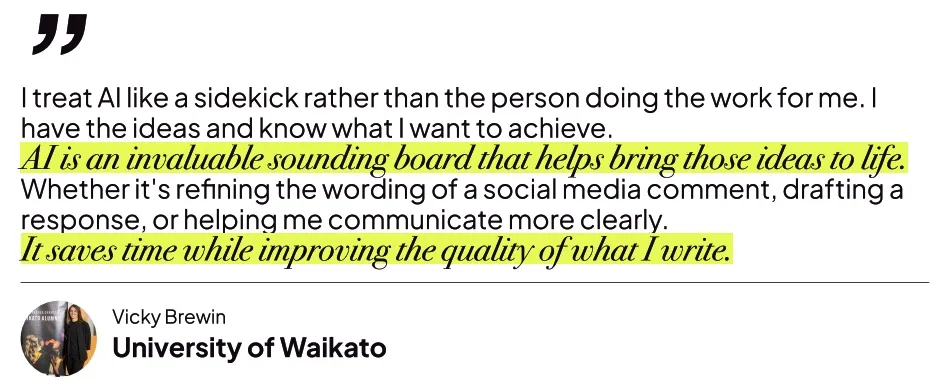
“It saves time while improving the quality of what I write.”
Vicky Brewin, University of Waikato
Almost nobody measures AI’s effect on how content performs or how good it turns out, and a third of professionals don’t track its performance impact at all. Its value shows up in the workflow long before it shows up in results, which is the clearest gap in how the industry reads AI right now.
More AI Use, More Scrutiny
Heavier use hasn’t softened anyone’s judgment. If anything, people have grown more skeptical:
- “Performs Worse” Nearly Tripled: From 5% in 2025 to 14% in 2026.
- “Matches or Beats Human” Dropped: From 59% to 53%.
The more people run through AI, the higher the bar they hold it to. You can see that caution in how content gets handled before it goes live:
- Minimal Changes: Only 17% publish AI output nearly as-is.
- Everyone Else Reworks It: The rest edit for tone, facts, and brand voice, treat it as a rough draft that needs heavy rewriting, or use it only for inspiration.
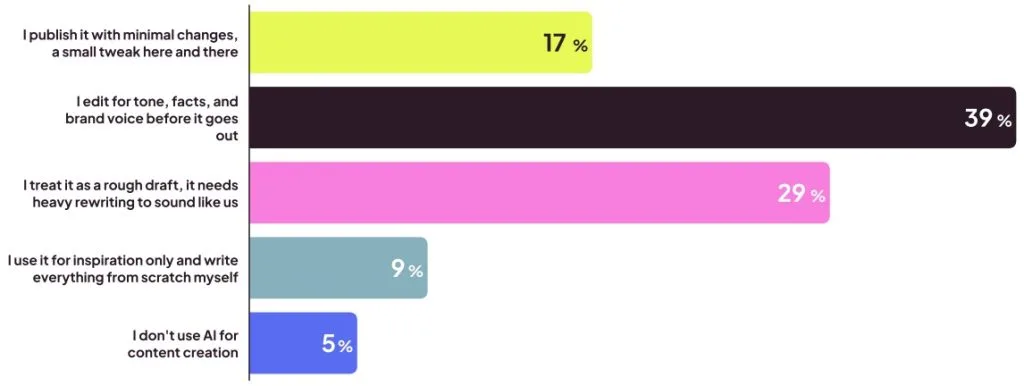
So heavy editing is the standard here. Most people treat AI output as a first draft to shape by hand. That instinct tracks with how visible they think AI is: about 1 in 6 believe well-made AI content is undetectable, while 48% say it depends on how much it’s been edited, and 34% think it’s usually obvious. Polishing is what keeps AI content from reading like AI.
Disclosure is a different story:
- No Shared Norm: A third don’t think it’s necessary to flag AI use at all, and only 1 in 10 always labels it.
- Little Outside Pressure: 57% have never been asked about it by a client or follower, and when someone does ask, they’re usually supportive or neutral (24%) rather than skeptical (9%).
With no shared norm and little outside pressure, everyone writes their own rulebook.
Creativity Is Still Human Territory
For all the ground AI has taken in social media, people still draw a firm line between AI and human creativity. Creativity is the one part of the job they most believe needs human judgment, named by 30%, ahead of customer relations (18%) and strategy (17%).
Asked about AI’s role in creative work, the answers split in a telling way:
- Good for Starting: 39% say AI helps them come up with ideas.
- Weak for Finishing: 24% say those ideas come back too generic, and another 23% say it helps them produce more without producing better.
AI is a good place to start and a poor place to finish.
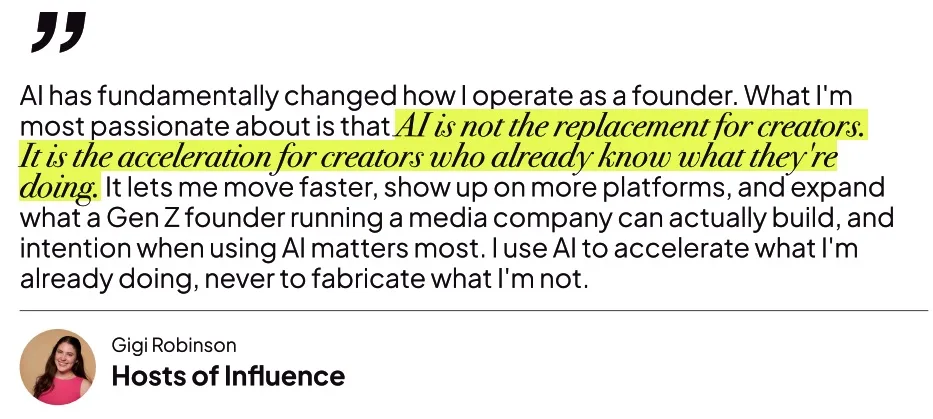
“AI is not the replacement for creators. It is the acceleration for creators who already know what they’re doing.”
Gigi Robinson, Hosts of Influence
The Money Is Moving Fast
Spending shows the sharpest year-over-year change of all. In 2025, most professionals were still on free tools. A year later:
- Free-Only Fell by Half: From 52% to 26%.
- Big Spenders Multiplied: Those paying more than $100 a month grew more than fourfold, from about 2.5% to 13%.
- Most Now Pay: Three in four pay for at least one AI tool, most often in the $21 to $50 range.
Nearly half of professionals (47%) pay for these tools out of their own pocket, and only 36% have a company covering the cost. AI is more often seen as a personal investment, not a line on someone else’s budget.
Appetite is still climbing, and it scales with team size:
- Solo: 34% plan to spend more this year.
- Teams of 2 to 5: 46%.
- Teams of 6 or More: 58%.
The bigger the team, the more AI reads as a line item worth funding.
The cancellation numbers cut against what you’d expect. Nearly 40% canceled a subscription in the past year, but price wasn’t the main driver:
- Found Something Better: 31%.
- Didn’t Use It Enough: 24%.
- Not Enough Value: 21%.
- Too Expensive: 16%.
These cancellations are more like upgrading than quitting: people swap tools for better ones, not cut AI out to save money.
That spending is coming out of somewhere. About 34% of professionals have cut their budget for outside creative services since adopting AI, and the cuts fall unevenly:
- Stock Image and Video: 93% of those cutting back reduced it.
- Copywriters and Editors: 86%.
- Designers and Illustrators: 65%.
- Translation and Video Services: Around half each.
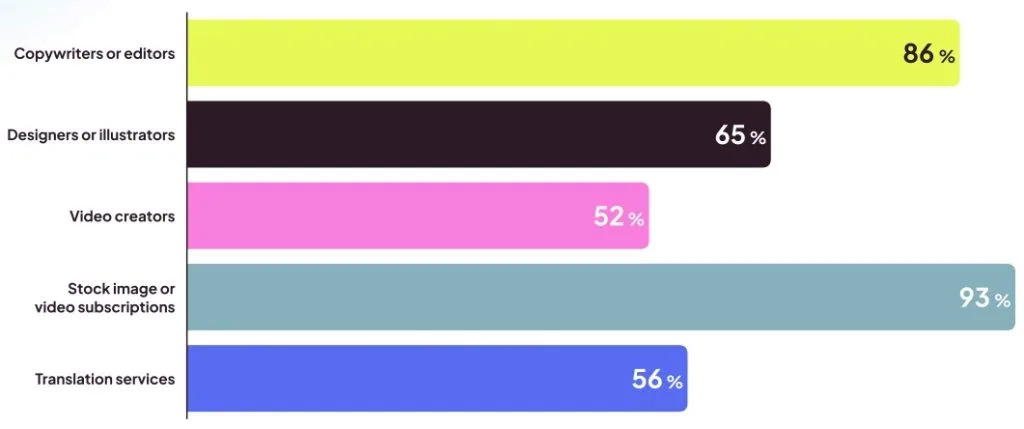
So AI’s effect here reaches past your own workflow and into who else gets paid for the work.
What’s Still Holding People Back
Adoption isn’t friction-free with the most common barrier being time: 35% say they don’t have enough of it to learn AI well. Business owners feel this most, which makes sense when you’re already running everything else yourself.
The barriers have shifted since last year. A year ago, the friction was about getting started, worries over content quality, which tools to pick, and open legal or ethical questions. Those have mostly settled and what’s left is practical: the hours it takes to learn.
The output is the other sticky point:
- Repetitive or Uncreative Results: The top frustration, at 30%.
- Artificial or Off-Brand Tone: 19%.
- Privacy and Accuracy Worries: About 10% each.
These are the same complaints that keep AI stuck in the draft stage instead of the publish stage.
What would help most is practical, not technical:
- Training and Tutorials: 24%.
- Integration With Existing Tools: 23%.
- Recommendations for Their Type of Work: 17%.
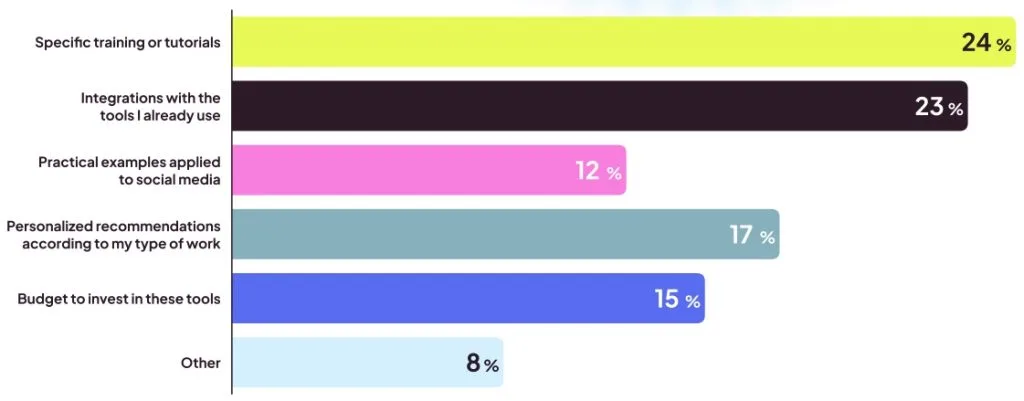
So the next round of adoption comes down to fit and know-how, not raw capability.
Where AI in Social Media Is Heading
Whatever their reservations, professionals are betting on the future of AI in social media:
- A Skill to Master: 36% expect it to become a core skill that sets people apart.
- A Reshaped Job: 43% think it’ll transform the work while opening new opportunities.
- A Job Threat: Only about 5% expect it to replace roles outright.
The mood leans toward engagement more than anxiety. A majority (56%) take the pressure to keep up as part of the job, and another 30% acknowledge the hype but move at their own pace. Only a small share feel stressed or worried about falling behind.
So the impact of AI on social media pulls in several directions at once. It’s saturated daily work and keeps pushing into strategy. It saves real time while its effect on quality goes mostly unmeasured. People lean on it every day and still won’t hand it their creative work. And it keeps changing where the money goes. The tools are here and widely used. What’s still unsettled is what the industry does with everything they’ve changed.
Make Room for the Creative Work
Let Metricool handle the scheduling and reporting so you can spend your time on the ideas only you can have.
