

Unlock Your Brand’s Potential with Meta Ads
 Kalum
14 October 2026
Meta ads provide a powerful suite of advertising tools to connect with billions of users across Facebook and Instagram. Whether you’re a seasoned social media manager or an ambitious entrepreneur, understanding and making the most of Meta Ads is crucial for achieving your marketing goals.
Sound daunting? Don’t worry, we’ve got you covered. This guide will break down everything you need to know, from the fundamentals of how Meta ads work to the intricacies of how to use Meta ads Manager and the diverse types of Meta ads available. Get ready to transform your social media strategy!
What Metricool’s 2026 Social Ads Study Says About Meta Ads
At Metricool, we recently published our 2026 Social Ads Study, in which we analyzed more than 600,000 campaigns from over 40,000 accounts on Meta and TikTok. 95.24% of participants used Meta Ads. This shows Meta is a vital part of any social ads strategy, but it also proves you need to go above and beyond to stand out. This partly explains why the average spend per Meta ad campaign rose 46.8% from $489.53 to $718.45, with brands spending more than ever to rise above the competition. One of the ways this money is being spent is on automation of ads on Facebook and Instagram. Find out more here:
Exploring the Different Types of Meta Ads
Meta offers a diverse range of ad formats to suit various objectives and creative approaches. Here are some key types of Meta Ads you should know:
- Image Ads: Simple yet effective, image ads use a single compelling image to capture attention and convey your message. They are versatile and work well across different placements.
- Video Ads: Engaging and dynamic, video ads can tell your brand story, showcase your products in action, or deliver informative content. They are particularly effective on mobile and in feeds.
- Carousel Ads: Display up to 10 images or videos within a single ad, each with its own headline, description, and link. This format is great for showcasing multiple products, highlighting different features, or telling a story in sequence.
- Collection Ads: Primarily for mobile, collection ads feature a hero image or video followed by several product images. When users click on the ad, they are taken to an immersive Instant Experience (formerly Canvas) showcasing your products.
- Instant Experience Ads: These full-screen, mobile-optimized experiences load instantly after someone clicks on your ad. They can incorporate a mix of images, videos, text, and interactive elements to create engaging brand narratives or product showcases.
- Lead Ads: Designed to collect valuable lead information directly within the Facebook or Instagram interface. Users can fill out a form without leaving the platform, making it a seamless experience.
- Dynamic Ads: Automatically promote relevant products to people who have expressed interest on your website, in your app, or elsewhere on the web. They are highly personalized and effective for retargeting.
- Stories Ads: Immersive and full-screen, Stories ads appear between users’ organic Stories on Facebook and Instagram. They offer a creative canvas for engaging your audience in a visually captivating way.
- Reels Ads: Short-form video ads that appear within the Reels feed on Facebook and Instagram. They tap into the popularity of this format and offer a fun and engaging way to reach your audience.
How Meta Ads Work: The Auction and Machine Learning Engine
Understanding how Meta ads work requires looking beyond basic ad creation and examining the underlying auction mechanics. Meta does not simply show ads to the highest bidder; it uses an automated ad auction system designed to balance user experience with advertiser value.
1. The Ad Auction Formula
Every time a user scrolls through Facebook, Instagram Reels, Stories, or Messenger, Meta runs an instant auction. The winner of the auction is determined by Total Value, calculated through this equation:
TotalValue=(AdvertiserBid)(EstimatedActionRate)+(UserValue)
- Advertiser Bid: The monetary amount you are willing to spend to achieve your selected outcome (e.g., cost per click or target acquisition cost).
- Estimated Action Rate: Meta’s algorithmic prediction of how likely a specific user is to complete your desired objective (such as submitting a form or buying a product).
- User Value: A quality score assessing ad creative relevance, post-click landing page loading speed, visual appeal, and user feedback history.
Because Estimated Action Rate and User Value carry heavy weight in the equation, highly relevant ad creative with strong conversion rates can regularly win auctions against higher bidding competitors with poorer user metrics.
2. Machine Learning and the Learning Phase
When you launch a new campaign, Meta enters the “Learning Phase.” During this initial period, the system delivers your ad creative to varied audience segments to observe who interacts and converts. Once a campaign collects approximately 50 conversion events within a 7-day window, the machine learning system stabilizes, optimizing delivery toward users who match winning conversion profiles.
Centralizing Performance Reporting with a Unified Meta Ads Dashboard
Managing Meta campaigns alongside organic social content across Instagram, Facebook, TikTok, and LinkedIn can easily lead to tool fatigue and reporting confusion. Switching between separate native ad managers makes it difficult to compare paid expenditure against organic channel growth.
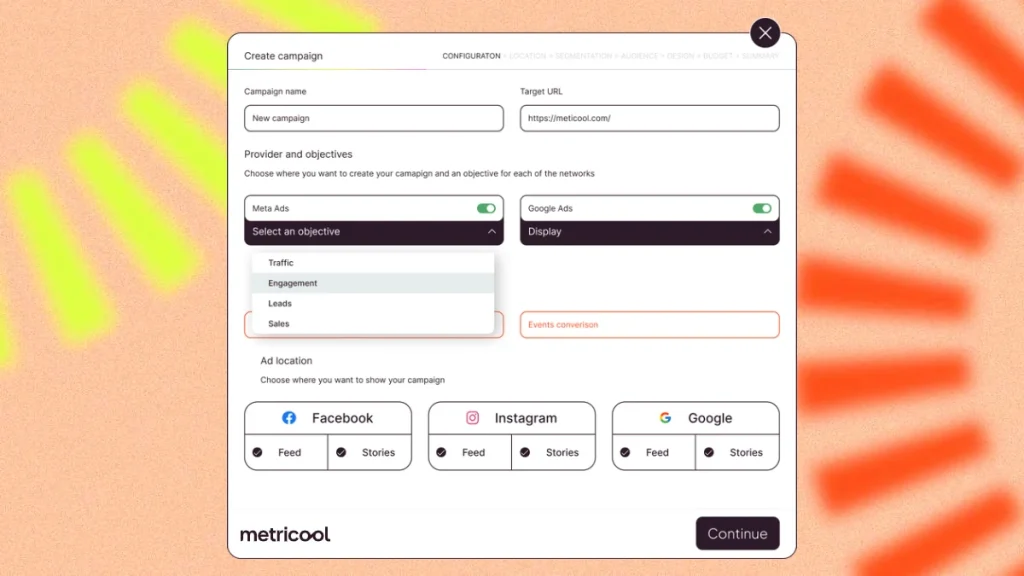
A consolidated Meta ads dashboard inside Metricool addresses this fragmentation by bringing paid campaign metrics and organic content analytics into a single workspace.
Key Benefits of Unified Dashboard Reporting
- Side-by-side analytics: Compare organic post engagement against paid ad campaign reach in one unified view.
- Cross-channel budget tracking: Monitor Meta ad spend alongside Google Ads and TikTok Ads campaigns to allocate budgets toward top-performing networks.
- Automated client reporting: Generate visual performance reports detailing ad spend, impressions, click-through rates, and conversion costs in seconds.
- Centralized content oversight: Coordinate your paid promotion schedule directly alongside your organic social publication calendar.
AI-Driven Advertising: Understanding Meta Ads MCP and Claude Integration
A prominent technological step forward is the integration of the Meta ads MCP framework with AI assistants like Anthropic’s Claude.
What Is the Model Context Protocol (MCP)?
The Model Context Protocol (MCP) is an open-standard connection architecture that allows AI models like Claude to interact securely with external software platforms. Through Metricool’s official MCP server, Claude gains secure, read-and-write access to your connected Metricool social accounts, analytics databases, and advertising tools.
Can Claude Run Meta Ads?
A common question among forward-thinking media managers is: Can Claude run Meta ads for your business?
The short answer is yes. When connected to Metricool via the MCP server, Claude can prepare, analyze, schedule, and trigger Meta ad campaigns using natural conversational prompts.
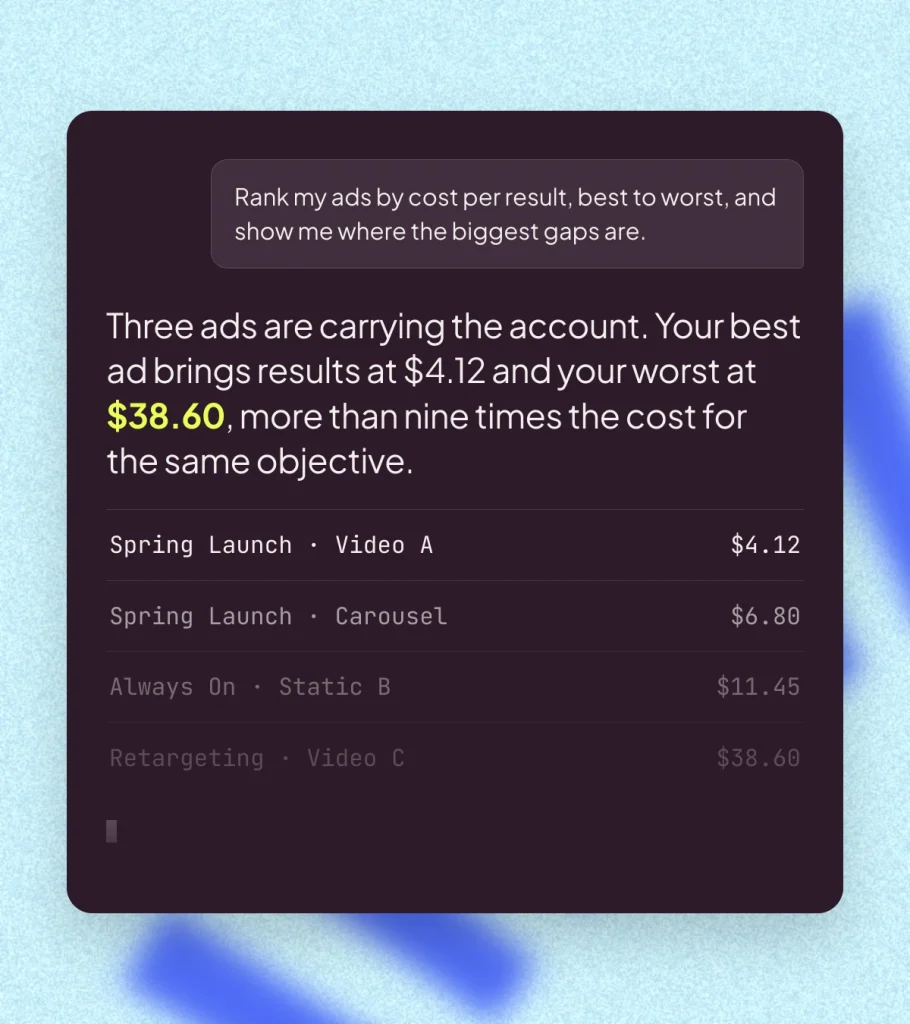
Here is how a conversational AI ad workflow operates in practice:
- Performance analysis: You prompt Claude: “Analyze my active Meta ad campaigns in Metricool. Identify which objective delivers the lowest CPA.” Claude queries your Metricool data and reports back that your leads campaign is averaging a $6.00 CPA.
- Creative and copy strategy: You instruct Claude: “Based on my top-performing Instagram Reel content from this month, write three ad copy variations for a new Advantage+ Leads campaign.”
- Campaign execution: Once you approve the drafted copy and targeting parameters, Claude uses Metricool’s API connection to create, schedule, and activate the campaign directly without you having to manually configure settings in Meta Ads Manager.
How to Use Meta Ads Manager
The heart of your Meta Ads campaigns lies within Meta Ads Manager. This powerful platform is your central hub for creating, managing, and analyzing your ads. Here’s a breakdown of its key components:
- Campaigns: This is where you set your overall advertising objective. Are you looking to increase brand awareness, drive website traffic, generate leads, boost sales, or promote an app? Choosing the right campaign objective is the crucial first step.
- Ad Sets: Within each campaign, you create ad sets. This is where you define your target audience, set your budget and schedule, and choose your ad placements (where your ads will appear). You can have multiple ad sets within a single campaign to target different segments of your audience.
- Ads: Finally, within each ad set, you design your actual advertisements. This includes the visuals (images or videos), the ad copy (text), and the call-to-action button that encourages users to take the next step.
Getting Started with Meta Ads Manager:
- Access Ads Manager: You can access Ads Manager by going to facebook.com/adsmanager.
- Create a Campaign: Click the green “Create” button and select your desired campaign objective.
- Define Your Ad Set:
- Audience: Carefully define your target audience based on the criteria mentioned earlier. Experiment with different audience combinations to see what works best.
- Placements: Choose where you want your ads to appear (e.g., Facebook Feed, Instagram Stories, Audience Network). You can opt for automatic placements or manually select specific placements.
- Budget & Schedule: Set your daily or lifetime budget and choose when you want your ads to run. Metricool is your go-to partner for managing your ad campaigns, allowing you to schedule your ads as far into the future as you wish.
- Design Your Ad:
- Format: Select the type of ad you want to create (we’ll explore the different types shortly).
- Media: Upload your images or videos, ensuring they are high-quality and visually appealing.
- Text: Craft compelling ad copy that clearly communicates your message and includes a strong call to action.
- Call to Action: Choose a relevant button that encourages users to take the desired action (e.g., “Learn More,” “Shop Now,” “Sign Up”).
- Review and Publish: Double-check all your settings and click “Publish” to launch your campaign.
Do Meta Ads Work? Performance by Objective
When media buyers ask if Meta ads work, the answer depends heavily on campaign goals, budget size, and setup quality. Metricool’s 2026 benchmark data reveals that automated features perform differently depending on whether your objective is engagement, lead generation, or direct sales.
Let’s break down campaign benchmarks across these three core campaign types from Metricool’s 2026 Social Ads Report.
1. Engagement Campaigns
Engagement campaigns focus on building brand awareness, video views, and social interactions across Facebook and Instagram posts.
Meta for Engagement Campaigns (2026)
| Objective | Engagement 2026 | Interactions 2026 | Reach 2026 | Spend Per Campaign ($) 2026 |
| Meta – Engagement | 2.15% | 2,096.31 | 97,336.03 | $193.87 |
Automated engagement campaigns allow Meta’s algorithm to deliver creative to users most inclined to like, comment, or share content. With a modest average spend per campaign of $193.87 yielding 97,336.03 in reach, 2,096.31 interactions, and an engagement rate of 2.15%, automated placement distribution works exceptionally well for top-of-funnel visibility.
2. Lead Generation Campaigns
Lead generation campaigns aim to capture user contact information through native instant forms or external landing pages.
Meta for Leads Campaigns (2026)
| Objective | CPA 2026 ($) | CTR 2026 (%) | Clicks | Conversions | Spend Per Campaign ($) 2026 |
| Meta – Leads | $6.00 | 2.04% | 5,469 | 259.1 | $1,555.00 |
Automated lead campaigns generated an average of 259.1 conversions per campaign from 5,469 clicks and a 2.04% click-through rate, with an average campaign spend of $1,555.00. Achieving a Cost Per Acquisition (CPA) of $6.00, automated lead setups minimize user friction and capture high volumes of prospective customer inquiries efficiently.
3. Sales Campaigns
Sales campaigns are designed to generate online store purchases, paid subscriptions, or high-value catalog orders.
Meta for Sales Campaigns (2026)
| Objective | CPA 2026 ($) | CTR 2026 (%) | Clicks | Conversions | Spend Per Campaign ($) 2026 |
| Meta – Sales | $11.14 | 2.67% | 13,228 | 240.67 | $2,681.23 |
Direct sales campaigns represent the highest average spend per campaign in Meta’s network at $2,681.23. With a click-through rate of 2.67%, 13,228 clicks, 240.67 conversions, and an average CPA of $11.14, automated sales tools like Advantage+ Shopping generate consistent transactional volume by dynamically showing relevant catalog items to high-intent shoppers.
Mastering Meta Ads: Tips for Success
Now that you have a solid understanding of the fundamentals, here are some tips to help you make the most of your Meta Ads campaigns:
- Define Clear Objectives: Before you even touch Ads Manager, clearly define what you want to achieve with your ads. This will guide your campaign setup and measurement.
- Know Your Audience Inside Out: The more you understand your target audience, the more effectively you can reach them with relevant messaging. Conduct thorough audience research.
- Craft Compelling Creatives: High-quality visuals and engaging ad copy are essential for capturing attention and driving action. Test different creative variations to see what resonates best.
- Write Strong Calls to Action: Tell people exactly what you want them to do with clear and concise call-to-action buttons.
- Test, Test, Test: Don’t be afraid to experiment with different audiences, placements, ad formats, and creative elements. A/B testing is your best friend for optimizing your campaigns.
- Monitor Your Performance: Regularly track your key metrics (e.g., reach, impressions, clicks, conversions, cost per acquisition) to understand what’s working and what’s not.
- Analyze and Optimize: Based on your performance data, make adjustments to your campaigns to improve results and maximize your ROI.
- Stay Updated: The world of Meta Ads is constantly evolving. Keep up with the latest features, best practices, and algorithm updates to stay ahead of the curve.
