


LinkedIn Content Ideas: What to Post in 2026
 Kalum
18 November 2026
LinkedIn’s been around a long time, but its recent boom makes it feel like a different platform than the one built for job-hunting. It’s now a real outlet for creative, substantive content, and the 2026 data backs that up in an interesting way: Metricool’s 2026 LinkedIn study found that Company Pages posted about 10% less often and reached fewer people than in 2025, yet their overall engagement rate climbed nearly 14%. Fewer, better posts are outperforming higher-volume, lower-effort ones.
So if you’ve ever stared at the LinkedIn composer wondering what to post, or searched for ideas that don’t feel like everyone else’s, this is built for you. Generic content won’t cut it. If you want to connect with a professional audience, you need LinkedIn ideas that spark real conversation and give your followers something worth their time. Here’s what the data says is working in 2026, from fundamental post ideas to carousels to exactly how hashtags and links change your reach.
The LinkedIn Difference: Why Your Content Needs a Professional Touch
LinkedIn runs on different instincts than other platforms. Here’s what sets it apart:
- Professional focus: people come here for industry news, career growth, networking, and business solutions. Content should match that tone: serious, but not stiff. That doesn’t rule out humor; it just means it should be work- or industry-relevant to land.
- Thought leadership: sharing real insight or a genuine opinion on your industry builds credibility fast.
- Networking and community: comments here tend to turn into deeper discussions, DMs, and real connections worth encouraging on purpose.
- Algorithm preferences: LinkedIn tends to reward content that keeps people on the platform and sparks comments and shares. Native video and document carousels are usually favored over outbound links.
- Character limits: posts allow up to 3,000 characters, but they truncate after roughly 200–250, so the hook and the formatting (short paragraphs, bullet points) matter more than the total length. Slang and viral phrasing that works on TikTok or X tends to land less well here.
With that in mind, let’s get into actual LinkedIn content ideas for your profile.
Fundamental LinkedIn Post Ideas for Any Business or Professional
In our study, we found that the average number of posts per month was 12.24 in the accounts we analyzed. For those currently at 0 per month, this number can seem daunting. If that sounds familiar, then check out these general LinkedIn post ideas that you can add to your content strategy. They’re suitable for most industries and professional goals.
1. Industry News & Analysis (Text Post or Carousel)
Share a recent report, a market shift, or new legislation; don’t just link it, add your own take and a question.
- Why it works: positions you as informed and current, and invites debate.
- Example: “Did you see the latest report on AI’s impact on X industry? My take: while it points to growth, the real challenge will be Y. What are your thoughts?”
2. “How We Solved It” Case Studies (Carousel or Long-Form Post)
Detail a client’s problem, your approach, and the measurable result.
- Why it works: shows your expertise in action, with real outcomes attached.
- Example: “From struggling with lead gen to a 30% increase in MQLs: here’s how we helped [Client Name] transform their sales pipeline.”
3. Thought-Provoking Questions / Polls (Text Post or Poll Feature)
Ask a genuinely challenging question tied to your industry.
- Why it works: directly invites engagement and gives you real insight into what your audience actually thinks.
- Example: “What’s the single biggest misconception about [your industry/role]? I’ll start: many think X, but the reality is Y. What’s yours?”
4. Behind-the-Scenes Insights (Photo or Short Video)
Show your team at work, a company event, or a product in development.
- Why it works: humanizes the brand; authenticity matters here.
- Example: “A busy Tuesday at the office as we finalize [project name]! So much passion goes into every detail.”
5. “Meet the Team” Spotlights (Photo + Text or Short Video)
Introduce a team member, their role, and a fun fact.
- Why it works: puts a face to the name, builds trust.
- Example: “Meet Sarah, our Head of Product. With 10 years in [industry], Sarah leads our innovation, but her secret talent is baking incredible sourdough.”
6. “Lessons Learned” from Successes or Failures (Text Post)
Share a real story where something didn’t go to plan, and what you took from it.
- Why it works: honesty and vulnerability resonate with a professional audience that values growth over polish.
- Example: “We launched a new product last quarter that didn’t meet expectations. Here are the 3 biggest lessons we’re taking from that.”
7. Resource Sharing & Curation (Text Post with Link in Comments)
Compile a short list of useful articles, tools, or books, with a line on why each matters.
- Why it works: direct value to your network, positions you as a go-to resource.
- Example: “My top 5 must-read articles on [topic] this week (links in comments). These shaped how I think about X, Y, and Z.”
8. Professional Growth & Development (Text Post or Carousel)
Share what you’re learning a new skill, a mentorship insight, a work-life lesson.
- Why it works: taps directly into what most people come to LinkedIn for.
- Example: “I just completed a course on [new skill], and here are my top 3 takeaways.”
9. Company Milestones & Achievements (Photo or Short Video)
Mark an anniversary, a new hire, an award, or a finished project.
- Why it works: builds prestige and keeps your network updated on real progress.
- Example: “Celebrating 5 years of [Company Name]. So much gratitude for the team and clients who got us here.”
10. “Unpopular Opinions” (Text Post or Poll)
Share a well-reasoned, contrarian take on something widely believed in your industry.
- Why it works: sparks real debate and shows you’re willing to push back on consensus.
- Example: “Unpopular opinion: [common industry practice] is hurting businesses more than helping. Here’s why…”
These LinkedIn content ideas should be enough to get you started posting at least once or twice a week. LinkedIn’s editor-in-chief, Tequia Burt, says, “Companies that post on LinkedIn at least weekly see a 2x lift in engagement”, if you need further convincing.
10 LinkedIn Carousel Ideas: Tired of Going Round in Circles?
Carousels aren’t the most common format on LinkedIn, making up only about 7.6% of Company Page posts, well behind images (49.5%) and video (24.7%). But they’re the best-performing format by a wide margin: Company Page carousels pull an engagement rate of roughly 49.5%, against single-digit rates for images, video, and text. Fewer brands are using them than you’d expect, given how well they do.
LinkedIn accepts PDFs for carousels, so design your slides in Canva or Google Slides, then export as a PDF. Here’s why they work:
- Visual appeal: breaks up text with real graphics
- Storytelling format: guides someone through a point step by step
- High engagement: swiping itself signals deeper interaction to the algorithm
- Actionable content: perfect for guides, checklists, or data breakdowns
- Reusability: an existing blog post or webinar can become a carousel with minimal extra work.
- “How-To” Guides / Step-by-Step Instructions: e.g., “How to Optimize Your LinkedIn Profile in 5 Steps,” “A Quick Guide to Creating a Social Media Strategy.”
- “X Tips for Y” Lists: e.g., “7 Tips for Effective Remote Work,” “5 Essential Skills for Marketing Professionals.”
- Myth vs. Fact / Debunking Common Misconceptions: e.g., “3 Common Marketing Myths Debunked,” “The Truth About [Industry Buzzword].”
- “Before & After” Transformations: e.g., “Our Website Redesign Journey: From Concept to Launch,” “Client Success Story: From Challenge to Triumph.”
- Data Visualizations & Infographics: e.g., “Key Stats from the Latest Industry Report,” “Market Share Changes Over the Last Quarter.”
- Checklists / Workflows: e.g., “Your Pre-Launch Marketing Checklist,” “Daily Habits for Peak Productivity.”
- Problem / Solution Analysis: e.g., “Struggling with [Problem]? Here’s Our Approach,” “The 3 Biggest Obstacles in X, and How to Overcome Them.”
- Quotes & Insights: e.g., “Our CEO’s Top 3 Insights on Innovation,” “Words of Wisdom from [Industry Expert].”
- Company Values / Mission Breakdown: e.g., “Our Core Values: What Drives Us,” “The Principles Behind Our Work.”
- Product/Service Feature Deep Dive: e.g., “Unpacking Our New Feature: [Feature Name],” “The Hidden Benefits of [Our Solution].”
What About Polls?
Polls still get the most reach of any format on LinkedIn, by a wide margin. Company Page polls average around 3,400 impressions, over 300% above the typical post. But reach isn’t the whole story anymore. That same huge audience converts into the lowest engagement rate of any format, at just over 4%, behind carousels, multi-image posts, and even plain text. The honest read: a poll is one of the best tools you have for pure visibility, but if your goal is a real conversation in the comments, a carousel or a multi-image post is doing more with a smaller audience.
Company Pages vs. Personal Profiles: Where the Real Engagement Is
Here’s a pattern worth paying attention to. In 2026, Company Pages and personal profiles got nearly identical reach: 831.96 impressions per post for Company Pages versus 817.67 for personal profiles, a gap of about 2%. But personal profiles pulled a 2.60% engagement rate against Company Pages’ 1.60%, 63% higher, and posted about 30% more often along the way.
Reach is roughly even. Connection isn’t. A personal voice is consistently outperforming the brand account speaking for itself, which tracks with everything else in this data: people engage with people, not logos.
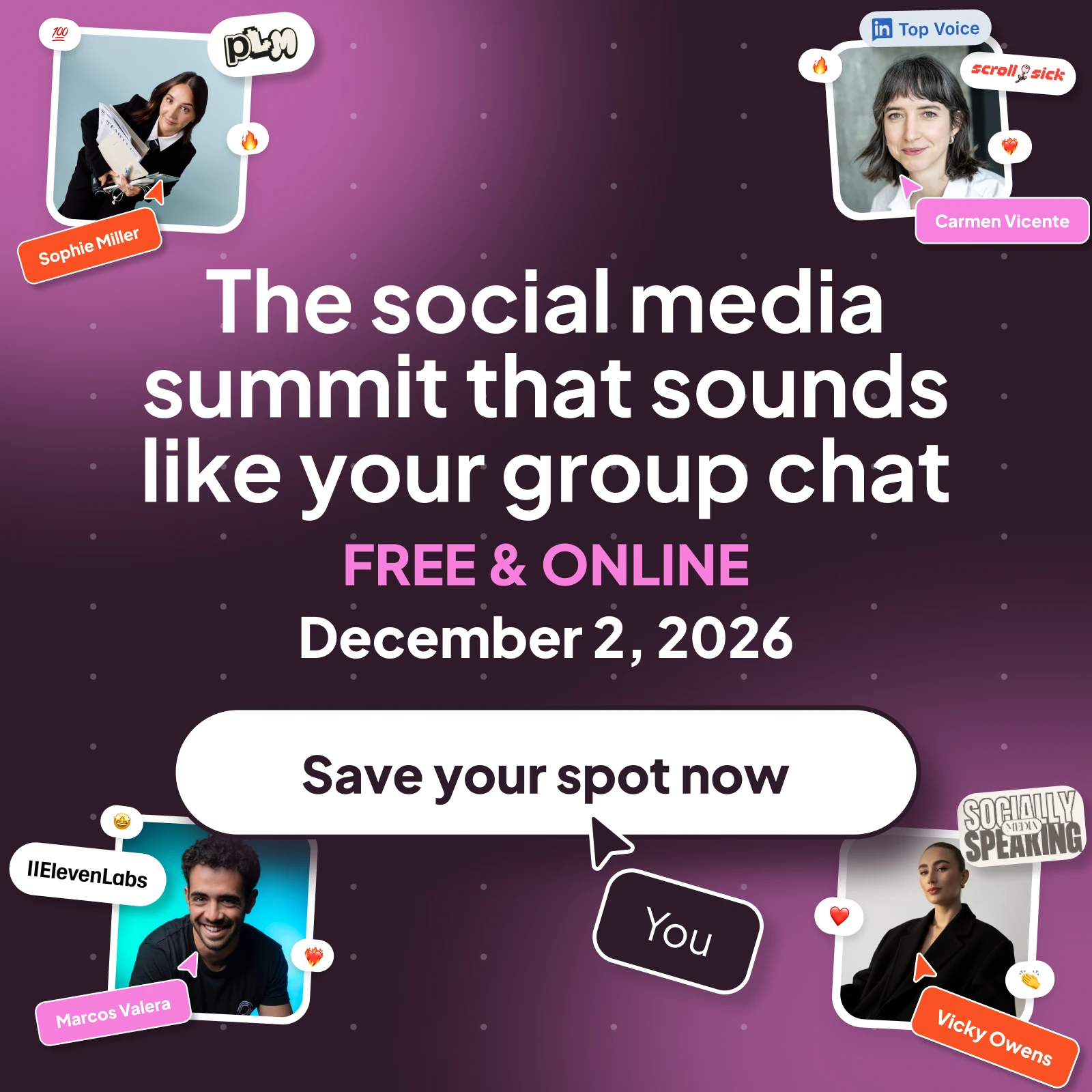
If you want to go deep on exactly why that is and how to build on it, Carmen Vicente is speaking on this directly at Unfiltered, Metricool’s free online Social Media Summit, on December 2, 2026. Her session, “Cringe Is More Fun: The Power of LinkedIn Personal Branding,” digs into why a real, sometimes imperfect personal voice is outperforming polished brand content on the platform right now.
Best Practices for LinkedIn Content That Converts
Good ideas only go so far without solid execution. Here’s what the data says actually moves the needle:
- Write compelling hooks: The first 2–3 lines are all anyone sees before “see more.” Open with a question, a strong statement, or a real number.
- Give every post a clear CTA and consider asking for a comment specifically: Posts that ask a direct question pull in 2.61 average comments, against a platform baseline of 0.59, a jump of over 77%. Posts with an explicit CTA to comment do even better, at 2.96, over 80% above baseline. If you want comments, ask for them directly; it works.
- Use high-quality visuals, and lean into carousels specifically: With an engagement rate roughly eight times higher than a single image post, a carousel earns the extra production time.
- Engage in the comments: Reply, ask a follow-up, keep the thread going; it signals to the algorithm that the post is worth showing to more people.
- Include at least one hashtag: This is one of the simplest wins from our data. Company Page posts with a hashtag saw impressions jump nearly 87% over the account average; personal profile posts saw an 85% jump. Two to five relevant hashtags is still a reasonable range, but even one makes a measurable difference.
- Think about links differently depending on where you’re posting: On Company Pages, adding a link actually increased impressions by over 50% and interactions by more than 40%; don’t be afraid to link out. On personal profiles, it’s the opposite: a link cut reach by nearly 27% and interactions by about 20%, though the smaller audience that did see it engaged slightly more intensely per view. If you’re posting personally, it’s often worth keeping the link in the first comment instead.
- Be consistent, not constant: Company Pages actually posted less often in 2026 than in 2025, and engagement rate still went up. Regular, planned posting is outperforming sheer volume. Three to five times a week is a reasonable target; a content calendar makes that sustainable.
- Show your personality, professionally: LinkedIn is still social. A genuine anecdote, where it fits, builds the kind of connection that, as the data above shows, a logo alone can’t.
LinkedIn in 2026 rewards well-matched content: the right format, a real hashtag, a direct ask for a comment, and increasingly a real person behind the post instead of just a brand name. Start with a format that’s already working for your industry, track what your specific audience responds to, and let that data shape next month’s calendar instead of guessing.