

TikTok Ads Cost in 2026: CPC, CPM & Budget Benchmarks
 Kata
17 November 2026

Thinking about giving TikTok ads a shot? Well, your timing couldn’t be better. Our latest Social Ads Study found that TikTok can get your brand in front of people for less than Meta, as long as your audience is on TikTok and you take the time to learn the platform’s quirks. TikTok’s average CPC (cost per click) is $0.03, less than half of Meta’s ($0.07). These numbers come from nearly 630,000 real campaigns run by more than 44,000 advertisers, who spent almost half a billion dollars on TikTok and Meta ads.
Read on to learn what to watch for in TikTok ad costs this year, including average CPC, CPM, how TikTok stacks up against Meta, and how to keep your costs down.
How Much Does It Cost to Advertise on TikTok?
Running ads on TikTok does take a bit of an investment. It requires a minimum budget of $50 per day per campaign and $20 per day per ad group (the set of ads inside a campaign that share the same audience and budget). Once you’ve hit the minimum, how much you actually pay comes down to how you bid. Your bid is the amount you’re willing to pay to show your ad.
Here’s how it works. Every time someone scrolls TikTok and there’s a spot for an ad, TikTok runs a quick auction. All the advertisers trying to reach that person compete for the spot. The winner isn’t just whoever offers the most money, because TikTok also looks at how relevant your ad is to that person.
There are a few ways to set up your bid:
- CPM (cost per mille): You pay for every 1,000 impressions. This works best for reach and awareness.
- CPC (cost per click): You only pay when someone clicks your ad.
- oCPM (optimized CPM): You still pay per 1,000 impressions, but TikTok shows your ad to the people most likely to take the action you choose, like signing up or buying.
- CPV (cost per view): You pay when someone watches your video for a set amount of time, such as 2 or 6 seconds.
TikTok Ads Cost: Key Benchmarks for 2026
So what does all this cost in practice? Here’s what advertisers in our study paid at each stage of the funnel, from getting seen to getting leads.
Top of the funnel: the price of being seen
If your goal is brand awareness or reach, you pay for impressions.
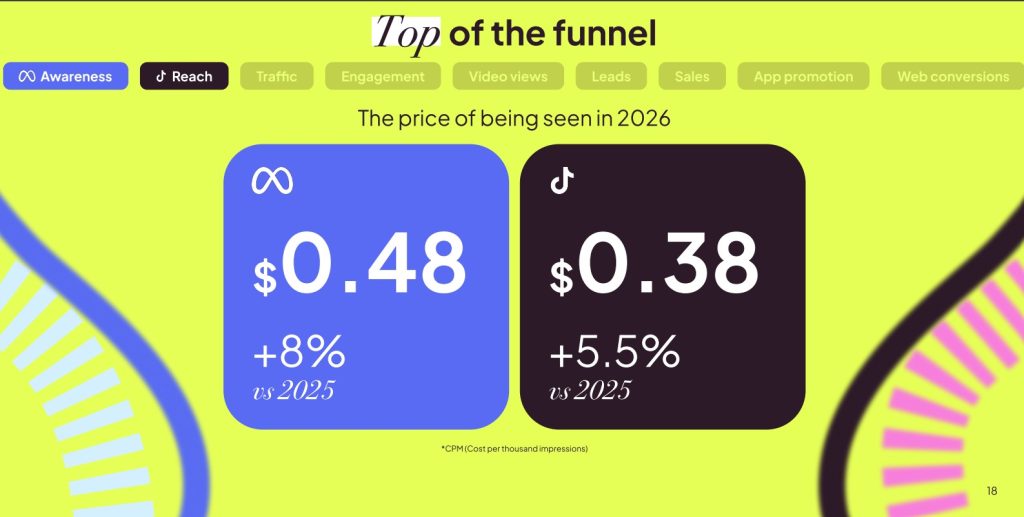
On TikTok, 1,000 impressions (CPM) cost $0.38, compared with $0.48 on Meta. That makes TikTok about 22% cheaper, even after a 5.5% increase from last year (Meta went up 8%). Awareness campaigns also reach 2.26M impressions on average, more than double Meta’s roughly 1M.
Middle of the funnel: bringing people to your business
Once people get familiar with your brand, the next step is getting them to interact with you.
At this stage, campaigns usually aim to get people to click through to your website (traffic), interact with your ads (engagement), or watch your videos (video views). TikTok wins on traffic, and Meta wins on engagement. Video views are a TikTok-only objective, so there’s no direct comparison.
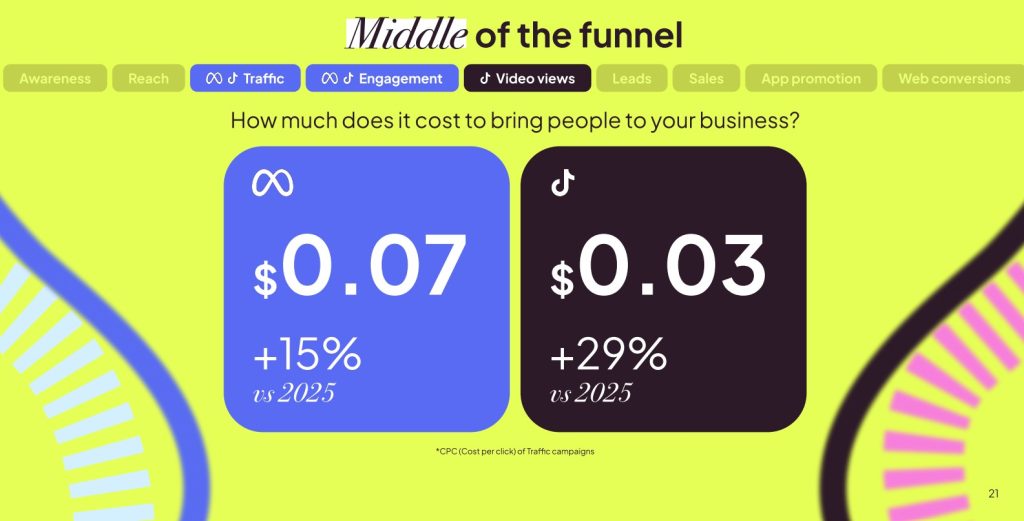
For traffic, TikTok is cheaper. The metric to watch here is cost per click (CPC). On TikTok, the average CPC is $0.03. That’s up 29% from last year, but still less than half of Meta’s $0.07. You also get far more clicks for your money: traffic campaigns on TikTok average about 35,493 clicks, compared with about 4,594 on Meta.
For engagement, Meta gets more for your money. Both platforms get a similar engagement rate (about 2%), but Meta gets there on a much smaller budget: about $194 per campaign, compared with $655 on TikTok. Per dollar, that works out to more interactions (likes, comments and clicks): about 11 on Meta, compared with about 8 on TikTok.
So if you want people to visit your website, TikTok is the better deal. If you want likes and comments, Meta gives you more for your money.
Bottom of the funnel: acquiring a lead
At this stage, we assume people have already heard about you and clicked on your posts. Maybe they loved what they saw, and now they’re ready to take the next step, like signing up, filling out a form or buying. The main metric to watch here is cost per action (CPA), which in this case is what you pay for each lead.
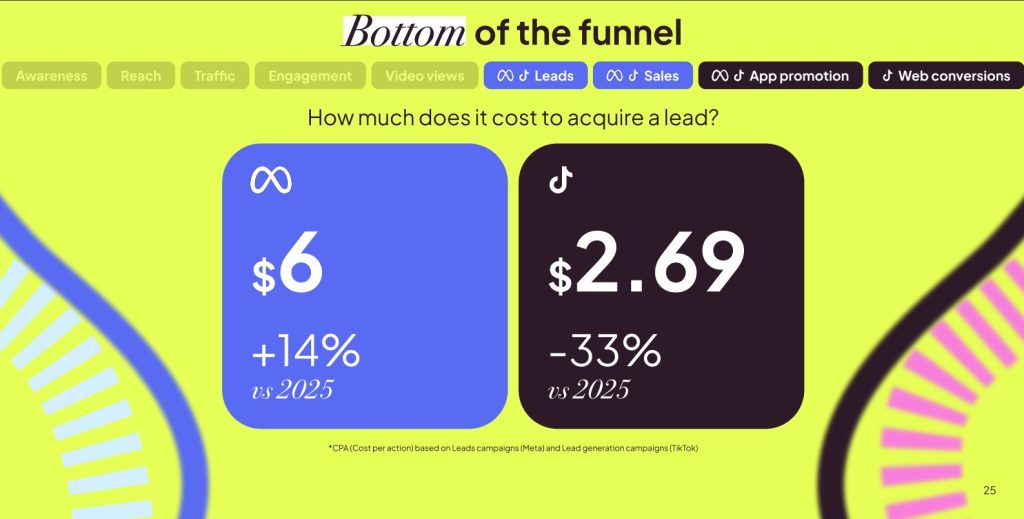
This is also where TikTok has improved the most. Its CPA dropped 33% to $2.69, while Meta’s rose 14% to $6.00. With nearly the same spend (about $1,550), TikTok campaigns bring in 574 leads on average, compared with 259 on Meta.
Average TikTok ad spend per campaign
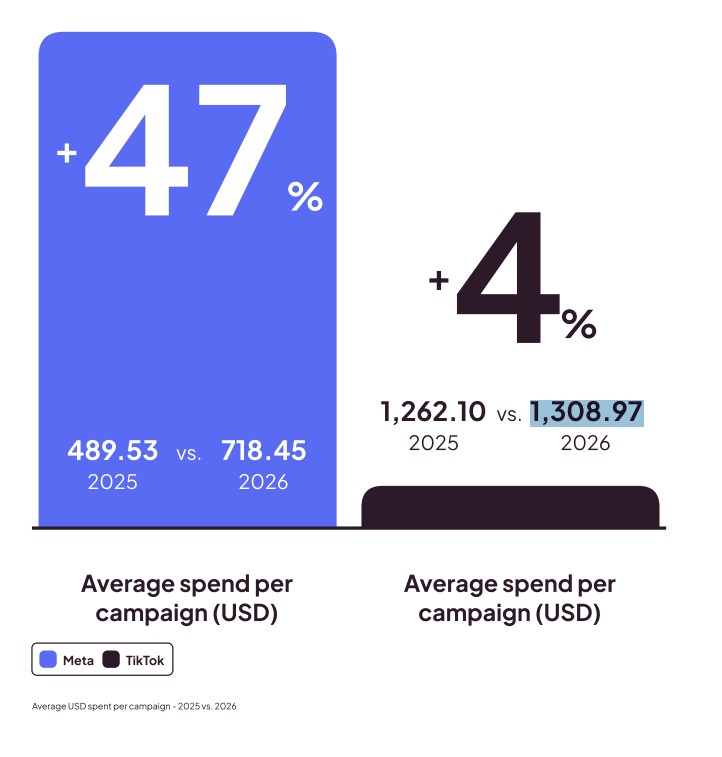
Now that you know what each stage of the funnel costs, let’s look at the bigger picture. How much are advertisers putting into TikTok? On average, $1,309 per campaign, up 4% from $1,262 last year and nearly double Meta’s $718. Meta spend grew much faster, rising 47% from $490.
That number depends on where in the funnel your campaign sits:
- Reach (top of the funnel): $853
- Traffic (middle of the funnel): $950
- Lead generation (bottom of the funnel): $1,546
The further down the funnel, the more advertisers spend, and that’s where most of the budget ends up. 58% of TikTok budgets go to bottom-funnel objectives, and web conversions alone take 28%. Reach and app promotion each get about 11%.
So how do the two platforms compare side by side?
TikTok Ads vs. Meta Ads: Which Costs Less?
Here’s the full comparison, from the top of the funnel to the bottom:
| Funnel stage | Metric | TikTok | Meta |
| Top | CPM | $0.38 | $0.48 |
| Middle | CPC | $0.03 | $0.07 |
| Middle | Interactions per dollar (Engagement) | 8.2 | 10.8 |
| Bottom | CTR (Leads campaigns) | 0.75% | 2.04% |
| Bottom | CPA (cost per lead) | $2.69 | $6.00 |
| — | Avg. spend per campaign | $1,309 | $718 |
TikTok costs less per impression, click and lead.
So why does the average TikTok campaign cost nearly twice as much as one on Meta?
Advertisers put bigger budgets behind TikTok campaigns and get a lot more back. A TikTok Reach campaign costs $853, compared with $493 on Meta, and gets more than twice the impressions. A Traffic campaign costs $950, compared with $304, and brings in nearly 8x more clicks. App promotion also pushes the average up: it’s just 1.8% of TikTok campaigns but takes 11% of spend.
Meta’s 47% jump in spend per campaign tells a different story. Most of that extra money covered rising prices: the cost of reaching 1,000 people on Meta went from $1.97 to $2.64, while TikTok’s barely moved. So on Meta, advertisers are mostly paying more. On TikTok, they’re mostly getting more.
That’s part of why budgets are slowly shifting toward TikTok. Most advertisers still use only Meta (91%), but among those running both, TikTok’s share of spend grew from 24% to 26%.
When to choose each platform
So which one should you pick? It depends on your audience and which part of the funnel you care about most.
Go with TikTok if:
- Your audience is already active there
- You want reach, clicks, or leads at a lower cost
- You can make short, native-looking videos regularly
Go with Meta if:
- Engagement (likes, comments, and other interactions) matters more to you than reach, clicks, or leads
- Your audience spends more time on Facebook and Instagram
- Your budget can’t cover TikTok’s daily minimums
You also don’t have to pick one. Running both lets you compare results with your own data.
What Affects Your TikTok Ads Cost?
The benchmarks in this article are averages. What you’ll actually pay depends on a few things:
- Campaign objective: Each stage of the funnel is priced differently. As the benchmarks show, a reach campaign costs less than a lead generation campaign.
- Bidding strategy: Whether you pick CPM, CPC, oCPM, or CPV changes what you pay for and how TikTok delivers your ads.
- Audience and targeting: The narrower or more competitive your audience, the more you’ll pay to reach it.
- Creative quality and fatigue: Ads that feel native to TikTok tend to perform better. Show the same ad too often, and people stop paying attention, which pushes costs up.
- Seasonality: Costs usually go up in busy periods like Black Friday and the holidays, when more brands are bidding for the same people.
How to Lower Your TikTok Ads Cost
You can’t control seasonality, but you can control most of the rest. Here’s where to start, from planning your campaign to optimizing it:
- Pick the right objective: Choose the objective that matches the funnel stage you’re targeting. If you want leads (bottom of the funnel), don’t run a traffic campaign (middle of the funnel) and hope for the best.
- Make ads that look like TikTok content: Polished, TV-style ads stand out for the wrong reasons. Shoot vertical, use real people, and follow the trends your audience is already watching.
- Test your hooks: The first second or two decides whether someone keeps watching. Try several openings for the same ad and keep the ones that work.
- Use Spark Ads: Spark Ads let you promote your own organic posts, or creators’ posts, so your ads keep their likes, comments, and the creator’s credibility.
- Refresh creative often: Swap in new versions before performance starts to drop.
- Track results and adjust: Check your numbers regularly and move budget to the ads and ad groups that perform best.
Manage your TikTok Ads With Metricool
Cheap clicks only pay off if you can see which campaigns bring them in. Metricool connects your TikTok Ads account and puts your results next to your Meta Ads and Google Ads campaigns, so you can compare platforms without switching between three ad managers.
With Metricool you can:
- Track every key metric in one dashboard: spend, impressions, clicks, conversions, CPM, CPC, and CTR, updated in real time.
- Compare TikTok and Meta side by side: see where each dollar works hardest, just like the benchmarks in this article.
- See paid and organic results together: find out how your ads perform next to your regular TikTok content.
- Build reports automatically: share ready-made ads reports with clients or your team, or ask Metricool Studio questions like “Compare my TikTok Ads with my Meta campaigns this month.” questions like “Compare my TikTok Ads with my Meta campaigns this month”.
If your audience is on TikTok, the numbers make a strong case for giving it a try. Impressions, clicks, and leads all cost less than on Meta. Just keep in mind that Meta still wins on engagement, and plan for the daily minimums.
Want all the data? Download the full Social Ads Report:
