

What We Learned at Adweek’s 2026 Social Media Week
 Anniston Ward
14 July 2026
Anniston Ward
14 July 2026 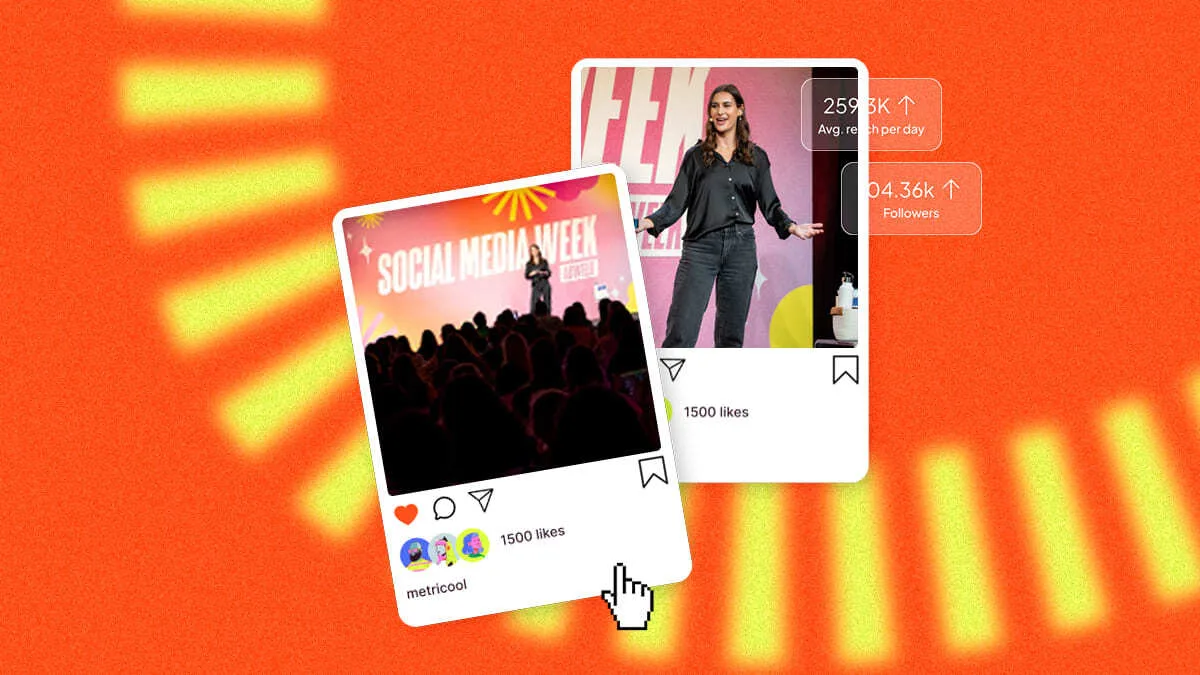
In April 2026, New York City hosted Adweek’s Social Media Week, one of the most important gatherings for social media professionals, brand strategists, creators, and marketers navigating the ever-shifting landscape of digital culture. Metricool was in the room, and what we heard from the stage reinforced what our own data has been telling us all year: the industry is at an inflection point.
The conversation has shifted. It’s no longer just about reach, impressions, or follower counts. It’s about something harder to measure, and far more valuable — humanity.
Here’s what stood out, and how it maps to the data from Metricool’s 2026 Social Media Study, 2026 LinkedIn Study, and our first-ever Well-Being in Social Media Professionals Report.
The State of Social Media: Constant Whiplash, Real Human Cost
If there was one feeling that permeated every session at Social Media Week, it was this: the industry never stops asking for more. More content, more platforms, more tools, better strategies, faster turnaround.
Social media isn’t just a job — it lives on the same device that holds our conversations, relationships, and sense of self. There’s no real separation from the work, no clear “off” switch. You’re expected to operate on the front lines of culture while simultaneously existing inside of it as an everyday consumer.
The data backs this up in stark terms. Metricool’s 2026 Well-Being in Social Media Professionals Report, the first study of its kind from Metricool, based on responses from nearly 1,000 professionals worldwide, found that:
- 73% of social media professionals work outside their scheduled hours, with overtime becoming a baseline expectation rather than an exception
- 44% cannot fully disconnect from work after hours
- 75% feel they are expected to manage too many responsibilities at once: juggling strategy, content creation, analytics, community management, and stakeholder communication simultaneously
- Nearly half (48% of in-house marketers and 52% of agency employees) have considered leaving their roles due to stress or burnout
This is not a personal failing. It’s a structural one. As Metricool CEO Juan Pablo Tejela put it: “The professionals behind this work are stretched too thin. Companies must implement structural changes to protect their talent.”
Recognition Gap: Creative Freedom Without the Reward
One theme that resonated across sessions was the disconnect between how much social media professionals contribute and how little that contribution is recognized, financially and professionally.
Our well-being data makes this gap impossible to ignore:
- 57% of social media professionals feel their work is valued less than other marketing roles, despite owning brand voice, real-time audience relationships, and increasingly, performance-driven outcomes
- Only 4% feel fully fairly compensated
- 60% feel underpaid: a sentiment consistent across agencies (66%), in-house teams (56%), freelancers (62%), and business owners (63%)
- While 59% report having high creative freedom, only 24% received any financial reward, a raise, a bonus, or business growth, tied to their work in the past year
The quiet hope that “doing more” earns credibility and career respect runs deep in this industry. The numbers suggest the system hasn’t caught up.
The Platform Landscape is Shifting Away from Short-Form Hype
On the content strategy side, what’s happening on the platforms themselves tells an equally important story. Metricool’s 2026 Social Media Study, the largest to date, analyzing over 39 million posts from more than 1 million accounts across 10 platforms, reveals that the era of chasing Reels reach and going viral on short-form video is giving way to something more durable.
Key findings:
Instagram: Reach is down, and the feed is more competitive than ever. More content was published in 2025 than in any prior year, but that volume did not translate into more visibility per post. The short-form hype cycle is showing its limits.
YouTube: The “YouTube is harder” narrative is fading. Weekly posting frequency was 524% higher than on TikTok and 1,007% higher than on Instagram Reels, signaling creators and brands are leaning into long-form with confidence.
LinkedIn: After years of growth, LinkedIn saw a 23% decrease in impressions and a 14% decline in interactions as posting frequency increased and competition intensified. Quality now matters more than quantity.
Facebook: Defying its “dying platform” narrative, Facebook saw a 51% increase in reach, a 57% rise in impressions, and a 56% jump in interactions, one of the strongest performance rebounds across all platforms.
Threads: Emerging quickly with strong early signals, with an average of 1,536 impressions per post and nearly 25 interactions per post.
Bluesky: The platform posted the highest relative engagement among emerging platforms, averaging 16.38 interactions per post, pointing to a growing appetite for decentralized social experiences.
Google Business Profile: Local businesses saw bookings rise 13%, direction requests increase 34%, and food orders jump 78%, proof that not all meaningful social action happens in a feed.
Metricool CEO Juan Pablo Tejela summed it up: “Reels reach is down, and algorithmic overcrowding is real. We are seeing long-form and community-first environments gaining further momentum.”
LinkedIn: The Rise of “Invisible Interactions”
Metricool’s 2026 LinkedIn Study, the third annual edition and the first to include both Company Pages and Personal Profiles, surfaced one of the most counterintuitive findings of the year.
Traditional engagement metrics are falling: likes are down 13%, comments down 17%, and shares down 10% year-over-year. And yet, overall engagement is up nearly 14%.
How? Through what the study calls “invisible interactions” – clicks, carousel swipes, video views, and link taps. Actions that signal genuine user intent, even when they don’t show up in a public engagement count.
Other notable LinkedIn findings:
- Personal profiles outperform Company Pages with a 63% higher engagement rate on average (2.60% vs. 1.74%)
- Carousels dominate reach, averaging 1,451 impressions per post, far surpassing the 606 impressions seen by video content
- Multi-image posts boast an engagement rate of 3.71%, more than double that of standard video (1.80%) or single images (1.81%)
- Smaller accounts (2K–10K followers) are the fastest-growing segment on LinkedIn, while large accounts see barely 1% growth, suggesting audiences are seeking out niche communities and fresh voices
The takeaway for brands: the people using LinkedIn actually want to connect with people. Personal profiles, authentic voices, and formats that invite deeper engagement are what the algorithm is now rewarding.
“Comments as Social Creative”: Your Audience is Already Writing Your Next Campaign
One of the most memorable moments from Social Media Week came from a panel featuring Rita Gorenberg (Clorox), Rob Lenois (VaynerMedia), and Lia Haberman (ICYMI), who introduced the concept of CASC — Comments as Social Creative.
The idea is refreshingly simple: your next campaign is already being written. It’s in your replies, your comment sections, the way your audience is already talking to you. When brands ignore that signal, that’s when things fall apart — not because they took a risk, but because they stopped listening.
This thinking aligns directly with what Metricool’s data shows about community-first platforms gaining momentum. Audiences in 2026 don’t just want to consume. They want to participate, co-create, and feel like they’re part of what’s being built.
As NéAndré Broussard put it at the event: “If brands want to show up in culture, they need to stop chasing moments and start committing to communities.”
Trust Is the Product
Elfried Samba from The Butterfly Effect offered a reframe that stuck: “We’re not in the marketing business. We’re in the trust business.”
Brand loyalty, he argued, is like life insurance. The brand’s “policies” have to be a package someone is willing to invest in. And that kind of trust cannot be manufactured through perfectly optimized content. It has to be earned — through consistency, authenticity, and showing up for your community over time.
This tracks with what Metricool’s data reveals about formats and platforms: the content winning right now isn’t the slickest or the most algorithmically engineered. It’s the content that feels human. The multi-image carousel. The thoughtful LinkedIn post from a real person. The comment that becomes a campaign.
AI as a Tool for Boundaries, Not Just Efficiency
A quieter but important thread throughout Social Media Week: the industry’s complicated relationship with AI. As much as professionals push back against over-reliance on it, AI adoption is accelerating. Metricool’s 2025 State of AI in Social Media Study found that 96% of professionals now use AI tools in their workflows, with 72.5% relying on them daily.
The more interesting shift isn’t about the technology itself — it’s about what we’re using it for. Increasingly, AI is being used to automate the mundane and reclaim time. In an environment that rarely encourages boundaries, that’s meaningful. It’s helping professionals do less of the repetitive work that drains energy, and more of the strategic, creative work that actually moves the needle.
That said, the well-being data is clear: AI has not yet translated into reduced stress or better work-life balance. 39% of social media professionals report a poor or very poor work-life balance. The technology is there. The structural support is not.
The Real Problem Is a Lack of Humanity
The through-line of Social Media Week — and of Metricool’s research this year — is this: the problem of social media in 2026 isn’t the content. It’s the lack of humanity.
In a world where we’re more connected than ever, genuine connection still feels rare. Audiences can feel the difference between content that was made for them and content that was made at them. And professionals are burning out trying to produce the latter at scale.
The shift that’s finally happening is a loosening of the ideals of “professional” online behavior and the realization that the most powerful thing a brand, creator, or social media manager can bring is themselves. Their opinions, their backgrounds, the parts of their voice they’ve been told to tone down.
As Metricool’s data shows, the platforms rewarding that authenticity right now are the ones gaining momentum. The formats that invite real interaction- carousels, conversations, and community- are outperforming the ones that broadcast.
Maybe the answer isn’t to do more, optimize harder, or chase every new trend. Maybe it’s to listen more closely, show up more honestly, and let go of the pressure to be perfect.
What This Means for Your Social Media Strategy
Here’s what the data and the conversations at Social Media Week tell us about where to focus:
Invest in community over reach. Platforms and formats driving genuine engagement (LinkedIn carousels, Threads, Bluesky, YouTube long-form) are outperforming short-form hype plays.
Mine your comments. Comment sections are gold mines for generating new campaign ideas, gathering customer feedback, and co-creating with your audience.
Prioritize personal voices on LinkedIn. Personal profiles drive 63% higher engagement than Company Pages. Your people are your best content strategy.
Take the well-being data seriously. Nearly half your team has considered leaving. That’s not a morale issue; it’s a structural one that requires structural solutions.
Use AI to reclaim time, not to replace voice. The 96% adoption rate means AI is table stakes. The differentiator is what you do with the time it frees up.
Metricool’s 2026 Social Media Study, 2026 LinkedIn Study, and Instagram Study are all available for free at metricool.com/studies.
View Anniston’s AdWeek Social Media Week summary on LinkedIn.
