

YouTube Trends 2026: What 799,718 Videos Tell Us about Views, Shorts, and Watch Time
 Gretchen Oestreicher
29 July 2026
Gretchen Oestreicher
29 July 2026 
YouTube in 2026 is busier and faster than it was a year ago. Views are climbing across both long-form video and Shorts, brands are publishing more, and the Shorts feed has become the main way people find new content. At the same time, viewers are watching each video for less time, which changes what a “view” is actually worth.
To see where the platform is heading, we dug into the YouTube trends shaping 2026: we analyzed 799,718 videos published by 71,177 accounts, comparing performance in 2025 with 2026. Here’s what the data shows, and what it means for how you plan your YouTube content this year.
How We Read the Data
All the figures below are averages per post unless noted otherwise. To make the benchmarks useful, we grouped accounts by subscriber count so you can compare yourself against channels at a similar level instead of against creators with millions of followers:
- Tiny: up to 2,000 subscribers
- Small: 2,000 to 10,000 subscribers
- Medium: 10,000 to 100,000 subscribers
- Big: 100,000 to 1,000,000 subscribers
- Huge: 1 million or more subscribers
YouTube Trends 2026
Before we get into each finding, here’s the short version of what changed this year:
- Growth is slow, and building a loyal audience matters more than chasing fast follower counts.
- More people are pressing play, but average watch time dropped across both long-form and Shorts.
- Long-form views climbed while ad revenue fell, because shorter watch time means fewer ads served.
- Shorts are the growth engine, and smaller channels are seeing the biggest gains.
- The Shorts feed now drives most of the discovery on the platform.
- A steady Shorts habit lines up with higher long-form views.
- Hashtags do very little for YouTube videos.
- The right posting frequency depends on the format, not on a daily quota.
- YouTube content keeps earning views for months, long after most social posts fade.
- Engagement peaks in the evening, but your own audience data beats any global average.
1. Growth on YouTube Is Slow, and Small Channels Have the Best Odds
YouTube rewards consolidation and a long-term presence more than fast growth. Most accounts stay within the same subscriber range, and only a portion gain enough to move up a tier. On average, 10.08% of accounts grew enough to jump to a higher category during the period.
Where you sit matters. Accounts with 2,000 to 10,000 subscribers had the highest chance of moving up, at 16.01%. They’re established enough for the algorithm to notice them, but still small enough to have room to climb. Channels under 2,000 subscribers grew at 9.59%, while it gets harder higher up: 7.01% for Medium accounts and 2.11% for Big ones.
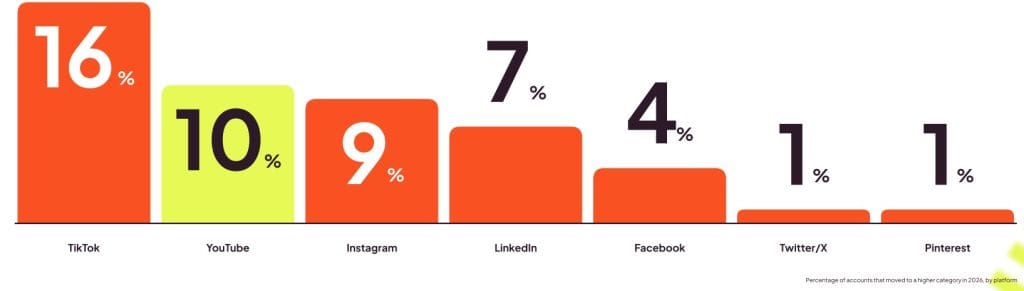
Compared to other platforms, YouTube’s 10.08% growth rate sits second only to TikTok (16.47%) and ahead of Instagram (8.93%), LinkedIn (6.89%), and Facebook (3.86%). That’s a meaningful signal for a platform where people find content through active search and recommendations rather than passive scrolling, which can make a YouTube subscriber more valuable than a follower elsewhere.
2. More Views, Less Watch Time
One trend defines YouTube in 2026: more people are pressing play, and staying for less time. It shows up in both formats.
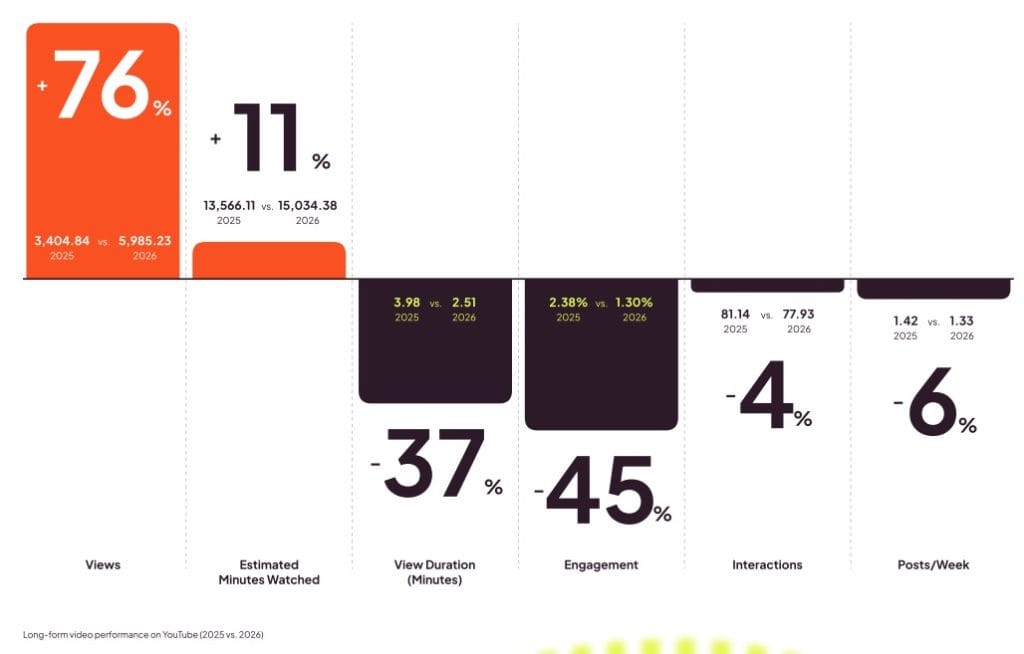
Long-form views rose nearly 76%, and estimated minutes watched went up almost 11%, so total consumption is growing. But average view duration fell about 37%, from 3.98 minutes to 2.51. Engagement dropped 45% over the same window. Viewers are arriving, but they aren’t sticking around the way they used to.
Shorts tell a sharper version of the same story. Views jumped more than 127%, while average view duration fell about 67%, down to roughly 16 seconds per Short, which is 32 seconds shorter than a year ago. That’s close to three times less watch time per video. Interactions slipped 15%. The content is reaching more feeds, but people are swiping away sooner.
3. Long-Form Video: Views Are Up, but Revenue Is Down
The rise in long-form views hasn’t translated into more money. Ad impressions fell 51%, monetized playbacks dropped 59%, and estimated ad revenue was down 55%.
The drop in watch time explains a lot of it. When viewers spend less time on each video, there are fewer openings for mid-roll ads, and fewer ads served means less revenue per view. Higher view counts alone don’t pay off if those views are shorter.
The picture also changes by account size. Tiny accounts saw the biggest jump in views, up 267%, but those views look thinner: average view duration fell more than 58% and engagement saw the steepest drop of any tier. Small accounts went the other way. Their views grew more modestly, but they were the only segment where view duration rose (about 13%) and interactions climbed (nearly 14%), a sign that their content genuinely holds the audience it reaches.
4. Shorts Are Growing Fast, and Small Accounts Are Winning
Shorts are light, quick to make, and built for fast consumption, and brands leaned into them hard in 2026, raising posting frequency by more than 20%. The payoff came in reach, with views up more than 127%.
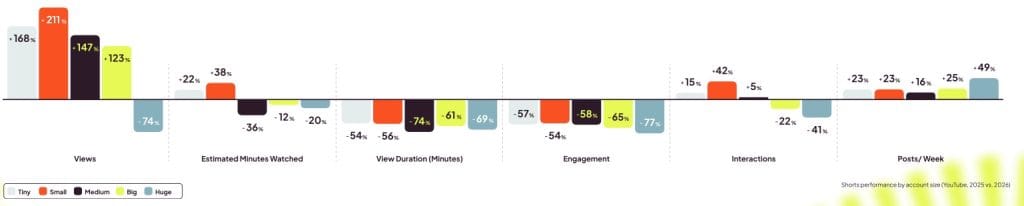
The clearest opportunity is for smaller channels. Accounts with under 10,000 subscribers saw the strongest gains across the board. Small accounts grew their Shorts views more than 200% and their interactions by 42%. The algorithm doesn’t weigh how long you’ve been around or how many subscribers you started with. It rewards how people respond to each video, so a Short that connects with a small audience can reach a much larger one.
The catch is that watch time per Short is falling for every account size, and everyone is posting more. So the opening is real, but it goes to the accounts that make people stop and watch, not the ones that simply publish the most.
5. The Shorts Feed Now Drives Most Discovery
More than 61% of all organic views in the sample came from the Shorts feed, which makes the Shorts algorithm the single biggest force in how content gets discovered on YouTube today.
The next largest sources are subscribers (11%) and YouTube search (9%). Those are smaller in volume but highly intentional: people watch because they already follow you or because your video matches what they searched for. Related videos (5.77%) and playlists (5.05%) fill in more. Only about 3% of views come from someone visiting your channel directly to find a video.
In a system where most traffic depends on algorithmic recommendations, working with the algorithm is the main thing that decides whether your content gets found.
6. How Often to Post
Publishing every day won’t automatically get you better results. The data points to a clear range where the effort pays off, and it differs by format.
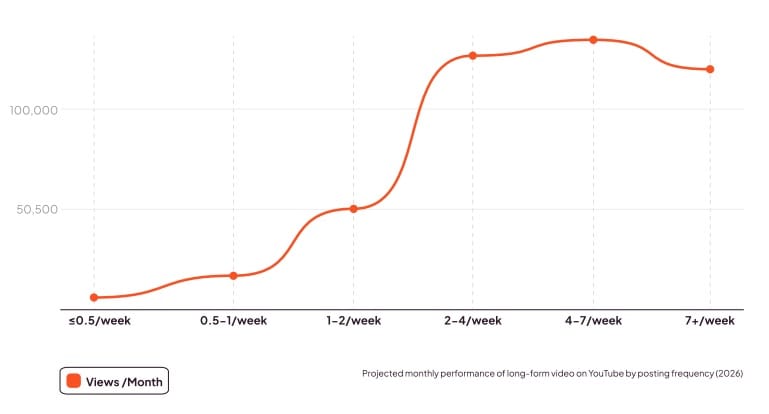
For long-form video, each individual video performs best at 2 to 4 posts per week, averaging 10,552 views per post. Looking at a full month, 2 to 4 posts per week remains the most efficient range: moving up to 4 to 7 posts per week takes noticeably more content and returns only about 6% more views. Posting more than 7 times a week actually pulls total monthly views down. On the other end, publishing less than once a week gives the weakest monthly result, since a single video ends up carrying your whole month.
Shorts behave differently. Each Short performs best per post at 2 to 4 uploads a week, but there’s no real ceiling on the monthly total. The more you publish, the higher your monthly views tend to go, because Shorts live in an infinite-scroll feed where every upload is another chance to appear. So the tradeoff comes down to how much you can produce without letting quality slip.
- Long-Form Video: aim for 2 to 4 posts a week for the best return on effort
- Shorts: start at 2 to 4 a week, and scale up if you can keep the quality high
7. Posting Shorts Can Lift Your Long-Form Views
Shorts don’t just perform on their own. They appear to help your long-form videos too.
Channels that publish no Shorts average 4,364 views per long-form video, below the global average of 5,985. Channels posting around 5 Shorts a month climb to 8,789 views per long-form video, about 46% above the global average.
There’s a limit, though. Channels posting 35 or more Shorts a month see their long-form performance fall back to roughly the same level as channels posting none. Correlation isn’t causation here, and channels that post Shorts may simply be more consistent overall. But the pattern is steady enough to act on: if you’re not publishing any Shorts right now, it’s worth testing a modest cadence and watching what happens to your long-form numbers.
8. Hashtags Play a Minor Role
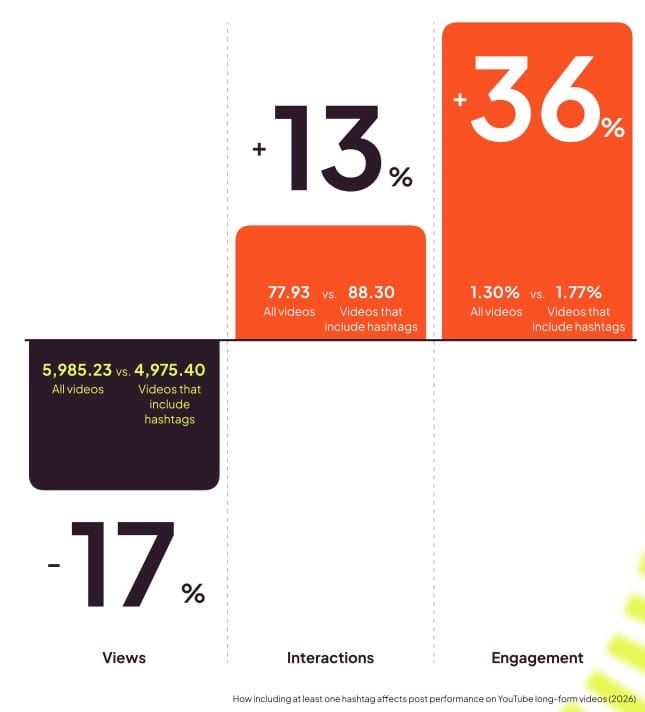
Hashtags aren’t among the signals YouTube weighs most heavily, and the data reflects that. On long-form videos, posts with hashtags saw views drop about 17%, while interactions rose 13% and engagement per view went up 36%.
That trade makes sense. Someone who reaches your video through a hashtag already has an interest in the topic, so they’re more likely to engage even though the raw view count is lower. For long-form, stick to 1 or 2 hashtags tied directly to your product or subject.
Shorts follow the same shape. Posts with hashtags got about 10% fewer views but nearly 9% higher engagement. For Shorts, the algorithm pays more attention to how viewers respond in the first moments than to the tags themselves. If you use them, keep it to between 1 and 5 that are actually relevant.
9. YouTube Content Has a Long Life
Most social platforms give a post a few days before it fades. YouTube works differently.
A video usually hits its peak in the first three days, when the algorithm pushes it to subscribers and similar viewers. That’s when most of your interactions arrive: roughly 83% of them show up within the first ten days. After that initial spike, the pace slows and then levels off, and YouTube keeps testing the video with broader audiences through suggested content.
That’s the part worth planning around. If your content stays relevant and your keywords are well chosen, a video can keep pulling views for months or even years, just at a steadier, quieter rhythm. It’s a reason to treat titles, thumbnails, and descriptions as long-term investments rather than launch-day decisions.
10. The Best Times to Post
Most brands publish long-form video between 10 a.m. and 4 p.m., which makes that the busiest posting window on the platform. For Shorts, activity shifts later, with most content going up between 2 and 6 p.m.
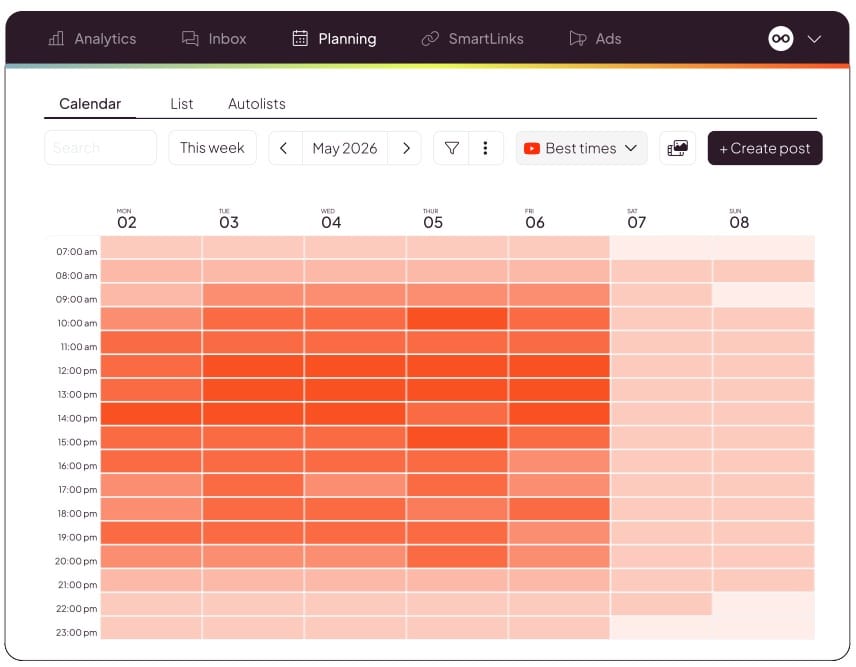
You can use those windows two ways. Post inside them to ride the periods of highest activity, or step outside them to avoid the crowd and give your content a less contested slot. Either can work depending on your audience, so it’s worth testing both against your own analytics.
What These YouTube Trends Mean for Your 2026 Strategy
Pulling the findings together, a few priorities stand out for the year ahead:
- Design for Retention First: views are rising while watch time falls, so the accounts that hold attention in the opening seconds are the ones pulling ahead
- Use Shorts as a Discovery Engine: with 61% of views coming from the Shorts feed, a steady Shorts cadence is one of the strongest ways to get found, especially for channels under 10,000 subscribers
- Match Your Cadence to the Format: 2 to 4 long-form videos a week is the efficient range, while Shorts keep rewarding higher volume as long as quality holds
- Pair the Two Formats: around 5 Shorts a month lines up with a meaningful lift in long-form views, so treat them as parts of one plan rather than separate tracks
- Play the Long Game: because YouTube content keeps earning views for months, well-chosen titles, thumbnails, and keywords pay off long after publish day
Schedule and Track Your YouTube Content
Everything above is only half the job. The other half is seeing how your own content performs, because that’s what tells you where to adjust and where to spend more of your time.
With Metricool, an official Google partner, you can schedule long-form videos and Shorts alongside your other channels and track how they perform from a single dashboard, instead of jumping between tabs and spreadsheets. You’ll see which formats hold attention, where your views come from, and your best personalized hours to post. From there, the next move usually becomes obvious.
Conclusion
YouTube in 2026 is busier and more competitive, and attention is harder to hold than it used to be. It’s also still one of the best platforms for building an audience that lasts, as long as you’re willing to rethink how you publish.
If you want your strategy to work this year, design for retention over reach, treat Shorts as your discovery engine, and give your best videos the long runway YouTube offers. Match your posting to the format, write titles and descriptions people actually search for, and let your own analytics guide your timing.
Now it’s your turn to dig into the full study, adjust your strategy, and pull your own conclusions from the data.
