

Instagram SEO Strategy Guide: Ranking On and Off the Platform
 Gretchen Oestreicher
24 June 2026
Gretchen Oestreicher
24 June 2026 
The way we find information has changed a lot. In 2026, Gen Z is more likely to search for a new coffee shop, skincare routine, or marketing tutorial on social media than on a traditional search engine. And even millennials who still use Google for search are often led to social media for the answers. This is why Instagram SEO has never been more important, especially for social media managers and business owners relying on relevance for revenue.
Hopefully you’re not asking “what is Instagram SEO?”, but if you are, that’s fine (…and welcome to the 2020s). This guide will help you understand Instagram SEO and how it can help your content reach more people on and off the platform.
What Is Instagram SEO?
Instagram SEO is the process of optimizing your content and profile to rank higher in Instagram’s search results and reach your target audience more effectively. While SEO principles can be applied across social media platforms, each network has its own unique algorithm and set of rules.
The goal of Instagram SEO is to ensure your content appears at the top of relevant searches on the platform. Just like traditional search engine optimization. When users search for a specific question, topic, or issue, the top-ranking content is more likely to receive interactions and engagement
3 Key Ranking Signals for Instagram SEO
Before we give you the practical instagram seo tips you’re here for, it is important to understand what the platform is looking for when it ranks content. The algorithm considers three primary signals:
- Relevance to the search query: This is the most important factor. How well does your text (bio, captions, hashtags) match what the user typed in the search bar?
- User activity: If a user frequently engages with sports content, the search results will prioritize sport content accounts that have high engagement rates.
- Post engagement info: A post that has high shares and saves for a specific keyword will rank higher than a post with the same keyword but low engagement.
Building an Instagram SEO Strategy
A successful instagram seo strategy needs a consistent approach to how you label and describe your brand. Here is how to build a framework that ensures your content is always search-ready.
The Profile Audit
Your profile is your home page. If your home page isn’t optimized, the rest of your content will struggle to rank.
- Handle and Name Field: Your handle (@username) should be your brand name. However, your Name Field (the bold text under your profile picture) is prime real estate. Do not just put your name; put your primary keyword there. For example, instead of “Jane Doe,” use “Jane Doe | Social Media Content Strategy Consultant.”
- The Bio: Your bio needs to be a keyword-rich summary of what you do. Use natural language, but ensure your top 2 to 3 Instagram SEO keywords are included. This helps the platform categorize your account immediately.
Don’t forget to add a link to your website or online store. Tools like Metricool’s SmartLinks allow you to add multiple links to a single page. You can customize the background, change themes and colors, and even include images. With SmartLinks, you can share a variety of content without worrying about Instagram’s one-link-in-bio limitation.
Finding Your Instagram SEO Keywords
You cannot optimize without knowing what your audience is searching for. Finding the right instagram seo keywords requires a mix of intuition and research.
- The Search Bar Method: Start typing a broad term related to your business into the Instagram search bar. The “suggested” terms that appear below are the most common searches. These are your target keywords.
- Competitor Analysis: Look at the top-ranking posts in your niche. What words are they using in their first two lines of text?
- Category Research: Go to the Explore page and click on different category tabs. Note the language Instagram uses to describe these categories.
Here’s a breakdown of keyword types and how to align them with your goals:
| Keyword Type | Example | Goal |
| Broad Keywords | “Digital Marketing” | High volume, high competition, but greater reach potential. |
| Niche Keywords | “Email Marketing for SaaS” | Lower volume, potentially high traffic, high conversion potential. |
| Local Keywords | “New Jersey Interior Design” | Local reach, high conversion potential. |
| Intent Keywords | “How to start a podcast” | Targets specific user intent, high conversion potential. |
Instagram SEO Content Optimization Guide
Once your profile is set, every post you publish needs to follow instagram seo optimization rules. This ensures that even your old content continues to bring in new followers months after it was posted.
Optimizing Captions
Gone are the days of one-emoji captions. In 2026, the caption is the most important piece of metadata you provide.
- Keywords at the top: Place your most important keywords in the first sentence. The algorithm values the beginning of the caption more than the end.
- Natural Language: Do not engage in “keyword stuffing.” The algorithm is smart enough to recognize spam. Write for humans, but include the terms that signal the topic clearly.
- Descriptive Language: Describe exactly what is happening in the image or video. If you are showing a “vegan pasta recipe,” use those exact words.
The Role of Hashtags
Hashtag performance is experiencing a noticeable decline on Instagram, with our 2026 Instagram study showing that posts relying on them see 32% fewer views and 34% fewer interactions. While this striking performance gap represents a clear correlation rather than a definitively proven cause, it signals a major shift in user behavior. Profiles that still lean heavily on massive blocks of tags might simply be missing out on newer optimization practices that the algorithm now prioritizes.
This shift comes as Instagram focuses heavily on indexing text captions through direct keyword search. Furthermore, public posts now appear in Google and Bing search results, meaning the descriptions you write drive brand discovery far beyond the app itself.
To maximize your organic reach, prioritizing clear, natural language embedded with business-specific keywords is essential. Simply put: Instagram SEO has arrived, and copy relevance is the new standard for content distribution.
- Quantity: Use 3 to 5 highly relevant hashtags rather than 30 generic ones.
- Relevance: Ensure the hashtag matches the keywords in your caption. If your caption is about “Morning Routines,” using #travel is a confusing signal that can hurt your ranking.
Does Alt Text on Instagram Help SEO?
This is one of the most common questions from marketers. Does alt text on Instagram help seo? The answer is a definitive yes.
While alt text was originally created for accessibility (to help visually impaired users understand the content), it now serves as a major secondary signal for the algorithm. When you write descriptive alt text, you are providing a direct “read” of the visual content to the machine.
How to add it: When you are on the final screen before posting, go to “Advanced Settings,” then “Write Alt Text.” Describe the image as if you were explaining it to someone over the phone, and weave in a keyword if it fits naturally.
Instagram Video SEO: Ranking Reels
In 2026, video is the dominant format. Because of this, the platform has become very good at “reading” what happens inside a Reel. Focus on these features to ensure your Reels appear first in searches.
- On-Screen Text: The words you type over your video are scanned by the algorithm. Use your keywords in your headlines and captions within the video itself.
- Transcripts and Audio: If you use original audio, the words you speak are transcribed and used as search data. This is why clear, spoken keywords are an essential part of an instagram seo strategy.
- Captions (Subtitles): Use the built-in “Captions” sticker. This provides another layer of text for the algorithm to index.
3 Advanced Instagram SEO Tips
To stay ahead of the competition, you need to go beyond basic keywords and look at how the overall health of your account affects your search visibility.
1. Consistency and Categorization
The algorithm builds a “profile” of your account over time. If you consistently post about a specific topic, the platform becomes “confident” in recommending you for those search terms. Sudden shifts in content can confuse the categorization process and lead to a temporary drop in search rankings.
2. High-Quality Engagement
Search results prioritize content that people actually like. A post with high “Saves” and “Shares” tells the algorithm that this content is a definitive answer to the user’s search query. Encourage these actions by creating “saveable” content like checklists or “shareable” content like relatable quotes.
3. Geotagging
For local businesses, the location tag is a vital part of instagram seo optimization. When people search for things “near me” or in a specific city, the location tag is the primary signal Instagram uses to serve results. Even if you are an online business, tagging major hubs where your audience lives can help you appear in local discovery.
Finding the Right Instagram SEO Tool
While many SEO tools offer in-depth keyword data, you’ll need more than that if you want to succeed on Instagram. Here are some of the SEO features available with Metricool:
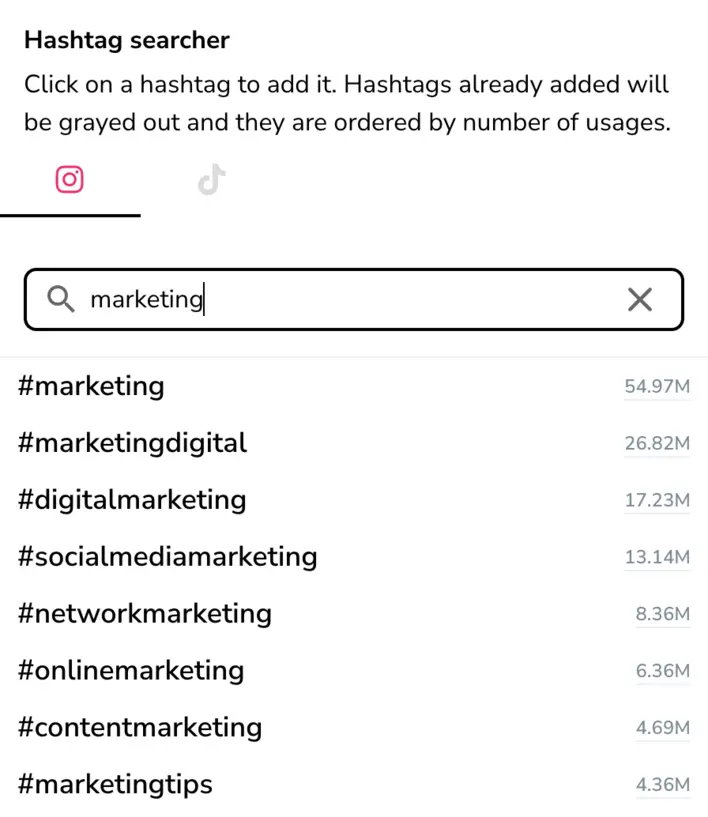
- Hashtag searcher: Find the most popular hashtags for your content. Simply type your keywords in and find the most relevant hashtags, ordered by usage.
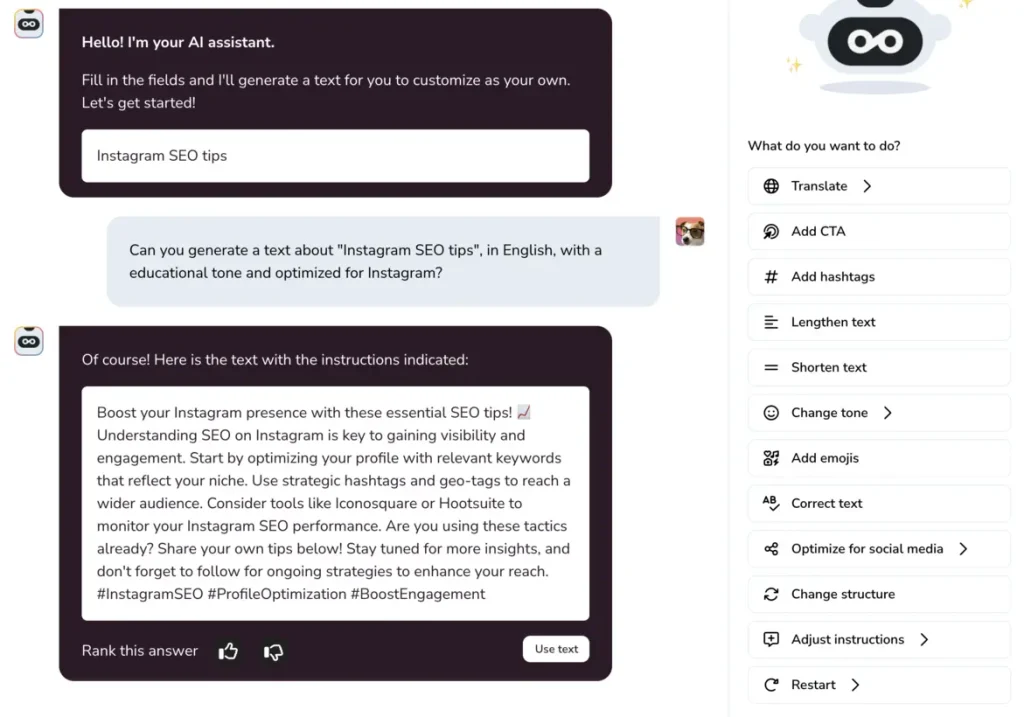
- Write captions and alt text with AI: Metricool’s AI Social Media Assistant can write optimized captions and alt text for your content, to help you reach the right eyes.
- Schedule content for consistency: As we mentioned above, consistent posting is key for Instagram SEO. Metricool’s calendar makes it easy to schedule content in bulk for all your networks.

- SmartLinks: Great Instagram SEO transports your content to the right people, but then what? SmartLinks ensures you don’t waste profile visits, with a fully customizable link-in-bio page that allows you to add multiple links to direct potential clients to.

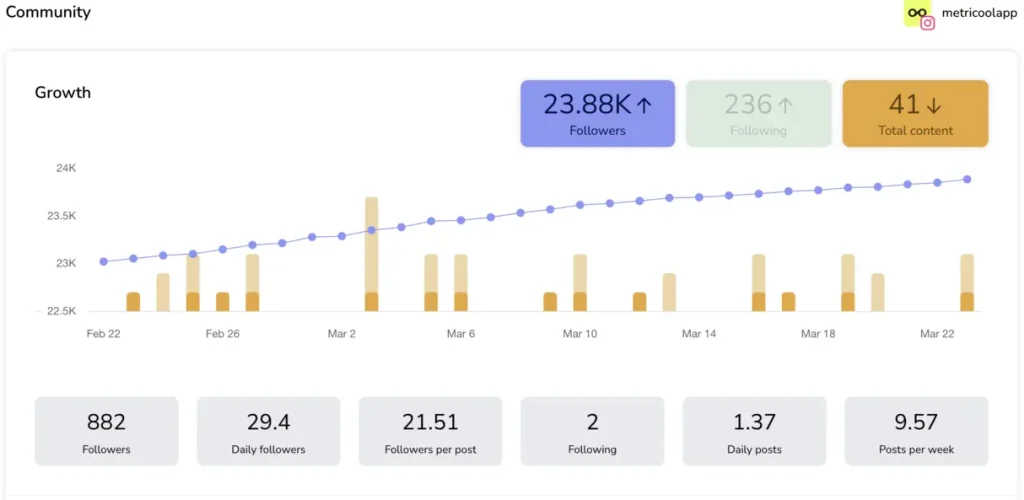
- Analyze results: Assess your content performance with customizable reports at the frequency you need them so you can never stop improving. Double down on what works, or pivot with confidence when needed.
Instagram Content on Google
Instagram has announced an exciting feature for those who optimize their content:
From July 10, 2025, public posts from professional accounts can now appear in Google search results.
This is undoubtedly a big step toward achieving greater organic visibility outside the social network and opens up new Instagram SEO opportunities.
What does this new feature entail?
- It only affects professional accounts.
- These are public accounts.
- It affects users who are over 18 years old.
- It includes photos and videos (including those previously posted in the feed).
- Google can index posts so that they appear in external searches.
- You can enable or disable this option in your account’s privacy settings.

Note: Although this option has been available as an option for some creators for months, it is now enabled by default and search engines like Google can display Instagram content in their results.
How to Disable Indexing of Your Instagram Content
If you prefer your posts not to appear in search engines, there are three ways to prevent Instagram from appearing on Google.
1. Disable indexing of your Instagram account
From your profile, you have the option to disable the indexing of your Instagram account by following these steps:
- Go to your profile and tap the button in the upper right corner (☰).
- Go to Settings and Privacy.
- Go to Account Privacy.
- Tap on Search Engine Content.
- Disable the option “Allow search engines to show your content.”
2. Switch your account from professional to personal
This feature only applies to public professional accounts. If you switch to a personal account, your posts will no longer be indexed by search engines.
3. Switch your account from public to private
When you make your Instagram account private, your content is no longer public and cannot be indexed by search engines. We explain how to do this in the following post:
⚠️ Important: Even if you disable indexing for your Instagram content, the social network does not guarantee that search engines will deindex or remove your content, nor when they will do so. This process depends on each search engine and not on Instagram.
Metrics to Measure for Instagram SEO Efforts
By closely monitoring key performance indicators, you can gauge the effectiveness of your Instagram SEO efforts and make data-driven adjustments to your strategy.
To track the success of your Instagram SEO strategy, focus on the following key metrics:
- Reach: The number of unique accounts that have seen your content
- Impressions: The total number of times your content has been viewed
- Profile Visits: The number of users who have visited your Instagram profile
- Follower Growth: The rate at which you’re gaining new followers
- Engagement Rate: The percentage of your audience that interacts with your content
The 2026 Instagram SEO Checklist
Use this Instagram SEO checklist to ensure your profile and content are fully optimized for discovery.
Profile
- Does my Name Field contain my primary keyword?
- Is my bio written in natural language with 2 to 3 niche keywords?
- Is my account set to “Public” and “Business/Creator”?
Posts
- Does the first sentence of my caption contain my main keyword?
- Is the caption descriptive and at least 2 to 3 sentences long?
- Have I added descriptive Alt Text in the Advanced Settings?
- Are my hashtags (3 to 5) directly related to the keywords in the text?
- Is the visual quality high-resolution?
Reels
- Does the cover image contain clear, keyword-rich text?
- Have I used the “Captions” sticker for spoken words?
- Are the on-screen headlines relevant to the search intent?
