

Social Media Marketing for Universities: Why Social Is Now the Front Door of Your Institution
 Gretchen Oestreicher
18 May 2026
Gretchen Oestreicher
18 May 2026 
Ask a high school junior how they’re researching colleges this year and you’ll hear TikTok before you hear Google. For Gen Z, the TikTok feed has replaced the viewbook, and most prospective students decide whether to apply to your school long before they ever take a campus tour or open your homepage.
The shift this represents is bigger than “post more Reels.” A few years ago, success looked like a polished brand video and a well-staged campus shot. Now it looks like a sophomore filming her dorm room on her phone, captioned in the lower third, getting reshared in a group chat with a cousin who’s a junior in another state. The institutions seeing the most growth in 2026 stopped trying to look like brochures, started treating their feeds like search engines, and handed a lot more of the storytelling to students themselves.
This guide walks through how to build that kind of strategy from the ground up, whether you’re a team of ten or the only person running the entire account.
The Benefits of Social Media for Universities
Before getting into tactics, it helps to be specific about why this work matters and who it serves. Social media does very different things at different points in a student’s relationship with your school, and most teams underestimate how broad that range is.
Recruitment and Enrollment
Most schools think about social as a recruitment channel, and they’re right to. Social meets prospective students at the awareness stage, long before they request information, sign up for a tour, or fill out an application. That early exposure shapes which schools end up on their shortlist in the first place. It also tends to bring down the cost per inquiry compared with print mailers, billboards, and college fair travel. A single TikTok that earns 200,000 organic views does work that would have cost real money five years ago.
Alumni Engagement and Fundraising
What gets less attention is everything that happens after graduation. The relationship with a student doesn’t end at commencement, and social is where it keeps going. Giving Day campaigns now lean heavily on short video, hashtagged challenges, and matching-gift unlocks pushed across every channel.
NC State’s 2026 Day of Giving pulled in about $43.65 million from 18,028 gifts in a single 24-hour campaign, with much of the momentum coming from college- and unit-level challenges amplified across social. Regional alumni chapters live on Facebook. LinkedIn quietly keeps faculty, alumni, and current students connected for decades. When an alum donates ten years after graduation, there’s usually a social thread running through those years in between.
Brand Building
Social is also where your brand gets defined for most people. Prospective students rarely sit down and read your “About” page. They form an impression in 30 seconds of scrolling. A consistent feed communicates what makes your campus distinct, whether that’s a strong research culture, a deep sustainability commitment, or a particular kind of community feel. It’s also how prospective students discover programs they hadn’t considered, like that environmental policy minor or the new design certificate.
Community and Belonging
Not every student lives on campus. Commuters, online learners, transfer students, and study-abroad students build their connection to school life mostly through what they see in their feeds. The same goes for accepted students during that uncertain summer between decision day and move-in, when Discord servers and admitted-student Facebook groups can do real work to reduce summer melt. The first time an accepted student feels like part of the community is rarely orientation. It’s usually online.
Real-Time Updates
When something happens on campus, severe weather, a safety incident, a schedule change, social reaches students faster than email ever will. Most students don’t open campus email on weekends or in the evenings. They do open TikTok and Instagram. For time-sensitive communication, your social channels are no longer a complement to email. In a lot of cases they’re the primary channel.
Building Your School’s Social Media Strategy
A good strategy doesn’t need to be 30 pages long. The teams that struggle most are usually the ones with the most elaborate plans. The teams that do well usually have a few decisions written down clearly, and the discipline to follow through.
Start With One Clear Goal
Every school has a long list of things they want social to do: drive applications, support yield, attract grad students, keep alumni engaged, lift the brand, help with crisis comms, support athletics, recruit faculty. The list is fine. The problem is when all of those goals get equal weight in the same calendar. The result is a feed that’s trying to do everything and ends up doing none of it well.
Pick one or two priorities for the year. If you’re in a rebuilding phase, brand awareness might be the focus. If applications are down in a particular region, lean toward recruitment content for that audience. If your endowment campaign is launching, alumni storytelling moves to the front. Everything else still gets done, but it stops competing for the top slots. This single decision changes more downstream choices than people expect.
Identify Your 3 to 5 Content Pillars
Content pillars are the recurring themes your feed comes back to. They give the calendar structure, prevent decision fatigue, and stop the account from drifting toward whatever’s trending that week. Most university accounts can cover what they need with five:
- Student life
- Academics and research
- Athletics
- Alumni and career outcomes
- Community impact
You can rotate these by week, by day, or by platform. What matters is consistency. Someone landing on your profile for the first time should be able to figure out what your school is about within three posts. If your pillars are clear, they will. If they’re not, that visitor is gone.
Write Simple Social Media Guidelines
A short internal document beats a 40-page brand bible nobody reads. Most teams really only need to cover four things:
- Brand voice (warm, witty, supportive, pick what fits and stick with it)
- Visual identity basics (logo, colors, type, what’s okay to deviate on)
- How to respond to negative comments, and when to escalate
- Who approves crisis posts (with names and a backup person)
That’s it. Two pages, maybe three. Long enough that someone covering the account on a Friday afternoon knows what’s expected. Short enough that they actually read it.
Manage Decentralized Accounts
Most institutions have dozens of accounts: department pages, club pages, sports teams, residence halls, individual professors, study-abroad programs, alumni chapters. Some of them have more followers than the main institutional account. That’s manageable as long as someone keeps an inventory of who runs what.
Set tiered standards. The main account holds the highest bar for visual identity and voice. Clubs and student orgs can have more flexibility. Sunset accounts that haven’t posted in over a year, since they show up in search results and confuse prospective students. And offer light annual training, even a 30-minute session, so the people running the smaller accounts understand brand voice basics and crisis protocols.
Knowing Your Audience
Higher education is one of the few categories where you’re genuinely speaking to several different audiences at once: future students, current students, parents, alumni, faculty, donors. They behave very differently on social media, and the platforms they trust are very different from each other. Trying to reach all of them with one content strategy is what makes most accounts feel generic.
Prospective Undergraduates (Ages 14 to 18)
These students live on TikTok, Instagram, and YouTube Shorts. They’re looking for authenticity, a sense of what the place actually feels like, and peer voices they can trust. They can spot polished marketing from across the room, and the moment something reads as an ad, they scroll past. Phone-shot student footage is the format they take seriously, because it looks like what they already make themselves.
It’s also worth saying this audience is researching schools years before they apply. By the time a student fills out an inquiry form, they’ve often been watching your TikTok content for 18 months. The implication is that awareness-stage content matters far more than most schools assume, even though recruitment-stage content tends to get the bigger budget.
Transfer and Adult Learners
One of the fastest-growing recruitment segments, and one of the most overlooked. Transfer and adult learners spend their time on Facebook, LinkedIn, and YouTube, and they want very different things than a high school junior does. They care about ROI, flexibility, and how their existing credits will transfer. Most of them are working full-time, which means they’re making a real decision about opportunity cost. Content for this group needs to be more practical and more direct: how long does the program take, what’s the schedule, what’s the format, who else does this. The lifestyle-aspirational content that works for 17-year-olds doesn’t move them at all.
Graduate and Professional Students
Found mostly on LinkedIn, YouTube, and niche subreddits. They care about faculty research, program reputation, and the career trajectories of past graduates. They read program pages carefully. They read alumni LinkedIn profiles even more carefully, because that’s the most concrete evidence they have of what your program leads to. Content that highlights faculty work, recent publications, and alumni outcomes in specific fields does better with this group than general campus content ever will.
Current Students
Already on your campus, but still hungry for resources, event info, and real-time updates. Class-specific Facebook Groups and Discord servers do most of the day-to-day work here. Your job is to keep them informed about events, resources, and deadlines without drowning them in promotion they can already see everywhere on campus.
Parents and Families
Facebook is still dominant here, and it’s not close. Parents want reassurance: that the campus is safe, that the investment is paying off, that their kid is okay, and that they know when family weekend is and how to RSVP. Posts that calm parents tend to perform well. So does anything that helps them feel involved without overstepping.
Alumni
LinkedIn, Facebook Groups, and Instagram. The trick with alumni content is segmentation, ideally by graduation year. A class of 2008 alum and a class of 2024 alum are at very different life stages and respond to very different things. One is starting their career and looking for connections, the other is funding scholarships and showing up to reunions. Even loose segmentation here produces a measurable lift in engagement.
Content Best Practices for Universities
Authenticity Over Polish
Phone-shot content usually beats produced content on social, and the gap is wider than most teams expect. People engage more with brands sharing real, unfiltered content. Higher ed teams that invest heavily in production sometimes have the opposite of their intended effect: the content looks expensive, which makes it look like marketing, which makes it underperform a much cheaper student-filmed clip.
This doesn’t mean abandoning production quality. It means using it selectively. The brand sizzle reel still has a place. The day-to-day feed doesn’t need it.
Make Your Feeds Look Like One School
The flip side of authenticity is recognizability. A feed that looks completely different from week to week, or different from one campus account to the next, makes the institution feel scattered. School colors, mascots, type pairings, and graphic marks are the cheapest form of brand recognition you have, and most schools underuse them on social.
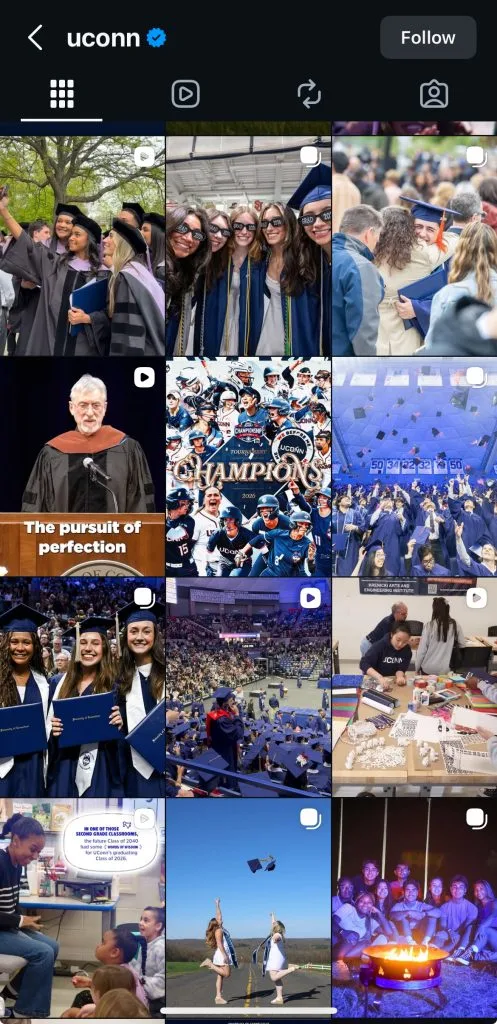
You don’t need a 40-page brand guide for visual identity any more than you need one for voice. Pick the two or three brand colors that show up in most posts, choose one or two type pairings that work on a phone screen, and put your mascot in regular rotation. The mascot tends to overperform on social specifically because it’s instantly recognizable, it’s already part of campus culture, and audiences find it more fun to engage with than a wordmark ever will.
The hardest part of visual consistency in higher ed is the decentralized account reality. Athletics will keep using its own color treatments. Departments will post graphics in PowerPoint defaults. That’s fine. What matters is that the main institutional account, plus the top three to five accounts driving the most reach, hold a recognizable visual style. From a prospective student’s scroll, the institution should still feel like one place.
Feature Real People
Faces stop the scroll. Students, faculty, staff, and alumni are the most powerful visual assets you have, and they cost nothing to use. Stock photography of generic college students walking with backpacks does the opposite. It tells the viewer this could be any school, which is the last thing you want to communicate when you’re trying to stand out.
Lean Into UGC From Across Your Campus Community
The best peer content doesn’t only come from students. Faculty, staff, coaches, athletic trainers, and alumni all post things worth resharing, often without realizing they’ve made anything you’d want.
Encourage students to tag the school in their campus posts. Montclair State University runs a Content Creator Program under #MontclairCreator, organizing Social Media Ambassadors, Student Influencers, and Student Vloggers around a single hashtag that’s easy to monitor and easy to amplify. Pick a few hashtags that are simple to remember and easy to scan, and check them weekly. Reshare faculty research updates, staff “behind the scenes” posts, and alumni career milestones. Always repost with credit, and always ask permission first when a student is identifiable in the content.
Be Trend-Aware, but Stay True to Your Voice
Trends are useful when they fit your brand but they’re awkward when they don’t. The instinct to chase every TikTok sound or format usually backfires, because audiences can tell when an account is reaching. Skip the trends that miss the mark for your audience, and move fast on the ones that genuinely work for what your campus is about. Most trends have a shelf life of a few days, so once you’ve decided to jump on something, speed matters.
Don’t Be Salesy
“Apply Now” in every caption stops working almost immediately. The accounts that drive applications consistently are the ones that build a real community first. Treat the feed like a community, not a funnel. Applications come from the community, but the community has to come first, and the order matters.
10 University Content Ideas to Steal
If you’re stuck on what to post next week, this list will keep you busy for a quarter:
1. “Things I Wish I Knew Before College”
The summer before move-in is when prospective students are most anxious and most actively searching for exactly this kind of reassurance. Have a current student or recent grad list three to five things they wish someone had told them, filmed in their dorm or apartment with no fancy edits. Make the title school-specific (“Things I wish I knew before Madison”) and the same video does double duty as awareness content for next year’s applicants.
2. Degree Speedrun: “My Major in 30 Seconds”
Most prospective applicants can’t tell a marketing major from a communications major from a media studies major until someone shows them, and your program pages aren’t doing that work the way TikTok does. Have a student explain what their major actually involves, fast, in one breath. Real classes, real lab work, real readings. One student per program, single takes, run as a series. Cheap to produce and evergreen on TikTok and YouTube search for years.
3. Day in the Life Vlogs
This is the most-searched higher ed format on TikTok, full stop. Prospective students type “day in the life [school name]” directly into the search bar and watch whatever comes up, so the question is really whether what comes up is yours. Follow one student through one day, and vary the student types so a future engineering applicant sees engineering and a future nursing applicant sees nursing. Hand a creator a phone for the day, cut it to sixty seconds with their voiceover on top, and you have something that performs for months.
4. Honest Cafeteria Food Reviews
Food is the top non-academic concern for prospective students and their parents, and a student rating the dining hall on camera is funny and shareable on its own. The “honest” part really matters, though. If every review is glowing, the audience tunes out and stops trusting the account. Real reviews, including the occasional “this one is not great,” build the credibility that makes the positive ones land.
5. Financial Aid Breakdowns
Financial aid is the number-one source of anxiety for first-generation students and their families, which means clear short explainers travel further here than almost any other content type you can make. Stick to one specific piece of aid per video. How merit aid stacks at your school. What “meets full demonstrated need” actually means in practice. What this year’s FAFSA timeline does to award letters. Put an actual financial aid counselor on camera, because the authority matters here as much as the script.
6. Mental Health and Wellness Resources
Mental health is now a deciding factor for many Gen Z applicants, and seeing real campus resources matters more than reading about them on a webpage. Walk through the counseling center, the meditation spaces, the peer wellness programs, what to do when a week is just rough. Coordinate with your counseling services on framing, post more often during midterms and finals, and keep the tone warm rather than clinical.
7. Study Hacks and Library Spots
“Best study spot at [school]” tour videos are practical, peer-credible, and quietly double as a tour of campus indoor spaces nobody usually shows in a brochure. The hidden corners beat the obvious main library every time. The fourth-floor reading room nobody talks about, the architecture studio at 11pm, the rooftop courtyard, the back booth at the campus coffee shop. Crowdsource these from current students, because you’ll never find them on your own.
8. “Ask a Professor” Q&As
Real questions from prospective or current students, answered by faculty in thirty-to-sixty-second clips. A “submit your question via DM” call works well for sourcing the questions. The format demystifies academics, makes faculty feel approachable, and surfaces what your professors actually research and teach. One thirty-minute sit-down with one professor can produce six or eight short cuts, and the faculty member usually enjoys the process more than they expect to.
9. Alumni Career Trajectories
Where alumni are five, ten, and twenty years after graduation, told in their own words. Vary the paths. A founder, a graduate student, a non-profit director, a high school teacher, a creative who has pivoted twice. Career-outcome content does the most work with transfer students, adult learners, and graduate program prospects who are explicitly weighing the return on a program. Your advancement office can usually surface willing alumni faster than you can find them yourself.
10. Behind-the-Scenes of Major Events
The polished final-product video of an event gets one engagement spike. The BTS content leading up to it gets four or five, because each piece gives the audience a reason to come back. Move-in setup, commencement rehearsal, homecoming float building, big-game prep, alumni weekend logistics. Plan it at least two weeks before the event and put someone on the unglamorous parts: the 6am setup, the dry runs, the team meetings that audiences find surprisingly compelling once you point a camera at them.
Platform-by-Platform Playbook
There’s no single right way to use social media for universities, partly because the platforms reward such different things. Here’s how each one actually works in this category, and what success looks like.
TikTok: The Discovery Engine
TikTok’s algorithm rewards relevance over follower count, which is why small regional schools regularly outperform Ivies on the platform. A small liberal arts college can land a video in the For You feed of a high school junior a thousand miles away who has never heard of them before, on the strength of one well-made clip. That’s the whole game.
The format requirements are straightforward: vertical, captioned, hook in the first 1.5 seconds, and a clear payoff before the viewer’s thumb scrolls past. Three to five posts per week is the floor for any account hoping to grow, because the algorithm needs that volume to keep your content in rotation. Drop below it and growth stalls.
Instagram: Campus Life and Reach
Instagram works as a three-format platform now. Reels handle reach. Stories handle engagement and time-sensitive promotion. Carousels handle education and saves. Most university accounts treat Instagram as their flagship, and that’s fine, as long as they’re using all three formats deliberately. A feed that’s only Reels misses the engagement value of Stories. A feed that’s only Stories has almost no discoverability.
YouTube: Long-Form and Search
The most underused platform in higher ed, and one of the most strategically valuable. Campus tours, faculty lectures, student documentaries, and admissions Q&As all perform well here, and they keep performing for years instead of weeks. There’s a quiet SEO win waiting too: when a prospective student searches “[School Name] dorm tour” or “[Major Name] day in the life,” your video can sit at the top of Google results for the next five years. That’s an asset most accounts forget to build.
LinkedIn: Graduate, Alumni, and Brand
Where graduate and PhD recruitment lives. Also where alumni career stories spread organically, and where faculty thought leadership has the most pull. The tone is less playful than Instagram or TikTok, but it isn’t corporate either. The schools doing well here treat LinkedIn as a place to celebrate alumni and faculty work, which tends to get reshared, which tends to reach the next cohort of graduate applicants.
Facebook: Parents, Alumni, and Groups
Don’t write off Facebook. Parents and alumni are still there in real numbers. Groups still get strong algorithmic priority, often higher than Pages do. The Events feature drives actual RSVPs for things like family weekend, alumni reunions, and on-campus open days. The mistake most teams make is treating Facebook as a duplicate of Instagram. The audiences are different, and the content should be too.
X (Twitter): News and Real-Time
Useful for real-time updates, weather closures, athletics scores, and breaking news. Less useful for sustained recruitment work. Most schools maintain a presence here mostly for the breaking-news use case, and that’s a reasonable use of the platform.
Reddit: Where Honest College Decisions Happen
For a lot of prospective students, Reddit is the number one research platform, more trusted than your website or your TikTok. Future applicants look up r/ApplyingToCollege, school-specific subreddits, and major-specific threads. They ask real questions and get real answers from current students and recent alumni. That conversation shapes a lot of decisions, and most institutions aren’t even tracking it.
Treat Reddit as a listening tool first. Most schools that try to post their way in get flagged as advertising fast, because the community is sensitive to anything that smells like marketing. The value is in monitoring: what are people asking about your school, what concerns come up repeatedly, and how can your content address those concerns elsewhere?
Threads, Bluesky, and Discord: Emerging Platforms
Threads and Bluesky are low-cost to maintain and worth claiming, partly as a hedge against X’s volatility. Don’t expect either to be a primary channel yet. Discord is more interesting: it’s one of the most effective tools for accepted-student communities and for cutting summer melt before move-in day. A well-run admitted-student Discord can do more for yield than most external campaigns.
Pinterest: Overlooked but Valuable
Strong for graduate programs in creative fields like design, architecture, and fashion. Also a quiet favorite among parents doing college research, which most institutions don’t realize. Pins keep driving traffic for months after they go up, unlike almost every other platform.
Student Creators, Ambassadors, and Influencer Programs
If there’s one thing worth investing in it’s building a student creator program. Student-led content consistently outperforms institution-led content, often by multiples, because the audience trusts it more.
Why Student Voices Convert
Peer credibility can’t be faked. Prospective students know the difference between a current student talking about their experience and an admissions office talking about the same thing. The exact same words land differently depending on who’s saying them. A creator program is the most reliable way to put those words in the mouths of people the audience already believes.
Building a Student Creator Program
Recruit across programs, backgrounds, and content styles. A pre-med, a theater major, a transfer student, and a varsity athlete will each reach a different corner of your prospective audience. Run a simple application and audition (a short video submission works), then onboard with basic brand voice guidance and signed image release forms. Don’t over-train them. The reason their content works is that it sounds like them, not like a brand.
How to Pay Student Creators
Pay them. “Exposure only” stopped being acceptable years ago, and it tends to produce low-effort content anyway. Options include:
- Stipends or hourly pay (often work-study eligible)
- Scholarship credits or tuition discounts
- Swag and portfolio-building opportunities
The good news is student creators are usually thrilled to work with their own school, so the rates don’t have to match outside influencer fees. Montclair State’s Social Media Ambassadors earn $750 per semester, which is meaningful to a college student without coming anywhere near the rates outside creators in their 20s would charge.
What to Have Student Creators Do
- Account takeovers, especially during move-in week, finals week, and commencement
- Co-created Reels and TikToks tied to your content pillars
- Real-time coverage of major events like game days and admissions weekends
External Influencer Collaborations
Beyond your own student creators, local or regional creators can work well for awareness campaigns, particularly for transfer or adult learner recruitment. Alumni-turned-creators are an underused angle: an alum with 50,000 followers who graduated from your school and still loves it is one of the most credible voices you can find. TikTok Spark Ads let you boost a student creator’s best post to a wider audience without losing the organic feel that made it work in the first place.
Paid Social and Full-Funnel Campaigns
Organic reach on Meta platforms has been shrinking for years, and that trend isn’t reversing. You can post great content and still see fewer people each year if you’re relying purely on organic. Paid ads are how you guarantee visibility during the windows that matter most: open days, application deadlines, and yield season.
The Full-Funnel Framework
Paid social really comes down to three jobs. The first is getting people to notice your school at all, which mostly shows up as video views and reach. The next is turning that recognition into action, which means tour signups, RFI form completions, and event registrations. The last is closing the gap with people who already know you, getting them to start an application or put down a deposit.
Different platforms and creative formats are better at different jobs. A flashy TikTok video meant to show up in someone’s For You feed is great for getting noticed. A Meta ad reminding someone about an upcoming application deadline is great for closing. Trying to use one for the other usually disappoints, because each piece of creative was built for a different moment in the journey.
TikTok Ads
Three formats do most of the heavy lifting on TikTok. In-Feed Ads are the ones that show up in someone’s For You feed, and they work especially well for campus life content because they blend in with the videos around them. Spark Ads let you put paid spend behind your best-performing organic posts, which is often the highest-converting move you can make, especially when the post in question came from a student creator who already had reach. And TopView Ads are the big takeover format that opens the app when someone in your target audience launches TikTok. Save those for open days and application deadlines, since they’re expensive but unmissable.
Meta Ads (Instagram and Facebook)
On Meta, Reels and Stories ads usually outperform standard feed ads for prospect audiences, because they blend in with the content people are already scrolling. The most efficient targeting available is what Meta calls a “lookalike” audience, which means showing your ads to people who look statistically similar to your current students. You can build one from your CRM data. The other audience worth your time is retargeting: ads aimed at people who already visited your site but didn’t fill out an inquiry form. That group tends to deliver the lowest cost per application of any audience you can buy.
LinkedIn Ads for Graduate Programs
For graduate programs, LinkedIn is where the ad spend earns its place. Sponsored Content (regular posts you’ve put budget behind) and Lead Gen Forms (forms that fill themselves in from someone’s LinkedIn profile so the prospect doesn’t have to type) are the two formats that do most of the work. Target by job title and industry for MBA, executive education, and certificate programs. The cost per lead runs higher than on Meta, but the leads tend to be much more qualified, because LinkedIn’s targeting is unusually precise.
When to Scale Paid in the Academic Year
Three windows tend to pay back the hardest:
- Yield season (after acceptance, before deposit), where retargeting and admitted-student-focused creative does the most work
- Summer recruitment, especially for transfer and adult learner programs
- Application deadline pushes, especially the two weeks before the deadline
Outside of those windows, paid campaigns can still build awareness, but the ROI on a given dollar tends to be lower.
Social Media Tools, Workflow, and Team Structure
The Modern Higher Education Social Team
A full team would include a strategy lead, content creators (including student creators), a community manager handling DMs and comments, paid media support, and an analytics lead. Most institutions don’t have that. Most have one person wearing all five hats, sometimes two if they’re lucky. That’s manageable when the priorities are clear and the workflows are simple, and almost impossible when neither is.
In-House vs Agency vs Hybrid
In-house teams tend to win on community, daily content, and crisis response, because they’re closer to what’s happening on campus. Agencies tend to help most with paid media and high-end video production, where specialized skills make a real difference. Hybrid is the most common setup at mid-size schools, and it usually works well when responsibilities are written down clearly and one person on the in-house side owns the relationship.
Pick a Social Media Management Platform
What you really want is one place where every message and comment from every platform lands, so you can answer without app-switching. One calendar for scheduling across TikTok, Instagram, LinkedIn, and the rest. One approval flow that covers the dozens of accounts on campus. And analytics you don’t have to assemble from five different dashboards every Monday morning. If you’re using Slate or Salesforce on the admissions side, a tool that talks to those is worth the extra evaluation time.
Metricool covers all of that and is built around managing many accounts at once, which fits how higher ed teams are usually structured.
Content Production Stack
Editing tools like CapCut, Adobe Premiere Rush, and Canva cover most of what a higher ed team needs day-to-day. A shared Google Drive folder or a simple asset library works for storage. You don’t need to overbuild this part.
Workflow Essentials
A few habits separate teams that ship consistently from teams that always feel behind. Build your editorial calendar around the academic year, not the calendar year, because that’s the rhythm your audience lives in. Batch your filming. One good filming day can produce ten posts, and once they’re cut, you can queue the whole month up in Metricool in a single sitting instead of logging back in every few days to publish. Create a simple intake form for departments and clubs requesting content, so requests don’t come in as random Slack messages at 4pm on a Friday. None of this is fancy. All of it adds up.
Team Up With Your Athletics Account
At a lot of schools, the athletics account quietly outperforms the main institutional account by a wide margin, sometimes 5 to 10 times the followers and engagement. That’s a huge audience you don’t have to build from scratch. Coordinate with athletics on cross-promotion: share their highlight reels on the main account, tag them in campus content, and ask them to feature non-athletic campus moments now and then. Joint posts and Collab features can drive serious reach back to the institutional brand. This partnership is one of the highest-ROI things a university social team can build, and most don’t.
Partnering Across the Rest of Campus
Admissions, advancement, student life, communications, and academic departments all generate stories that belong on your channels. The way to surface those stories without becoming a content reception desk is a quarterly content meeting plus a shared calendar everyone can see. Once departments know they have a regular slot to bring ideas, they stop sending one-off requests, and your calendar fills up with content you didn’t have to chase.
Measurement and ROI Made Simple
This section is for people who don’t live in spreadsheets, which is most people running university social accounts.
Start With Three Numbers
You don’t need 30 metrics. You really only need three:
- Reach: how many unique people saw your content
- Engagement Rate: likes, comments, shares, and saves divided by reach
- Conversions: inquiries, applications, event signups, or donations attributed to social
Track those three consistently and you’ll know more about your account than most higher education teams do about theirs.
A Simple Goal Framework
For each goal, pick one metric and stick with it.
- If the goal is more applicants, track inquiry form submissions from social
- If the goal is stronger brand, track reach and engagement rate over time
- If the goal is alumni giving, track gifts attributed to social campaigns
The framework is purposely boring. The discipline of picking one metric and watching it move over time is where the real insight comes from.
How to Tell If a Post Worked
Compare a post to your own recent average, not to someone else’s benchmark on LinkedIn. A post is working if it beats your last 30 days of similar content. That’s the only honest comparison you can make. Look for patterns over time: what topics, what formats, what posting times consistently outperform your average? Those patterns are your strategy, even if nobody wrote them down yet.
Connect Social to Real Outcomes
Use UTM links on every social post that drives to your site, so Google Analytics shows you which traffic came from where. Add a “How did you hear about us?” question to inquiry and application forms. Those two simple habits will tell you more about social ROI than any dashboard, because they connect what happens on social to what happens in your CRM.
A Reporting Cadence That Won’t Burn You Out
Checking your analytics every day isn’t sustainable. Aim to check in with your data:
- Weekly (15 minutes): a quick look at what worked and what didn’t
- Monthly (1 hour): review top posts, paid performance, and follower growth
- Quarterly (half a day): check progress on your big goal and adjust strategy if needed
Anything more than that and you spend more time reporting than posting. Most of this can be automated. Metricool can send scheduled reports straight to your inbox on whatever cadence you set, so those 15 weekly minutes go to reading the data, not assembling it.
Benchmarks to Aim For
Instagram engagement rates in higher education average between 1% and 3%. TikTok runs higher, with 4% to 8% being a solid range. Try not to get too attached to benchmarks though. Your own trend line tells a more useful story than someone else’s average ever will, because it’s the only number that reflects your actual audience.
Trends and What’s Next for 2026 and Beyond
AI Becomes a Recruitment Channel
Prospective students are already asking ChatGPT, Perplexity, and Google AI Overviews questions like “What’s the best school for marine biology?” Those tools answer with specific schools, and the schools they cite are the ones with strong topical authority across the web. Ranking on Google still matters. Getting cited by AI models matters more every quarter.
Build that authority through consistent content on your owned channels, encourage authentic UGC and Reddit conversations (which feed AI training data), and use AI tools yourself for drafting captions, surfacing trends, and speeding up social listening. Keep a human in the loop before anything goes live. The goal is to use AI for the parts that don’t need a human touch, so you have more time for the parts that do.
Social Search Is Overtaking Google
Students increasingly skip Google for TikTok and Instagram search. They search “best dorms at [school name]” inside TikTok now. Treat your social profiles like SEO assets: keywords in captions, keywords in bios, and consistent topical content that builds discoverability over time. A lot of the traffic that used to arrive through Google is now arriving through search inside social platforms.
Vertical Video Becomes the Default
Short-form vertical content now dominates every major platform, including LinkedIn. Build your production pipeline around 9:16 first and adapt down to other formats as needed. Trying to do it the other way around, shooting horizontally and cropping later, almost always produces worse content.
Creator-Led Institutional Brands
Student and faculty creators take on more of the content load each year, and the institutions handling this well have stopped resisting it. That means less centralized brand control and more orchestration. The social team functions less like a publisher and more like a producer: matching the right people with the right ideas, supporting them, and amplifying what they make.
Gen Alpha Enters the Funnel
Today’s middle schoolers will start showing up in your awareness data by late 2026. They grew up with AI, with vertical video, and with social search baked in from the beginning. By the time they’re applying, the strategies that work for Gen Z may not work for them. It’s worth starting to think about how you’ll talk to them now, while you still have time.
Putting It All Together
Social media marketing for universities has shifted from a publishing job to a community job. The institutions winning in 2026 share a recognizable pattern. They show real campus life through real people. They listen as much as they post. They treat their feeds like the front door of the school. Budget helps, of course. Discipline and authenticity matter more.
Start small if you need to. One goal, three content pillars, a few student creators, a consistent posting cadence. The rest builds from there. You don’t have to do everything in this guide in the first year. You just have to start doing some of it consistently.
Keeping all of that organized takes its own kind of work: scheduling posts across platforms, tracking engagement, monitoring what’s being said about your institution, and reporting on what’s working. A tool like Metricool pulls your social presence into one place, so you spend less time switching tabs and more time creating content that connects.
Higher education social media is a lot of work.
From planning content across every platform to tracking what’s working across every account, Metricool brings the daily work of higher ed social into one place built for the way these teams operate.
