

How to Grow on YouTube in 2026: A Data-Backed Guide to Growing Your Channel
 Gretchen Oestreicher
12 August 2026
Gretchen Oestreicher
12 August 2026 
Growing a YouTube channel in 2026 comes down to two jobs: getting in front of people, which is easier than it’s been in years, and holding their attention once you’re there, which is harder. More people are reaching your videos, mostly through the Shorts feed, but they watch for less time on every format now.
Everything below is drawn from Metricool’s 2026 YouTube Study, 799,718 videos across 71,177 accounts, and it covers both sides of growing on YouTube: getting discovered, then turning those views into subscribers.
Get Discovered on YouTube
The biggest shift on YouTube is where views come from, so this is where growth starts. Get these levers right and people actually see your work. Miss them and even strong videos stay invisible.
Publish Shorts, Even if Long-Form Is Your Focus
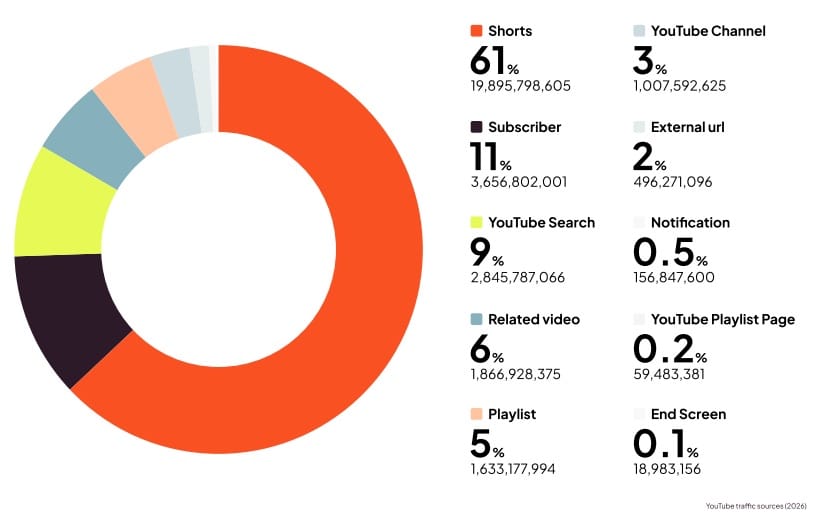
YouTube Shorts are the main way people find you now, so if long-form is your world, this is the highest-upside change you can make. About 6 in 10 organic views on the platform come from the Shorts feed, more than search, subscriptions, and suggested videos put together, and Shorts views more than doubled in a year. Skip them and you’re leaving your biggest source of new viewers untouched.
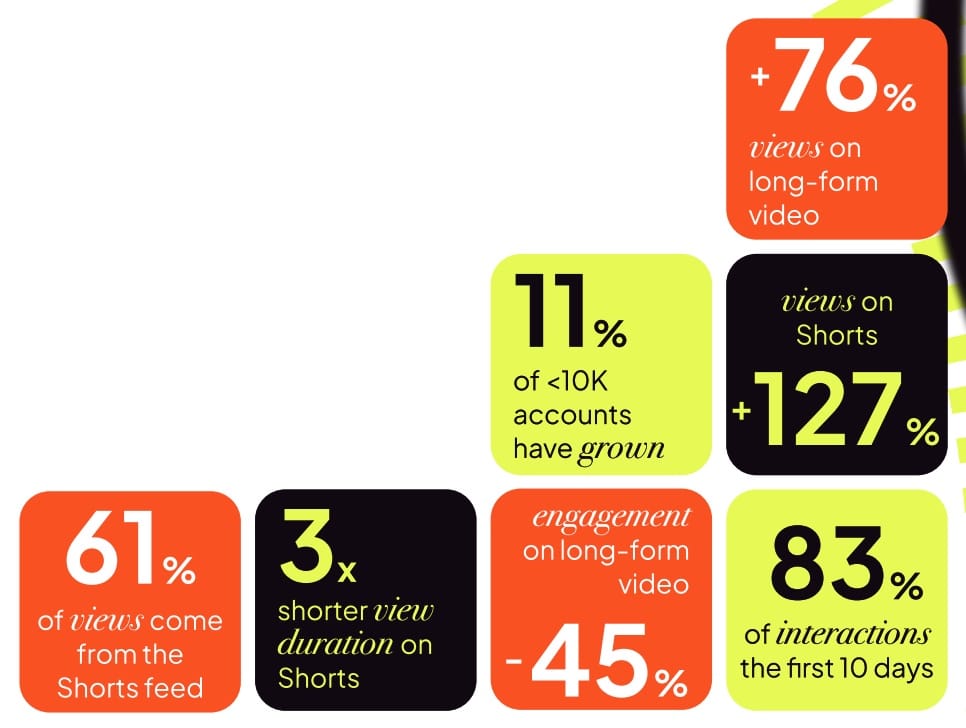
Being small is an advantage here, which isn’t true of much else on YouTube. Accounts in the 2K to 10K range grew their Shorts views by more than 200%, faster than any bigger tier. The feed doesn’t care how long you’ve been around, only whether people stop and watch, so a new channel can break out with a Short as easily as an established one.
A few Shorts a month also pull your long-form videos up. Channels posting around five Shorts a month average 8,789 views per long-form video, about 46% above the typical channel, while channels posting none sit below average. Push past 35 a month, though, and the lift disappears back to where it started. So the move is a handful of strong Shorts, not flooding the feed.
- Turn each long-form video into two to four Shorts built from your best moments.
- Lead with the hook in the first second, since watch time per Short keeps shrinking.
- Shoot vertically (9:16) so the video fills the phone screen.
- Loop the ending back to the opening when it fits, which nudges viewers into a second watch.
- Point viewers from a Short to the full video with a pinned comment or a clear on-screen line.
Find the Posting Frequency That Pays Off
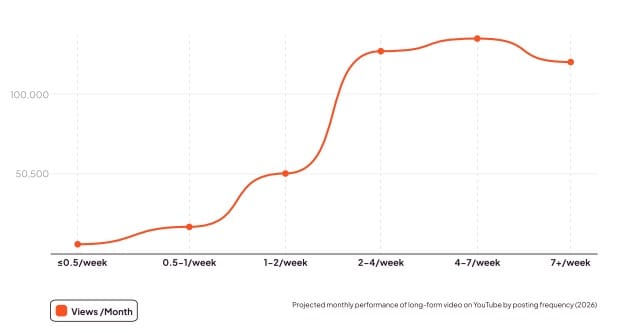
For long-form, more uploads stop paying off sooner than you’d expect. Two to four videos a week is where each one performs best. Bumping up to four to seven barely moves your monthly views, about 6% more for a lot more filming, and past seven a week your total views actually drop. If you’re wearing yourself out on a near-daily schedule, the data says ease off and put that time into fewer, stronger videos.
Shorts work the other way. There’s no clear ceiling, so the more you post, the more monthly views you tend to pick up, since every upload is another chance to surface in the feed. The only real limit is how many you can make before quality slips.
- Long-form: aim for two to four solid videos a week.
- Shorts: post as often as you can keep up without cutting corners.
- Pick a rhythm you can hold for months, since consistency is what the algorithm rewards.
Post When Your Audience Is Active
When you post on YouTube matters less than what you post, but it’s a free edge. Across the study, long-form uploads cluster between 10 a.m. and 4 p.m., and Shorts skew later, around 2 to 6 p.m. Those are the busiest windows, so you can ride the activity by posting inside them or stand out by posting when the feed is quieter. Your own audience’s active hours beat either rule once you can see them.
- Check your analytics for when your viewers are actually online.
- Schedule ahead so videos go out in your window without you at the keyboard.
- Test a few slots and compare first-day views.
Use Hashtags with Intent
Hashtags can quietly cost you views on YouTube, which surprises people. Long-form videos with them pulled about 17% fewer views than those without, though they picked up 13% more interactions, and Shorts showed the same trade. The reason is simple: a hashtag narrows your reach to people already interested in that topic, so you swap a bigger audience for a warmer one. Use them to label what you’re about, not to chase a viral hit.
- Long-form: one or two hashtags tied directly to your topic or brand.
- Shorts: up to five relevant ones in the first line of the description.
- Mix one broad tag with one specific tag instead of stuffing in as many as you can.
Win the Click
Getting shown is half the job. A viewer decides in about a second, and two things carry that decision: the thumbnail and the title.
Design Thumbnails Catch Your Audience’s Eye
With attention dropping across the platform, your thumbnail has one job: make someone stop and pick your video over everything else on screen. It’s the first thing a viewer weighs, often before they read a word of the title.
- Use high contrast and one clear focal point, like a face or a product, that reads at a small size.
- Keep any text to a few large words.
- Repeat the same colors, fonts, and framing across videos so your channel is recognizable at a glance.
- Export at 1280×720 in a 16:9 ratio, under 2 MB.
- Run YouTube’s built-in A/B test, which serves up to three thumbnails and keeps the one with the best watch time.
Write Titles That Earn the Click
Your title turns a browsing viewer into a click, so it has to catch the eye and read clearly at a glance. Work in the words people would actually search for, since that’s one more way for the right viewer to find you, but write for the person first.
- Put the main idea near the front, where it stays visible before the title cuts off.
- Keep it under about 60 characters so it isn’t trimmed in results.
- Use a number or a specific promise where it fits (“7 tips,” not “some tips”).
- A/B test up to three titles per video and keep the one that holds attention.
Keep People Watching
Views are easy to come by in 2026, but watch time is the scarce resource, and it’s the thing sliding hardest across the platform. The goal from here is holding the viewers you’ve already earned.
Hook Viewers in the First Few Seconds
Your opening decides whether anyone stays. The average long-form view got 37% shorter this year and Shorts dropped by about two-thirds, so people are clicking in and bailing fast. The first few seconds have to earn the next ten.
- Open with the payoff, not a slow intro or a long branded animation.
- Tell people what they’ll get, then get to it.
- Tease something that pays off later so there’s a reason to stay.
- Front-load the most interesting moment of a Short into the first second.
Get the Length and Pacing Right
There’s no perfect video length, only the length your content earns. A tight 8-minute video beats a padded 20-minute one every time, because pacing holds attention and dead air loses it. Match the runtime to what you actually have to say, then cut anything that doesn’t move the video forward.
- Let the topic set the length: quick tips run short, tutorials run longer.
- Cut slow intros, repeated points, and filler between ideas.
- Watch your retention graph to see where people leave, then tighten those spots.
Add Chapters and Timestamps
Chapters split a video into labeled sections viewers can jump to, which makes a longer video easier to stay with and lets someone hop straight to the part they came for.
- Add timestamps to the description starting at 0:00, one per line.
- Keep labels short and descriptive, using the words people would search for.
- List them in the order the video runs.
Add Subtitles and Captions
A lot of viewing happens on phones, often on mute, and captions keep your videos working in that setting while opening them to more people.
- Upload an accurate caption file (.srt or .sbv) rather than leaning on auto-captions.
- Fix names, brand terms, and jargon that auto-captions tend to miss.
- Add subtitles in your top one or two audience languages if you’re reaching viewers abroad.
Build Playlists to Extend Watch Sessions
Playlists pull more weight than they get credit for. They drive about 5% of all views, more than people who arrive on your channel page directly, but the real value is what they do to a session: the next video autoplays, so one click can turn into a run of three or four. Group your videos well and you stretch watch time without filming anything new.
- Group videos by topic or series with clear, searchable titles.
- Put your strongest video first to pull people in.
- Give each playlist a description with relevant keywords.
Use End Screens and Cards to Guide the Next Click
Don’t count on end screens and cards to grow the channel. Together they drive almost nothing directly, well under a tenth of a percent of all views. Where they pay off is retention: sending someone who’s already hooked to the next video keeps the session alive. Treat them as a nudge between videos, not a growth engine.
- Point end screens at a closely related video or playlist, not just a subscribe button.
- Place cards at the moment they’re relevant instead of stacking them at the start.
- Keep the layout clean so it doesn’t cover the content. End screens run in the final 20 seconds, so leave room.
Build a YouTube Channel Worth Subscribing To
Discovery brings people in once, but a channel that’s easy to understand and worth returning to is what turns a view into a subscriber. And a YouTube subscriber is worth chasing, since they seek your videos out instead of scrolling past.
Pick a Niche Worth Subscribing To
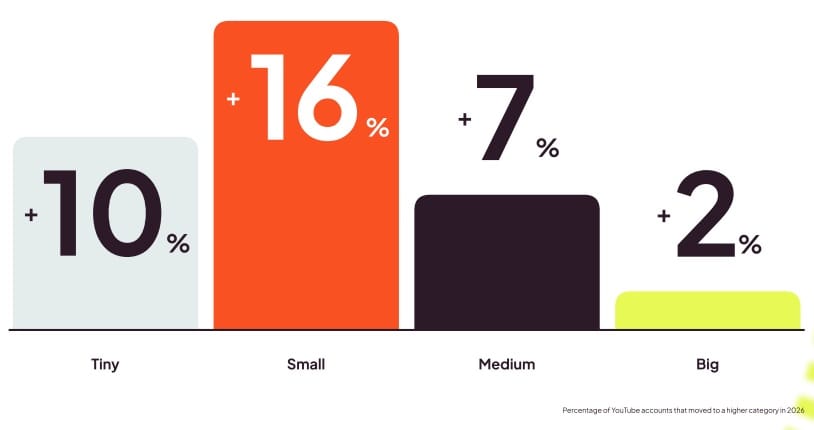
Smaller channels are growing the fastest right now. Accounts in the 2K to 10K range moved up a size tier at 16% this year, ahead of both newer and bigger channels, and they were also the only group whose average watch time rose instead of falling.
The reason tends to be focus: a channel built around one topic, or a tight cluster of related ones, holds a specific audience better than one trying to reach everyone. So pick a niche you can keep making videos in, make it obvious in your first few videos and your channel description, and resist wandering into unrelated topics that confuse the people who just subscribed.
- Choose a topic you can sustain, not just one that’s trending this month.
- Say what the channel is about in the first line of your description.
- Keep new uploads recognizably in the same lane so subscribers know what to expect.
Choose a Channel Name and Handle That Stick
Your name is how people find you again and recommend you to someone else. Pick something that reflects what you make, is easy to say and spell, and matches the handles you use elsewhere so viewers can connect you across platforms.
- Keep it short and easy to spell and say out loud.
- Match it across your social accounts for one consistent identity.
- Claim a custom channel URL once you’re eligible.
Set Up Your Channel Page to Convert Visitors
When someone arrives on your channel page, two things decide whether they subscribe: what you say you do, and a trailer that shows it. The first lines of your description carry the most weight, both when people find you and when they’re deciding to stay.
- Lead the description with what’s in it for the viewer, not a company bio, and say what you post and how often.
- Add a channel trailer for new visitors, using a strong, representative video.
- Work in a keyword or two without forcing it.
Ask Viewers to Subscribe
Plenty of viewers would subscribe if you asked, and most creators either don’t or ask at the wrong moment. A generic plug at the very end, once people have already clicked away, does little. Ask right after you’ve delivered something useful, when the value is fresh, and say what they’ll get by subscribing instead of a bare “please subscribe.”
- Ask once you’ve solved a problem or shared a real tip, not only at the end.
- Frame it around value: “subscribe for a new breakdown every week.”
- Use YouTube’s subscribe cards and end screens so the ask doesn’t interrupt.
Stay Consistent
Consistency is what trains both your audience and the algorithm to expect you. That means a steady topic, a recognizable look, and a posting rhythm you can actually hold, more than it means posting constantly. Pick a cadence you can sustain through a busy month and keep it, since a reliable channel earns trust that a sporadic one can’t.
- Settle on a schedule you can keep, weekly or biweekly, and stick to it.
- Bank a few videos ahead so an off week doesn’t break your streak.
- Keep your look and format familiar so viewers recognize you at a glance.
Use the Community Tab and Pinned Comments
Your subscribers matter more than the feed makes them feel. They’re the second-biggest source of your views at about 11%, behind only Shorts, and they’re the people most likely to watch to the end and come back. Staying in front of them between uploads takes little effort for a steady return.
- Post polls and questions to spark quick interaction.
- Tease upcoming videos to build anticipation.
- Pin a friendly comment or question on each new video, which invites more people to reply.
- Reply to comments early, while the video is still in its first-day push.
Grow Beyond Your Own Channel
The algorithm rewards videos that arrive with momentum. Bringing an audience with you gives a new upload the early engagement that helps it travel further.
Repurpose and Cross-Post Across Platforms
You’re probably already making short vertical video for Instagram or TikTok, so posting those clips to YouTube gives the same work a second home, one where content keeps earning views for months instead of days. Publish everywhere at once, or let the other platforms test a clip and bring your winners over.
- Add YouTube to your existing short-form workflow instead of building a separate one.
- Repurpose the highest-engagement moments from long-form videos into Shorts.
- Post your proven clips to YouTube once you know what worked elsewhere.
Collaborate and Engage with Other Creators
Getting in front of an audience that already likes content like yours is one of the fastest ways to grow, and both collaborations and genuine participation in your niche do exactly that.
- Team up with creators around your size on videos you both appear in.
- Comment thoughtfully on newer videos in your niche, where your reply can sit near the top.
- Build the relationships first, since cross-promotion works best when it feels natural.
Promote Where You Already Have an Audience
Views that arrive from your own channels give a new video early momentum, which is when it matters most. Email tends to be the strongest source, since your list is your most engaged audience and email doesn’t throttle outside links the way social feeds do.
- Email your list when a video goes live, with a thumbnail and a reason to click.
- Share on your other social accounts, putting the link in the profile or first comment where feeds bury outside links.
- Embed videos in related posts on your site so readers who want more can watch on the spot.
Measure and Refine
You can’t improve what you don’t watch. YouTube’s own analytics show you where each of these moves is working and where it isn’t.
Track the Metrics That Matter
A few numbers tell you most of what you need. Impressions and click-through rate show whether your titles and thumbnails are earning the click. Average view duration and the retention graph show where people drop off, which is where that platform-wide slide in watch time shows up on your own channel. Traffic sources show how people actually find you, so you can see your version of that 6-in-10 Shorts split.
- Read CTR alongside impressions: lots of impressions with a low CTR points at the thumbnail or title.
- Use the retention graph to find the exact moment viewers leave, then tighten that spot next time.
- Check traffic sources to see which of Shorts, search, or suggested video is carrying your channel.
Give Each Video Room to Compound
YouTube pays off on a longer timeline than most platforms, which changes how you should treat a new upload. A video earns its biggest burst in the first three days, and about 83% of its interactions come in the first ten, so that’s when to promote hardest and reply to every comment. After that, instead of disappearing, a good video keeps drawing a slow, steady stream of views for months as the algorithm keeps suggesting it. A back catalog of solid videos compounds into a real source of growth, so it’s worth refreshing titles and thumbnails on older videos that still get traffic.
- Push hardest in the first few days, when a video earns most of its early views and comments.
- Reply to early comments fast, while the first-day push is still live.
- Revisit older videos that still pull views and update their titles or thumbnails.
Analyze Competitors and Benchmark Your Numbers
Global averages tell you what’s normal, but your competitors show what’s working in your niche right now. Comparing your views, engagement, and posting rhythm against similar channels shows where you’re ahead and where there’s room to grow.
- Track a handful of channels at your level and note their formats and cadence.
- Compare against accounts your size, not channels with millions of subscribers.
- Look for gaps: topics your audience wants that nobody’s covering well.
Track and Grow Your YouTube Channel with Metricool
Metricool brings your YouTube analytics into one place so you can act on them. Follow subscriber and view growth over time, break your audience down by age, gender, country, and traffic source, and see watch time and per-video performance at a glance. A competitor view lets you benchmark your channel against others in your space, and you can plan and schedule your videos and Shorts, reply to comments, and keep an eye on your other social accounts from the same dashboard. See your numbers clearly and you’ll know which of these moves to make next.
See What’s Actually Growing Your Channel
Metricool pulls your YouTube views, watch time, and subscriber growth into one place, so you can tell which of your efforts is paying off.
