

10 Instagram Trends Backed By Real Data in 2026
 Gretchen Oestreicher
16 June 2026
Gretchen Oestreicher
16 June 2026 
This year’s trends come from an analysis of 24,364,803 posts across 375,118 accounts worldwide. Across all of it, one pattern keeps showing up: Instagram is rewarding accounts that build real relationships with a specific audience. Chasing broad reach matters less than it did before.
People posted 24% more this year, and reach, views, and interactions all went up. One reason is that Instagram’s algorithm now gives content a second chance, reshowing posts to users who didn’t engage the first time. Carousels benefit from this especially, since the same post can pick up views over multiple sessions.
Here’s what’s working on Instagram right now.
1. Format Choice Matters More Than Ever
Video has settled in as part of how Instagram works. Reels do better on almost every measure: reach, interactions, and engagement. The engagement rate on Reels went up 24.76% in the past year, which makes them the only format growing in that direction. Creators noticed too, since Reels were the most used format on the platform in 2025.
The story with single-image posts and carousels is more interesting. Single images are still the second most used format on Instagram, but carousels beat them on every measure. Carousels get saved 9x more often, and their average view count is even slightly higher than Reels, by about 1.69%.
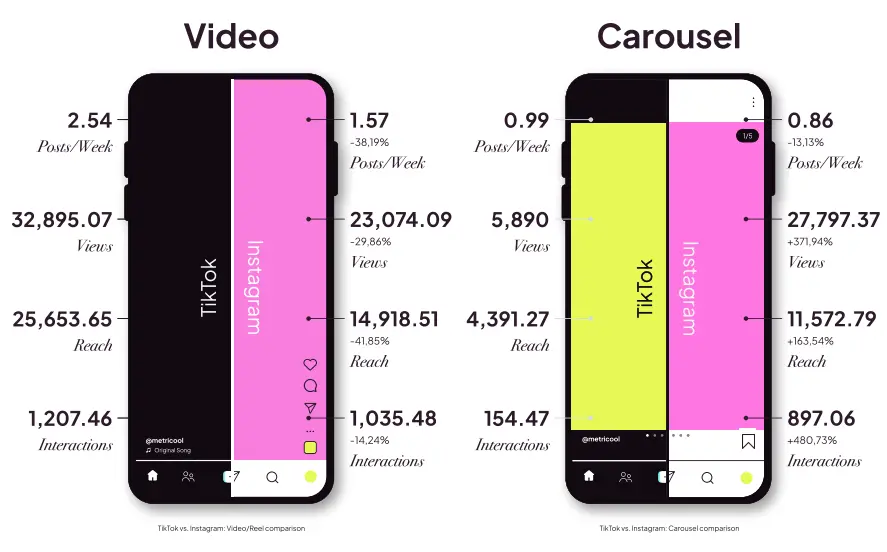
The TikTok comparison makes carousels look even stronger. The same format gets 4.7x more views and 5.8x more interactions on Instagram than on TikTok. Reels still lose to TikTok by about 30% on views and 14% on interactions. The reason carousels do so well here is that Instagram reshows them to users who didn’t swipe through the first time, so one post can collect views over and over.
This doesn’t mean single-image posts are off limits. Use them when there’s a real reason to, not as the default. Otherwise, give carousels more space in your mix, since they’re the format Instagram is pushing hardest right now.
Carousels Are Easier to Make With the Metricool Carousel Agent
If you want more views, carousels are the answer. The catch is that they take time to put together. The Metricool Carousel Agent handles the whole process through a single conversation with Claude Code. It learns your brand, designs each slide, writes the caption, and schedules the post in Metricool. You share the idea, guide the process, and sign off at each step.
Reels Are Getting Longer, and People Are Still Watching
The average time people spend watching a Reel went up 117% compared to 2025. That holds across every account size. Users are watching more Reels and staying with each one for longer.
2. Shares Are Doing More Work Than Likes
If it feels like you’ve been getting fewer likes lately, the data backs that up. The picture varies by account size, but overall, likes on Reels went up 16.68%, while likes on single-image posts and carousels declined almost everywhere.
The more interesting numbers are comments, saves, and especially shares, all of which went up. The algorithm pays much more attention to those than to likes.
Shares went up across every account size, especially small and huge accounts. The biggest jump was on Reels, with shares up 67.19% year over year. When people share your content, they’re spreading it for you to audiences you couldn’t reach on your own. The algorithm also reads shares as a strong signal and pushes the post further.
That means the goal is to build content people would want to send to a friend. That’s where the growth is now.
3. Captions Are Doing the Job Hashtags Used to Do
Hashtags are slowly losing their job. Posts with hashtags get 31% fewer views and 33% fewer interactions than posts without. Worth flagging that this is correlation, not proven cause, but the direction is clear.
A few changes from Instagram set this up. They removed the option to follow hashtags in December 2024, capped posts at five hashtags in late 2025, and started indexing captions by keyword search. Since July 2025, public Instagram posts also show up in Google and Bing results.
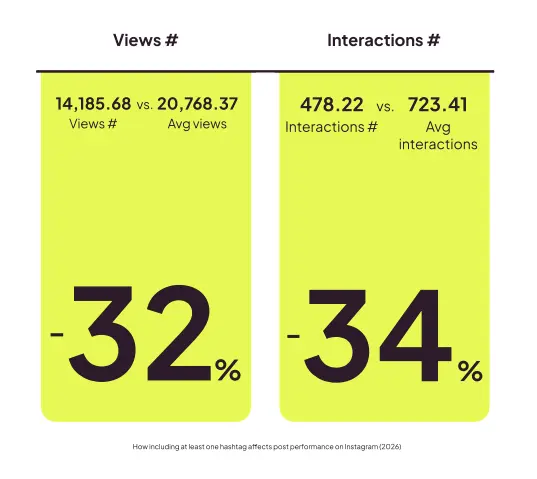
Captions now work like search results, both inside and outside Instagram. Write yours using words your audience would actually search for. One or two relevant hashtags is plenty, and the generic ones can go.
4. Stories Now Get More Replies Than Reach
Reach on Stories is basically flat, with impressions down 1.48% and reach down 1.77%. But replies are up 88% year over year. People are watching further through too, with exits down 6%, and accounts are posting fewer Stories overall (down 7.6%) while getting more back from each one.
The pattern holds at every account size. The smallest accounts saw replies more than double (+107%), and so did the biggest (+101%). Huge accounts only cut their Stories posting by 2.88%, the smallest drop of any tier, which suggests they still see Stories as worth doing.
The best Stories now are ones that ask something back. Polls, questions, sticker prompts. They work best as a way to talk with people who already follow you, not as a way to reach new ones.
5. Ask for the Right Action
If you’re going to add a CTA to your caption, choose it carefully. The data on what works is pretty clear:
- Asking for comments triples them, up 203%
- Asking for saves nearly doubles them, up 92%
- Asking for likes actually loses likes, down 4.9%
Posts with a question in the caption get 37% more comments on average. The pattern makes sense. Likes are validation people give on their own terms, while comments and saves take a bit more thought. Comments also signal real interest to the algorithm, which then pushes the post wider, which gets more comments.
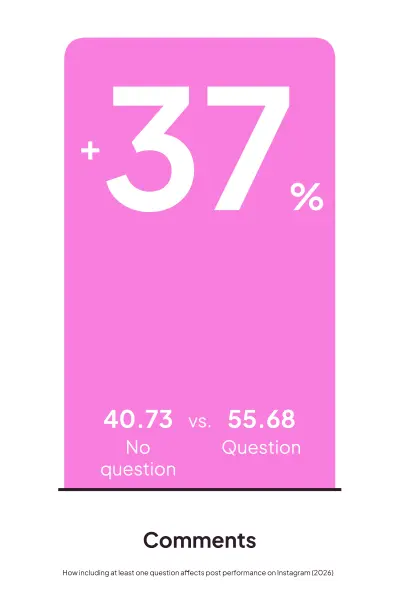
So stop asking for likes. Write posts worth saving or commenting on, and ask for the action you want.
6. The First 72 Hours Decide Everything
70% of total views on Instagram happen in the first three days. After that, performance flattens out fast.
For Reels, days 1 to 3 account for 65% of views and 61% of interactions. For posts and carousels, the share is 76% of views and 75% of interactions. Day 1 alone is about 30% of a Reel’s lifetime views and 44% of a static post’s.
Plan the first 72 hours of every post carefully. Share it in your Stories, reply to comments quickly, send it directly to people who’d care. Don’t count on posts catching on later, because most of them won’t.
7. Mentions Help Smaller Accounts Most
Tagging another account boosts reach, but how much depends a lot on your size:
- Tiny (under 2K): +108% reach, +167% comments
- Small (2K to 10K): +37% reach, +174% comments
- Medium (10K to 100K): +31% reach, +166% comments
- Big (100K to 1M): +9% reach, +73% comments
- Huge (over 1M): +4% reach, +16% comments
The reach lift fades fast above 100K followers. Comments, though, go up across every tier, even the biggest accounts.
If you’re under 10K followers, mentioning relevant accounts is one of the easier ways to grow your reach. Bigger accounts get less of a lift, but mentions still help start conversations.
8. How Often to Post Depends on Your Size
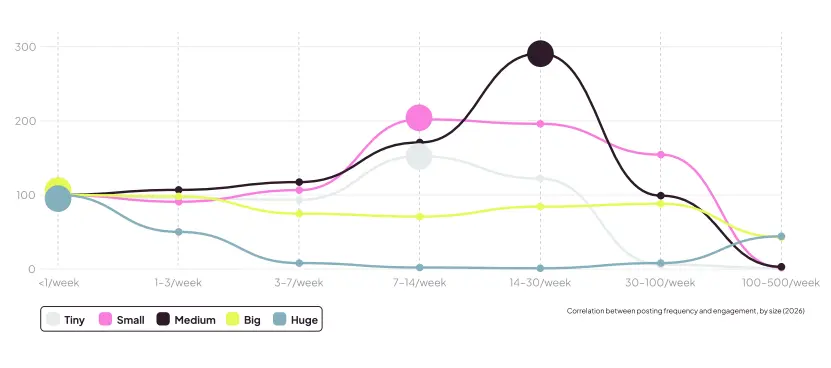
There’s no universal answer for how often to post. The right number depends on where your account sits:
- Small (2K to 10K): peak interactions at 7 to 14 posts per week
- Medium (10K to 100K): peak at 14 to 30 posts per week
- Big (100K to 1M): generally better per post when they post less
- Huge (over 1M): accounts posting less than once a week get nearly 6x more interactions per post than huge accounts posting daily
Bigger audiences split their attention across more posts, so flooding the feed waters down performance. Ignore generic posting advice. Smaller accounts grow with consistency, while bigger ones hold back and let each post do more.
9. Niche Beats Broad
The standout accounts in the study all share the same pattern. They’ve picked a very specific audience and a very specific topic, and they’re posting numbers way above their category averages.
A few worth mentioning:
- Ryan Hall Y’all (weather): 35x more interactions than similar accounts
- ThatTileChick (tile installation tutorials): 26x the average reach in her category
- Modesty Yacht Carpentry (small business): 145x the average views in its category
- Odd Sox and Autry Global (fashion): 10x and 18x interactions vs category averages
These accounts know exactly who they’re posting for. They aren’t trying to please everyone, and that’s the point. Pick a real audience and talk to them well. A smaller community that knows why they follow you beats chasing reach.
10. The Best Hours to Post
Posting times still matter, even with the algorithm doing more of the work to reshow content. On average across the study, 7 to 9 PM is when engagement is highest, any day of the week. That window lines up with when most people are off work, scrolling on their phones, and more open to interacting with what they see.
These numbers come straight from Instagram’s API, so they reflect real audience activity rather than guesswork. But they’re global averages, which means your audience might not match them. A B2B account talking to people during their workday will see a different pattern than a fitness creator whose followers check Instagram first thing in the morning.
The way to find your own window is to check the analytics in Metricool, which show when your specific followers are most active. Post during your audience’s peak hours, and the timing will work harder for you than any blanket recommendation.
Manage Every Platform from One Dashboard
Instagram is one piece of a bigger picture. See your data across every social platform in Metricool.
