

Instagram vs. TikTok in 2026: What Does the Data Say You Should Do?
 Gretchen Oestreicher
19 October 2026
Gretchen Oestreicher
19 October 2026 
Instagram and TikTok look more alike every year. Both run on recommendation algorithms, both put short video first, and both work as search engines. In 2026, though, their numbers moved in opposite directions, and the split shows the main differences between TikTok and Instagram.
In the Instagram vs. TikTok comparison, TikTok is still the faster place to get discovered and grow an audience. Instagram is where that attention turns into comments, saves, shares, and sales.
Metricool’s 2026 studies show where each platform stands. The Instagram study covers 24,364,803 posts from 375,118 accounts, and the TikTok study covers 2,314,756 posts from more than 92,000 accounts. The Short Video Report then puts Instagram, TikTok, and YouTube side by side across 6,177,375 short videos from 375,462 accounts.
Instagram vs. TikTok in 2026 at a Glance
| TikTok | ||
| Sample (2026 study) | 24,364,803 posts from 375,118 accounts | 2,314,756 posts from more than 92,000 accounts |
| Content published (year over year) | +24.04% | +72.10% videos, +139.55% image posts |
| Views (year over year) | +26.56% | -31.30% |
| Interactions (year over year) | +19.25% | -31.17% |
| Engagement rate | 3.54% | 3.67% |
| Accounts that moved up a size tier | 8.93% | 16.47% |
| Best-performing format | Reels and carousels | Video |
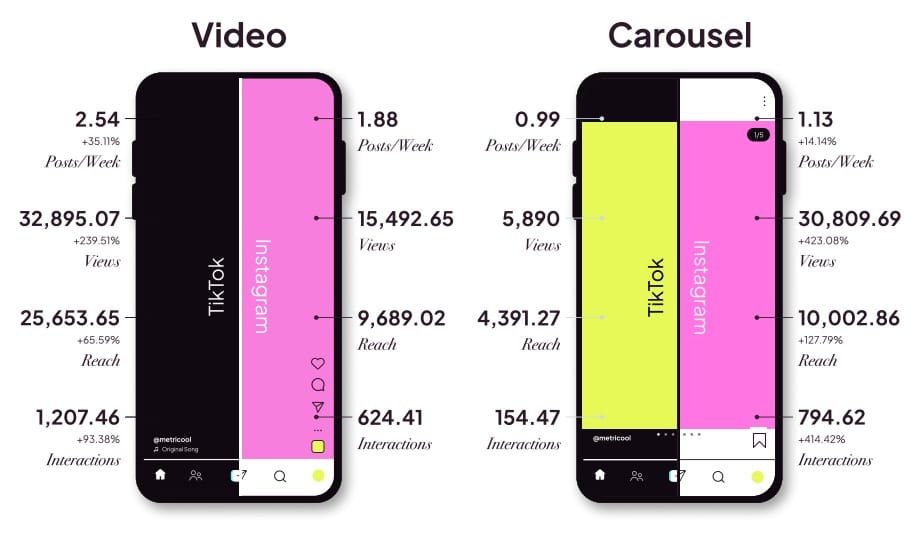
| Average views per short video | 23,074.09 | 32,895.07 (42.6% more) |
| Shares on short video | Leads at every account size | Behind Instagram at every account size |
| Main discovery source | Keyword search and Reels distribution | For You page (72.70% of views) |
| Content lifespan | 65% of Reel views and 76% of post views in the first 3 days | 96% of views and nearly 98% of interactions in the first 10 days |
| Best posting window | 7 to 9 p.m. | 6 to 9 p.m. (peak at 8 p.m.) |
What Changed This Year
Five changes shaped both platforms this year:
- Post Performance Drives Distribution: Both platforms now decide what to show based on how each post performs, so a smaller account with a good post can compete with a much bigger one. On TikTok, the For You page still drives about 7 of every 10 views.
- Instagram Counts Views Differently: Instagram now counts a view every time a post is replayed or shown again, and it brings posts back to people who didn’t engage the first time. Saves and shares also carry more weight, so a post that people keep or send to a friend keeps collecting views.
- Instagram Views Went Up and TikTok’s Went Down: Instagram views rose 27% and interactions rose 19%, while the average TikTok post lost about a third of its views and interactions.
- TikTok Got More Crowded: Metricool users published almost 80% more TikTok content than last year, so the same attention is now split across far more posts. Instagram volume grew by about a quarter, and views there still went up.
- TikTok Audiences Are Still Watching: Videos are the same length as last year, nearly as many people watch to the end, and engagement rate hasn’t moved.
So if your TikTok views dipped this year, more competition for each view is the likelier cause, and your content may be doing its job.
Growth and Reach
TikTok is still the fastest way to grow an audience. Nearly twice as many TikTok accounts moved up a size tier this year as Instagram accounts, and no other major platform comes close.
Both platforms favor smaller accounts, but TikTok gives them much more room to grow. Over a quarter of TikTok accounts with 2K to 10K followers moved up a tier, against about 1 in 10 on Instagram. If you’re starting from zero, TikTok is where a new account has the best chance of building an audience quickly.
Instagram growth slows much earlier. Once an account passes 10K followers, about 3% or fewer move up a tier in a year. Growing a mid-sized Instagram account takes patience and a steady flow of content that people want to share.
Reach follows the same pattern, and it’s the clearest difference between the two platforms. TikTok pushes content to people who don’t follow you, so a strong post can travel far with an audience of any size. Instagram reach leans more on your existing audience and on the formats that people share. It grows more slowly, but it compounds once you have people to build on.
Where Each Format Performs Best
If you’re comparing Instagram Reels vs. TikTok, TikTok gets your video in front of more people. TikTok videos average more views and more interactions than Reels, and TikTok accounts also post videos more often. If raw reach on video is your goal, TikTok gives you the bigger audience.
Instagram’s strength on short video is conversation. Reels tend to get more of the comments and shares that keep people talking about a post. Carousels are Instagram’s other big advantage. The same carousel gets several times more views and interactions on Instagram than on TikTok. If your idea works best as a set of slides, post it on Instagram first.
Inside Instagram, each format plays a different role:
- Reels: They’re the format to get right in 2026. Reels are the only format whose engagement rate grew this year, people are sharing them more, and average watch time more than doubled, to 8.5 seconds. People are watching longer, so a Reel has more time to make its point.
- Carousels: They’re the format for saves, with about 9x more than single-image posts, and they also do better on every other metric. Most accounts still post more single images than carousels, so turning some of those posts into carousels is one of the simplest changes you can make.
- Single-Image Posts: They’re losing reach, and larger accounts feel it most. They work best when you have a specific reason to use one, like a single striking photo or a quick announcement.
On TikTok, people expect video. There are about five videos for every static post in the feed, and video gets several times the views and interactions. That means images and carousels have to work harder to get noticed. Carousels can still do well when the first slide works like a headline and every slide after it gives people something worth saving.
Instagram Reels vs. TikTok by Account Size
The gap between the two platforms changes as an account grows, so the better choice depends partly on your size:
- Tiny Accounts (Under 2K): TikTok gives brand-new accounts the most visibility, with about 2,430 views per video against roughly 1,480 on Reels. If you’re starting out, TikTok is where people will see you first.
- Small Accounts (2K to 10K): TikTok still brings more views, but Instagram turns its smaller audience into more interactions and twice the shares. At this size, a smaller Instagram audience often does more for you than a bigger TikTok one.
- Medium Accounts (10K to 100K): This is where Instagram becomes the place for conversation. Reels average about 21 comments against 14 on TikTok, and TikTok’s lead comes down to views alone.
- Big Accounts (100K to 1M): TikTok brings far more views, but the two platforms end up almost tied on total interactions, because Reels get nearly twice the comments.
- Huge Accounts (1M+): This is the closest size class of all. Reels pull ahead on views, comments, and shares, while TikTok gets more total interactions and a higher engagement rate, so accounts this size get value from both.
Shares are the one metric that Instagram leads at every size. If you want people to send your content to each other, Reels give you the better odds.
Search and Discovery
Search is now a discovery channel on both platforms, though each one rewards different tactics.
On Instagram, captions now do the job that hashtags used to do. Posts with hashtags get about a third fewer views and interactions. That’s a correlation, since heavy hashtag users may also differ in other ways. Still, it matches what Adam Mosseri, head of Instagram, has said more than once: hashtags don’t increase reach. Instagram has stopped letting people follow hashtags and now caps posts at five.
Meanwhile, Instagram indexes captions for keyword search, and public posts appear in Google and Bing. The words that you choose for a caption help people find you on Instagram and off it.
On TikTok, hashtags are going the other way, bringing in twice as much traffic as last year. They give posts a small lift in views and interactions, and smaller accounts get the most out of them. For those accounts, hashtags bring in about twice the share of views that they do for huge accounts. Specific tags help TikTok understand what your video is about, while generic ones like #fyp add very little.
On both platforms, one or two relevant hashtags per post is plenty, and five is the limit.
How Long Content Lasts
Instagram and TikTok give a post very different amounts of time, which changes how you plan a calendar.
On Instagram, most of the action happens fast. About 70% of a post’s views arrive in the first three days, and static posts move even faster than Reels. By day three, you’ll have a good idea of how a post will perform.
TikTok gives a post more time. Views build over the first few days and stay steady for about ten days before they slow down. A video with a slow first day still has more than a week to find its audience.
Community, Engagement, and Driving Action
Instagram is where relationships and repeat engagement live, and Stories show it most clearly. Story replies nearly doubled this year, and fewer people tapped away before the end. The people watching your Stories are staying longer and talking back, which makes Stories a direct line to your most interested followers.
Asking for engagement works on both platforms, and Instagram audiences respond far more strongly. On TikTok, the comments section has a life of its own, so asking for an opinion gets more back than asking for a quick tap.
For moving people to act, Instagram gives you more options, like DMs, saves, and link clicks. TikTok does more at the top of the funnel, where it catches the attention of people who’ve never heard of you.
Is TikTok or Instagram Better for Making Money?
If you’re weighing up TikTok or Instagram for making money, the answer comes down to where each platform sits in the sales funnel. Instagram has the more mature setup for turning attention into sales, with Meta ad integration, shopping tags, and DMs. TikTok is better for impulse discovery at the top of the funnel, though the TikTok Shop keeps expanding even as adoption still varies by market.
Instagram Shop vs. TikTok Shop is a split between two kinds of selling:
- Instagram Shop: It tends to perform better for repeat, relationship-driven selling, since buyers already follow you and can message, save, and click through.
- TikTok Shop: It tends to perform better for first-touch, creator-led product discovery, where a single video can put a product in front of people who’ve never heard of the brand.
For most teams comparing TikTok vs. Instagram for business, the simplest split is to sell on Instagram and attract new customers on TikTok. If your model depends on DMs, lead capture, or e-commerce, Instagram is usually the better base. If it depends on viral reach and impulse buys, TikTok is the better fit.
Best Platform by Goal
TikTok is the better fit if you want:
- To Grow Your Audience Fast: TikTok moves nearly twice as many accounts up a size tier as Instagram does.
- To Reach People Who Don’t Follow You: The For You page drives most views, so your content can reach new viewers at any account size.
- To Get More Views on Video: TikTok videos get more views than Reels in every tier except Huge.
Instagram is the better fit if you want:
- To Get More From Carousels: The same carousel gets far more views and interactions on Instagram than on TikTok.
- To Create Content People Save and Share: Reels lead on shares, and carousels lead on saves.
- To Build Community and Repeat Engagement: Story replies keep growing, so your audience stays in touch between posts.
- To Be Found in Search: Instagram indexes captions for keyword search, and public posts appear in Google and Bing.
- To Turn Attention Into Sales: DMs, saves, shopping tags, and Meta ads give you more ways to convert.
How the Instagram and TikTok Algorithms Differ
If you compare the TikTok vs. Instagram algorithm side by side, the biggest difference is what each one builds on. TikTok runs on an interest graph, and Instagram runs closer to a social graph.
TikTok’s For You page matches videos to people based on what they watch, and who they follow plays a much smaller role. A new account can reach a large audience quickly, so the feedback you get is a clean read on the content itself. If a TikTok video underperforms, the content is usually the first thing to look at.
Instagram gives more weight to the relationship between creator and viewer. Reels reach beyond your followers, but story replies, saves, shares, and repeat views all feed distribution. That’s why Instagram rewards an audience you’ve already built.
This makes TikTok a good testing ground for new ideas, and Instagram a good gauge of how ready your existing audience is to act.
Match Each Format to a Stage in the Funnel
Seen through the funnel, each format has a clear job:
- Reels and TikTok Video (Top of Funnel): They reach people who don’t follow you yet, and watch time is the signal to build around. Write for the first two seconds and structure the video so that people keep watching.
- Instagram Carousels (Middle of Funnel): They lead on saves, and saves come from content that people plan to come back to. Build carousels that people want to keep, like checklists, breakdowns, and reference material.
- Instagram Stories (Retention): The people watching your Stories already chose you. Use Stories to answer questions, run polls, show proof, and stay in front of buyers between bigger posts.
Rethink Your Posting Calendar per Platform
Content lifespan affects how you schedule and how soon you judge a post:
- Instagram: It wants a steady rhythm. Since most views arrive in the first three days, publish your best content when your audience is most active and review results once that window closes.
- TikTok: It rewards patience. Give each video the full ten days before you judge it or move on, because TikTok keeps testing it with different audiences throughout that window.
For posting times, the best windows are 7 to 9 p.m. on Instagram and 6 to 9 p.m. on TikTok, peaking at 8 p.m. Both studies pull those figures from the platform APIs as global averages, so use them as a starting point.
Your own audience’s active hours show up in your Metricool calendar, and you can schedule to both platforms directly from there.
Write Captions for the Signals You Can Prompt
Captions are one of the easiest places to apply this data, because they let you ask for the exact interactions that the algorithm counts. Some caption habits that the data supports:
- Ask for Comments and Saves: On Instagram, a caption that asks for comments triples them, and one that asks for saves doubles them. Comment CTAs also help on TikTok, though the lift is smaller.
- Leave Out Requests for Likes: Asking for likes backfires on both platforms. Instagram posts get slightly fewer likes, and TikTok posts get less than half their usual number.
- Ask a Question: A question gives people an easy way into the conversation, lifting comments by over a third on Instagram and about a quarter on TikTok.
- Write Captions to Be Found: On Instagram, the words in your caption help people find you through search. A well-written caption can keep bringing in visitors after the first three days.
Know Where You Are: The 100K Turning Point
On TikTok, growth slows sharply once an account passes 100K followers, and very few accounts make it from there to 1M. Instagram’s slowdown starts earlier, but on both platforms, 100K is where the tactics that work start to change.
Below 100K, focus on reach. This is where growth comes most easily, especially for small TikTok accounts. Some tactics that work at this stage:
- Post Consistently and Test Hooks: Small Instagram accounts get the most interactions per post when they publish 7 to 14 times a week. Regular posting also gives you enough data to see which hooks perform better.
- Tag Relevant Accounts: When your audience is small, a mention lets you borrow some of someone else’s. Tiny Instagram accounts get about twice the reach when they tag another profile, and small TikTok accounts get noticeably more comments.
- Use TikTok to Find What Resonates: Its interest-based feed shows you which ideas work with new audiences.
Above 100K, focus on depth. Growth slows, and the tactics that helped you climb bring smaller returns. At this size, it helps to:
- Use Mentions Sparingly: Past 100K, a mention adds little reach on either platform, and huge TikTok accounts lose reach and engagement when they use them.
- Post Less Often: Huge Instagram accounts that post less than once a week get nearly 6x the interactions per post of those posting daily. Posting more often probably splits the same audience across more posts.
- Focus on Your Current Audience: Put your effort into deepening and earning from the followers you already have.
What to Measure Now
The metric changes in both studies affect what your reports should track. The metrics that best reflect distribution and business value are watch time, shares, saves, and comments, plus DMs and link clicks on Instagram, where most of the selling happens.
Two metrics carry less weight than they used to:
- Follower Count: Distribution now depends on how each post performs, so follower count says less about the reach you can expect.
- Likes: They’re the interaction that Instagram’s algorithm weighs least, so they tell you less about how far a post will travel.
A post with modest likes but strong saves and shares is doing more for your business than a post with lots of likes and little else. Reporting on saves, shares, watch time, and replies gives you a clearer picture of which content is building an audience that will act.
Metricool’s analytics show these metrics for Instagram and TikTok side by side, so you can build that report around them instead of follower count.
Should You Post the Same Content on Instagram and TikTok?
You’ll get more from each platform if you adapt your content instead of posting the identical file to both. The best-performing formats and caption strategies differ between Instagram and TikTok, so it’s more efficient to film once and cut a version for each:
- Shoot One Longer Piece of Content: Record a few minutes of material, like a full walkthrough, a tutorial, or a conversation about one topic. A longer source gives you enough footage for several cuts, each with its own angle.
- Cut a TikTok Version: Open with the strongest moment, before any introduction, and edit with the sounds and trends that are popular on TikTok right now. Add one or two specific hashtags so that TikTok knows who to show it to.
- Cut an Instagram Reel: Use the same footage, with a different opening if it suits your Instagram audience better, and write a caption with the words people would search for. End the caption by asking for a comment or a save, since those prompts get the strongest response on Instagram.
- Turn the Main Points Into a Carousel: Pull out the most useful takeaways and give each one its own slide, with a first slide that works like a headline. This is the version that people save, so make it something they’ll want to come back to.
- Carry the Conversation Into Stories: Share the Reel or carousel to your Stories with a poll or a question sticker about the topic. Story replies land in your DMs, which gives you a direct conversation with your most interested followers.
If you schedule every version in Metricool, you can space them out across the week and publish each one in its platform’s best posting window.
How Metricool Helps You Run Instagram and TikTok Together
Running two platforms with different rules means two calendars to plan, two sets of numbers to read, and two audiences to keep up with. Metricool brings both platforms into one place:
- One Calendar for Both Platforms: Plan and schedule your Reels, carousels, and TikTok videos from the same calendar, at the times when your own audience is most active.
- Side-by-Side Analytics: Connect your Instagram and TikTok accounts and compare how your Reels and TikTok videos perform on views, interactions, and engagement.
- Competitor Analysis: See how accounts in your space perform on each platform, using the same metrics that you track for your own content.
- Hashtags and Sounds for TikTok: Find specific hashtags that help TikTok understand your video, and add music from the trending songs library.
- Claude Integrations: Connect Claude to Metricool to design and schedule Instagram carousels from a single conversation, or to benchmark your Instagram results against accounts your size.
Which Is Better, Instagram or TikTok in 2026?
TikTok is better for discovery, growth, and testing new ideas, because its interest-based feed puts your content in front of strangers fast. Instagram is better for community, conversion, and repeat business. It rewards the relationships you’ve already built and gives you more tools to sell.
If you need to pick TikTok or Instagram for a single focus, start from your main goal and use the list above. For most brands and creators, though, the practical plan for 2026 is to run both with a clear role for each. Use TikTok to reach new people and find out which ideas work, then bring those ideas to Instagram to build trust and turn attention into revenue.
